
Russia, Ukraine and the United States resumed trilateral peace talks in Abu Dhabi on Tuesday, November 10, the first time the three sides have met since February. Here, Kyiv is pressuring a question Washington has yet to answer: if a ceasefire comes, what will stop Russia from attacking again?
The working-level talks run until Wednesday and will cover post-war security arrangements, de-escalation and humanitarian issues, according to U.S. Special Envoy Steve Witkoff, who announced the round last week.
“For the United States, ending the fighting is the objective. For Ukraine, ending the fighting is the beginning of the problem, because the question that matters is what will prevent Russia from returning in two, five or ten years,” said Fabrício Vitorino, a Brazilian journalist, PhD candidate in International Relations at the Federal University of Santa Catarina (UFSC) and researcher specialising in Ukrainian affairs and international security.
The main obstacles facing negotiators are territorial disputes and the guarantees needed to prevent renewed hostilities. Russia continues to demand Ukrainian withdrawal from territory it does not control in the Donbas region, while Kyiv rejects surrendering territory defended by its forces.
Ivan Fechko, an analyst at the Ukrainian foreign policy think tank Ukrainian Prism, said the talks could represent another step towards peace, but remained cautious about immediate results while in conversation with EU Reports.
“From Ukraine’s perspective, simply freezing the conflict without credible guarantees against renewed aggression would create the risk of another war in a few years,” he said.
NATO membership remains a strategic objective for Kyiv, but Fechko argued that practical security arrangements with Western partners could also play an important role. In his view, agreements focused on limited ceasefires, energy infrastructure and maritime security in the Black Sea would not replace a comprehensive peace settlement but could help reduce civilian suffering and establish conditions for broader negotiations.
Even so, Fecho was cautious about immediate results. “Regarding the upcoming talks in Abu Dhabi, I would keep expectations relatively modest,” he said ahead of the meeting.
Many Ukrainians share that skepticism after nearly five years of war. Kateryna Vakarchuk, associate professor at Odesa I.I. Mechnikov National University, said years of unsuccessful negotiations and broken agreements have left many people doubtful about an imminent ceasefire.
According to Vakarchuk, her family, friends and colleagues no longer expect a peace agreement in the near future. They still hope for an end to the war, but their optimism has diminished considerably compared with two or three years ago.
The talks also come at a delicate moment for Donald Trump. The Democrats’ victory in the November 2026 midterm elections has added pressure on the U.S. president after the U.S.-Israeli military campaign in Iran failed to bring about change.
“The risk for Ukraine is not a weakened American president. It is a weakened American president in a hurry,” Vitorino argued.
Trump has suggested that an eventual settlement could reshape Europe’s broader security arrangements, claiming a deal “might involve all of Europe. It’s going to be a big, beautiful agreement and everyone’s going to be thrilled.”
Yet the prospect of a deal in Abu Dhabi has exposed divisions within the EU. Italian Prime Minister Giorgia Meloni expressed concern over Europe’s fragmented diplomatic approach, whereas Polish Foreign Minister Radosław Sikorski, along with Austria and Spain, also called for greater coordination, while European Council President António Costa acknowledged the need for the EU to speak with a clear and unified voice.
Disagreements also remain over how far Europe should engage with Moscow, particularly whether diplomatic relations with Putin could be normalised.
For Vitorino, Europe’s limited participation in the negotiations reflects a broader imbalance between its financial responsibilities and diplomatic influence.
“Even if the European Union spoke with one voice, Russia does not want Europeans at the negotiating table. Europe pays the bill but doesn’t get to choose the menu,” he said.
Fechko disagreed that Europe’s influence should be measured solely by its physical presence at the negotiating table.
“European countries are among Ukraine’s most important partners in military assistance, financial support, sanctions policy, and future reconstruction,” he stressed.
Since Russia’s full-scale invasion in 2022, the EU and its member states have mobilised €231.5 billion in financial, economic, military and humanitarian support, making them Ukraine’s biggest source of assistance. Fechko argued that this economic and political weight gives Europe an essential role in determining how any future agreement would be implemented.
“An agreement affecting European security cannot realistically be sustainable without European involvement.”
Trump’s approach to the war has shifted repeatedly since his return to the White House. While campaigning, he repeatedly claimed he would end the war in Ukraine in 24 hours. November 2026 marks nearly 57 months since Russia launched its full-scale invasion of Ukraine, and yet there is still no end in sight.
His administration reopened direct diplomatic channels with Moscow while increasing pressure on Kyiv to negotiate, temporarily suspended military assistance and intelligence sharing with Ukraine before resuming both, and introduced a mechanism that allows European NATO allies to finance U.S. weapons for Kyiv, shifting more of the responsibility for Ukraine’s defence onto Europe.
A month after taking office, Trump held calls with Vladimir Putin and Volodymyr Zelenskyy and said both sides wanted peace. A week later, he called Zelenskyy “a dictator without elections” in a Truth Social post, ignoring that Ukrainian law prohibits national elections under martial law.
Meanwhile, the war continues to reshape everyday life. Vakarchuk described electricity outages lasting 10 to 12 hours a day. Schools, universities and other institutions have been forced to rely on generators or alternate between in-person and online activities, depending on security conditions.
Nighttime air raid alerts are particularly frightening. Without electricity, elevators stop working, making it harder for residents to reach shelters.
“It’s very scary, really,” Vakarchuk said, describing the fear of hearing a siren during a blackout when residents may have only minutes to reach safety.
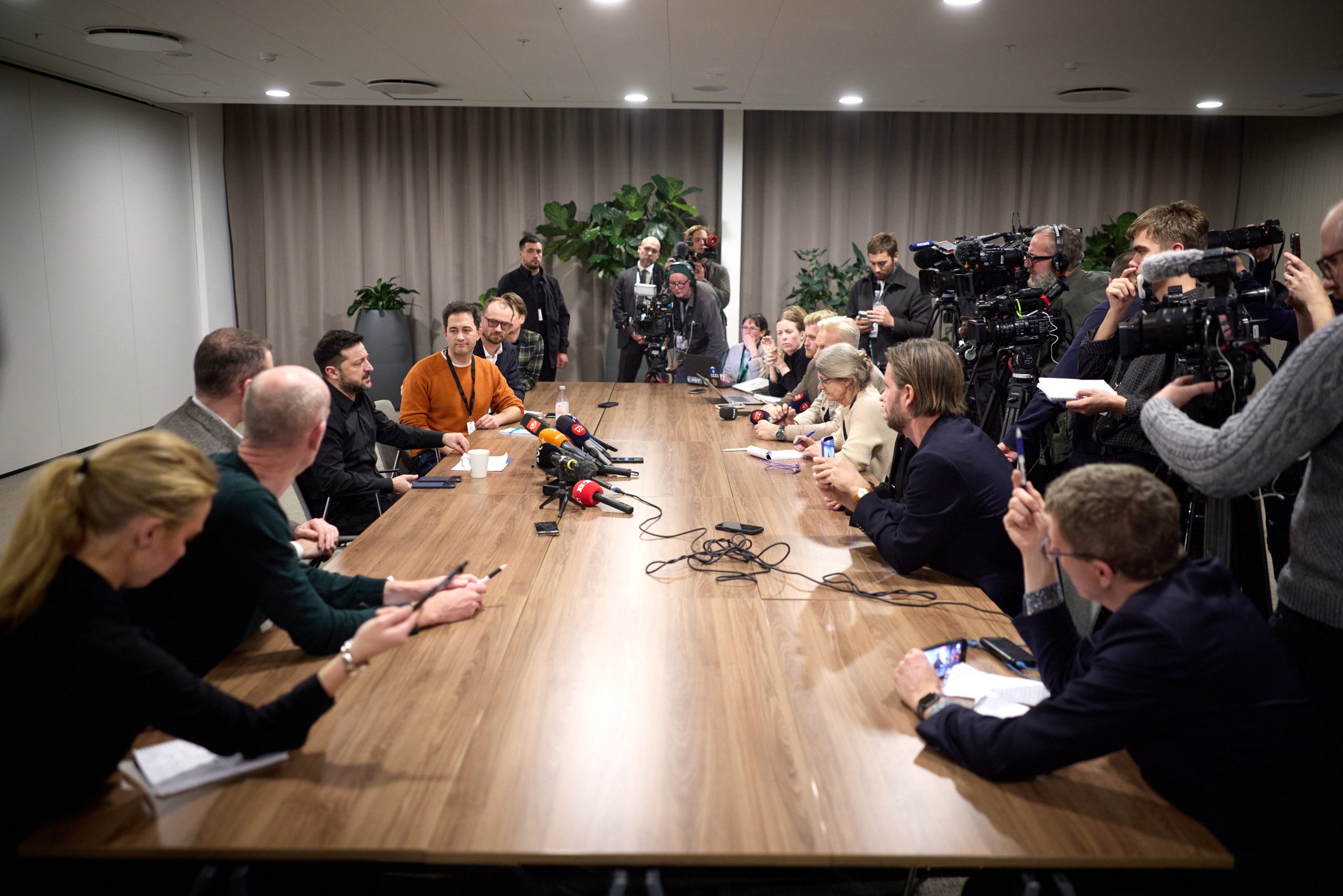
Featured image: Volodymyr Zelenskyy via X