
Russian President Vladimir Putin signed into effect in early August 2026 a new legislation which places additional and wide-ranging restrictions on citizens who the Russian government believes are avoiding punishment by living abroad.
The country’s Ministry of Justice will maintain a registry of those whom it suspects are evading punishment abroad, which will be shared with other agencies, including the Federal Security Service (FSB) and the Central Bank. This list will also be public on the General Prosecutor’s Office website.
Although the laws could apply to any Russian citizen evading criminal sentences abroad, there is a provision for targeting those who are convicted of specific administrative penalties, such as “foreign agent” offences, discrediting the Russian armed forces, or participating in “undesirable organisations”.
The new restrictions would severely limit access to key services for Russians who are convicted, including consular services, online banking, and online government services such as the portal Gosuslugi.
The law calls these measures ‘temporary restrictions’, although not because there is a given time frame in which they will end.
Instead, it means that a person can have restrictions lifted in certain cases. For example, as administrative offences are punishable by a fine, it could be possible for someone to pay these remotely to remove themselves from the Ministry of Justice’s list.
A person could also attempt to have their conviction or administrative fine overturned from abroad, although it remains unclear as to how this would be done based on the restrictions to accessing consular services.
Russian and international human rights organisations have argued that the laws deliberately target critics of the Putin government and the full-scale invasion of Ukraine.
The law has been deemed a “civil death” for political exiles by rights lawyers and activists.
How the law works
Having had two separate readings in the Duma, with additional amendments added at each stage, the final draft was signed into effect on August 4, 2026.
The restrictions are extensive, and target key services which Russians in exile have previously relied on, such as accessing municipal services and bank accounts in Russia online. However, the laws also create new anxieties for Russians in opposition to the Kremlin who have not been charged with administrative offences, but for whom returning to Russia may pose a risk.
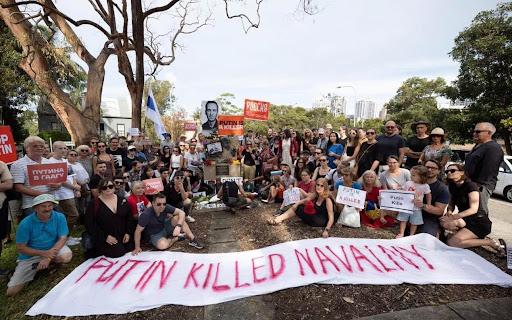
Petr Kuzmin, a Team Navalny representative and anti-war campaigner working with the diaspora in Australia, explained to EU Reports that Russians abroad are still able to be tried by Russian courts in absentia, even if they had not broken any laws within Russia’s borders. This has previously been limited to grave crimes carrying sentences over six years.
In April 2025, the Duma authorised trials in absentia for ‘political’ crimes of non-grave and moderate severity, such as those outlined in the foreign agents law. This means that even if someone is not currently guilty of an administrative offence, they may be added to the Ministry of Justice’s registry in the future.
“Cases against people abroad are often opened over social media posts […] Treason charges have been brought on remarkably thin grounds – a small transfer to a charity helping Ukrainian refugees has been treated as sufficient,” he explained.
Involvement in organisations which are designated as ‘undesirable’ or ‘extremist’ is also criminalised and can lead to trials in absentia. These organisations include an increasing number of groups working in the diaspora, and those linked to the murdered anti-corruption campaigner, Alexei Navalny.
Daria*, is a student who left Russia after the full scale invasion of Ukraine, and is now studying in the UK. She says that the legislation introduces new risks for remaining abroad, and possibly new incentives to return to Russia to access key services, as her civic activity outside the country could fall into several administrative offences.
“As a Russian national, whether my criminal record remains clear or not is not entirely up to me,” she stressed to EU Reports.
Another émigré, Ksenia*, had been living and working between the UK and Russia as a business consultant for several years before the full-scale invasion of Ukraine. Since 2022, she has been living permanently in the UK. She expects these new laws to have negative effects for all Kremlin-critical Russians living abroad.
She highlighted that some Russians who emigrated after 2022 are already facing challenges meeting administrative requirements which may cause greater scrutiny by the authorities.
The government services portal, Gosuslugi, serves as an example. Restrictions on the use of foreign email addresses, such as Gmail, mean that many people have been cut off from accessing administrative services, such as submitting utility meter readings.
“Issues have arisen for property owners whose apartments are unoccupied,” Ksenia explained to EU Reports. “If meter readings are not submitted regularly, or if reported consumption is significantly below expected norms, additional scrutiny or administrative complications may follow.”
According to Ksenia, the solution for many has been to risk travelling back to Russia to try and sell their assets, to share information to government accounts with trusted relatives or friends, or to arrange powers of attorney through consular services.
Under the new legislation, Russian citizens on the Ministry of Justice’s registry will be unable to access almost all consular services, including renewing passports and drivers’ licenses. It also includes a ban on notarising powers of attorney.
According to opposition publication The Moscow Times, the only exception to the ban on accessing consular services is to issue a certificate which confirms the individual is alive.
Trapped without documentation
Accessing consular services provides a work-around for those who are at risk of additional scrutiny or potential prosecution if they return to Russia. This includes renewing passports or drivers licenses, notarising birth or marriage certificates, and even renouncing Russian citizenship.
For Daria, losing access to consular services would be catastrophic. Studying on a student visa means she has no permanent legal status anywhere except for Russia.
She also has to renew her passport in the next couple of years and, if she were to find herself a target of these laws, it may leave her without any valid government-issued ID; she would be unable to work, study, travel, or receive permanent residency in another country.
“In this case, returning to Russia would be the only way to in effect continue having a citizenship,” she said.
For fighting-age men, this may also mean a risk of being conscripted into the armed forces.
What rights do citizens have under international law?
Accessing consular services is a key part of life for many who are living, working, or studying abroad. So could Russia break international law if it denies access to these services for its citizens?
The answer is no, according to Dr Timothy Jacob-Owens, an early career fellow in citizenship law at the University of Edinburgh Law School.
The 1963 Vienna Convention on Consular Relations is the main document which governs how consular relationships between states may be conducted. For example, Article 36 states that consular officers of the ‘sending State’ shall be allowed to communicate and assist its citizens without obstruction from the ‘host State’.
However, there are no laws which state a ‘sending State’ is obliged to provide these services to citizens.
“As a matter of international law, it is generally open to Russia to refuse to provide such assistance to some or all of its nationals abroad,” Jacob-Owens explained.
The new legislation also bans anyone on the Ministry of Justice’s registry from gaining a foreign citizenship or passport, which Dr Jacob-Owens describes as “nonsensical”.
“It is a longstanding principle of international law that it is for each state to determine its own rules on acquisition and loss of citizenship. Russia can ‘declare’ in its own legislation that its citizens cannot acquire foreign citizenship, but this has no bearing on the citizenship law of other states, which can still opt to grant their citizenship to Russian citizens if they wish.”
He further outlined that Russia may well choose not to acknowledge any foreign citizenships which are granted to its citizens evading charges abroad, however a granting state and its allies typically would.
For example, if the UK chose to grant citizenship to a Russian political exile, it would be unlikely that the UK’s international allies would subsequently refuse to recognise the individual’s status as a British citizen.
The problem, then, becomes gaining foreign citizenship. Without valid documentation, this may be impossible.
There are some who may already hold permanent resident status or dual nationality with another country. Kuzmin is among this group, holding an Australian passport alongside his Russian one.
The ‘civil death’ laws may now also impact pro-democracy and anti-war campaigns within the diaspora.
Asked what he thought the possible impacts of the legislation might be for his work, Kuzmin said “it is quite possible that some people who have the motivation to participate in pro-democracy and anti-war activities are afraid of these specific repercussions and choose to stay away. It’s only understandable.”
He added that these laws do not deter him from trying to make change.
A full list of restrictions outlined in the new legislation, as well as guidance for those who feel they may be at risk, is available via Meduza and rights organisation First Department.
Editorial note: *names have been changed to ensure anonymity and safety.
Featured image: courtesy of Petr Kuzmin via LinkedIn.