
London, United Kingdom – Although UK Prime Minister Andy Burnham has not yet confirmed that his government will enact a widely-anticipated ban on British trade with Israeli settlements, experts are already weighing in on the expected ban as well as its implications and limitations.
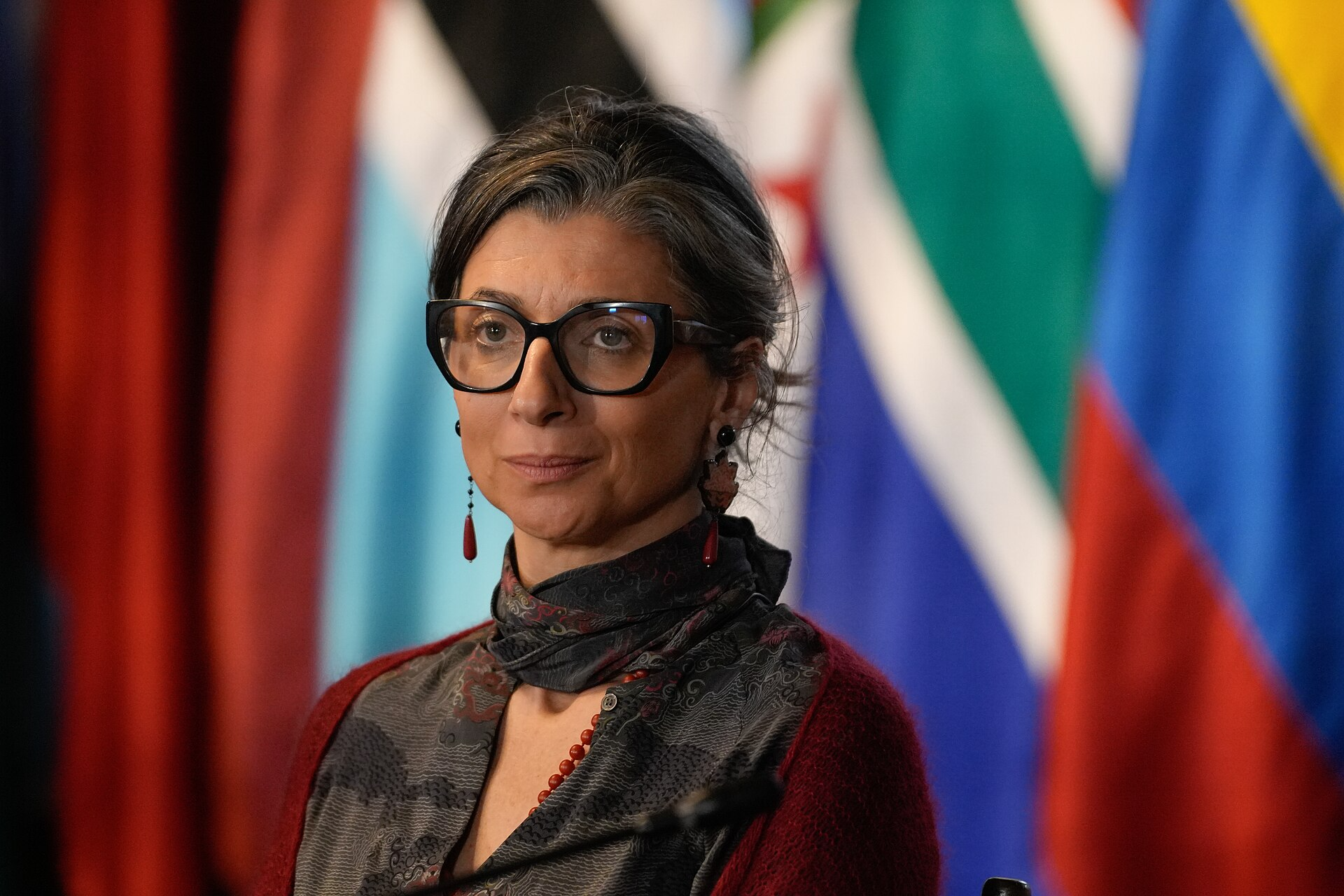
One such expert is Francesca Albanese, UN Special Rapporteur on the Occupied Palestinian Territories. In an interview with EU Reports earlier today, Albanese discussed the potential sanctions on settlements in the wider context of the British stance on Israel-Palestine.
The UN expert began the interview by praising the anticipated Burnham policy. “The value of this ban is that it strengthen[s] this movement to oppose settlement expansion, which has an impact on the legitimacy that Israel has at international level,” she said.
A British ban on settlement trade would likely be a response to the news that Israel is seeking to move ahead with plans to construct the controversial E1 settlement, which would effectively split the West Bank in two by cutting off East Jerusalem, the claimed Palestinian capital, from the rest of the occupied territory.
Despite welcoming the planned British ban, Albanese warned that it would have little practical impact on either the Israeli economy or the E1 project.
“The economic impact [on Israel] is going to be marginal because settlements mainly produce agricultural exports, dates, wine [and] dead sea cosmetics, a segment that weighs relatively little on Israeli GDP.”
“A British ban, however genuine, doesn’t alter the economic sustainability of the project, especially since the E1 expansion is an infrastructure and housing project, not an export-producing hub,”, she continued.
According to experts, the successful completion of the E1 project would likely end any realistic hope of creating a Palestinian state and thus render a two-state solution to the decades-long Israel-Palestine conflict impossible.
In light of these apparent constraints of economic measures against the settlements, Albanese also called on Burnham to expand any sanctions regime to include the state of Israel itself.
“There should be sanctions imposed against Israel as a state, not [just] individual settlers, not far-right ministers”.
“States like the UK have an obligation, not a policy option, not to render aid and material assistance in maintaining Israel’s unlawful presence [in the occupied Palestinian territories]. This is what the International Court of Justice has said.”
“So a ban on settlement goods alone, is not a policy for peace and much, much more is to be done,” Albanese concluded.
In July 2024, the International Court of Justice (ICJ) declared Israel’s occupation of the Gaza Strip, the West Bank and East Jerusalem as unlawful. As part of the ruling, the ICJ determined that UN member states “are not to render aid or assistance in maintaining the situation created by the continued presence of the State of Israel in the Occupied Palestinian Territory”.
This prompted many human rights experts to advocate for the international community to review all ties with Israel, be they economic, diplomatic or political.
The British government under Keir Starmer, Burnham’s predecessor, sanctioned far-right Israeli ministers Itamar Ben-Gvir and Bezalel Smotrich as well as Daniella Weiss, a woman known as the “godmother” of the settler movement.
However, the former British Prime Minister never enacted a full-scale punitive trade ban on the settlements, much less one against the entirety of Israel.
Although Burnham has indicated that he supports restrictions in weapons sales to the Israeli Defense Forces, it is unclear whether he is considering any further restrictions on the Israeli State.
Albanese, an Italian legal scholar and human rights expert, has served as the UN Special Rapporteur in the region since May 2022. She has accused Israel of committing a “genocide” against the Palestinians and called on the UN to consider suspending Israel as a member state as a result.
Albanese was personally sanctioned by the United States after she published a report which accused 48 companies, including U.S.-based Microsoft, Alphabet and Amazon, of complicity in an “economy of genocide” in Gaza. The sanctions on her have since been removed.
Featured Image: Francesca Albanese at the Emergency Conference on Palestine in Bogotá, Colombia in July 2025
Image Credit: Fotografía oficial de la Presidencia de Colombia via Wikimedia Commons
License: Creative Commons Licenses