
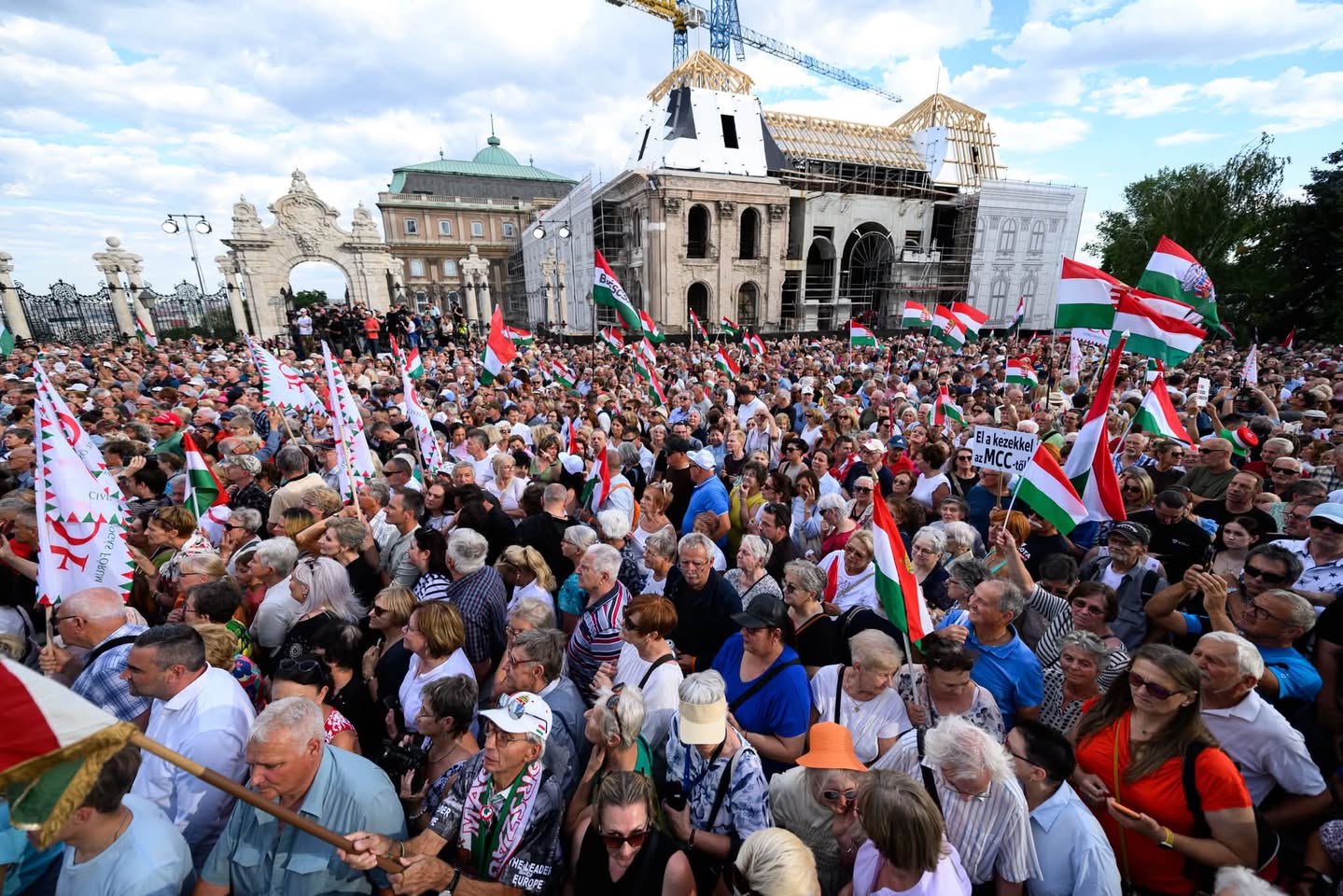

Demonstrators gathered in Budapest on Thursday, July 9, to protest the attempt to oust Hungarian President Tamás Sulyok, ahead of a constitutional amendment taking place next week.
Thousands assembled outside the presidential offices at the Sándor Palace in the Hungarian capital’s Castle District, decrying the proposed amendments by Hungarian Prime Minister Péter Magyar as “tyranny,” an assault upon the rule of law, and a move towards dictatorship.
Demonstrators maintained that the protests were not about Sulyok personally, but about the office of the presidency itself, with one being quoted as saying that “the point is not whether Tamás Sulyok is popular or not, but that this is simply unacceptable in a democracy.”
Having been elected by the Hungarian National Assembly, following his nomination by the far-right national conservative Fidesz-KDNP bloc, Sulyok has served as President of Hungary since 2024.
Although the Hungarian presidency remains a largely ceremonial role, critics have accused him of facilitating the alleged corruption and slide towards authoritarianism seen under Magyar’s predecessor, Viktor Orbán.
Read more: Hungary’s election race intensifies amid disinformation and Kremlin interference claims
The Magyar transformation
Prior to the Hungarian parliamentary elections, Magyar had repeatedly vowed to remove Sulyok from office. Immediately following his landslide win on April 12, Magyar called upon the president to step down alongside Orbán, stating that Sulyok was “unworthy of representing the unity of the Hungarian nation,” adding that the president is not fit to serve as a moral authority or role model.
“Following the formation of the new government, Tamás Sulyok must leave office immediately,” the prime minister added via X.
Since then, Magyar has reiterated that unless Sulyok steps down of his own accord, the new government would take whatever steps it could to force him out.
Magyar has pledged wide-ranging institutional reforms to remove all of Orbán’s “puppets,” declaring an end to what he deems the “mafia”-style system set up under the Orbán regime.
His government has already introduced term limits for prime ministers – effectively barring Orbán from ever running again – and removed the heads of Hungary’s national security and intelligence agencies.
Earlier this week, it also suspended Hungary’s public media outlets: the Kossuth radio station, and M1, the main public television channel. Magyar, who had previously compared MTVA – Hungary’s state broadcasters – to North Korean propaganda, hailed the day of the shut down, Tuesday, July 7, as a “historic day”.
“Today marks the end of propaganda broadcasts on public media platforms,” he claimed. “They lied at night, they lied during the day, they lied on every wavelength. That is now over.”
M1 has since resumed broadcasts, but only in the evenings, and without news programmes. “Public media should not lie. We are sorry for doing it for so long. Public media now will be reformed so it will be independent and trustworthy,” a statement from the channel read, as reported by The Guardian.
The constitutional amendment set to be voted on by the National Assembly next week would force an end to Sulyok’s term, as well as setting term limits for members of Parliament, implementing reforms to the judiciary, and creating a new authority to investigate corruption and financial abuses under the Orbán government.
The proposed amendment states it seeks to restore democracy based on the rule of law. “Voters have granted an unprecedented mandate to the National Assembly as a constituent power, to restore democracy,” it reads.
Sulyok’s pushback and the EU’s role
With Magyar’s centre-right Tisza party holding a two-thirds majority in the National Assembly, it is likely that the amendment will be voted through. Yet, whether Sulyok can contest this remains uncertain, as the president is still responsible for signing legislation into law – and can send bills passed by Parliament to the Constitutional Court for review.
President Sulyok has already objected to being forcibly removed, dismissing Magyar’s calls for him to resign on his own accord and describing the proposed amendment as “personalized legislation aimed at removing me from my legally held position.”
“The government evaluates and interprets the constitutional role of the president of the republic according to unilateral political expectations different from the Constitution,” Sulyok added.
“I have made it clear once again that this does not provide a constitutional reason for my resignation. The constitutional crisis situation emerging as a result deepens the social divisions and damages the international judgment of Hungarian democracy.”
“There is no public law justification for my removal,” Sulyok added in an interview with Polish conservative newspaper Do Rzeczy. Such measures, he has also insinuated, may also adversely affect the allocation of EU resources towards Hungary, in accordance with the EU’s rules on member nations adherence to democratic processes and the rule of law.
However, the Magyar reforms appear to have had much the opposite effect: the EU already unlocked €16.4 billion in funds for Hungary, which had been frozen in response to concerns over the erosion of democratic norms and judicial independence under Orbán.
“We can already feel a strong wind of change across Hungary,” European Commission President Ursula von der Leyen stated in May. “A great deal of work has already been achieved in very short time, and markets are already taking notice. Investors’ confidence is returning. Trust is being rebuilt.”
Meanwhile, Magyar has remained optimistic: “Billions of the Union are coming! We promised, we delivered,” he said via Facebook.
“Many did not believe in it, many thought it was impossible, Fidesz prevented it, and we did it with 3 months of hard work. Thousands of billions of the EU are finally […] going where they have to go: to the Hungarian people, our country’s transport, energy supply, healthcare, water supply and the development of our companies.”
Featured image: Viktor Orbán via Facebook