
Today, April 26th, marks International Chernobyl Disaster Remembrance Day, with various remembrance events having been held over the past week at the site itself, throughout Ukraine and Belarus, and across Europe to commemorate the 40th anniversary of the disaster.
Regardless of remembrance, however, environmental campaign group Greenpeace warns of potential further catastrophe in Chernobyl due to damages caused by the ongoing war between Russia and Ukraine.
“Chernobyl showed that when nuclear systems fail, the consequences do not stop at national borders or in a single generation,” Shaun Burnie, Greenpeace Ukraine’s senior nuclear specialist, told EU Reports.
“Communities were displaced, land was lost, and the impacts are still being managed today. The current situation around [the] Chernobyl Nuclear Power Plant and the on-going illegal Russian occupation of the Zaporizhzhia nuclear plant show us how unstable and dangerous nuclear power in the midst of a full scale invasion can become.”
Chernobyl and its fallout
The Chernobyl disaster took place at the northern Ukrainian city of Pripyat on April 26, 1986, when a safety test went sideways due design flaws and negligence – leading to the explosion of one of the reactors at the nuclear plant.
The explosion caused an unprecedented level of radiation – 400 times higher than that following the atomic bomb dropped on Hiroshima – and forced Soviet authorities to evacuate the area around the site.
A 1000-square-mile exclusion zone was created encompassing large parts of both northern Ukraine and Belarus. And, whilst the official death toll was set at just 31, casualties are widely assumed to be much higher, with radiation-related diseases set at the thousands.
The impact of the disaster was felt far outside the immediate area, with a spike in radiation being detected across Europe: countries as far as Britain were forced to impose restrictions on livestock for fear of contamination, and vast swathes of the region could have been made uninhabitable if not by the heroic efforts made to contain radioactive fallout.
The disastrous impact of the event on Ukraine and other former Soviet republics was seen as pivotal to their growing demands for independence from Russia – and their ultimate break from the USSR in 1991.
Even today, the area within the exclusion zone remains highly radioactive and is almost entirely uninhabited – save for the few staff required to help manage and maintain the site. In fact, it is expected to remain uninhabitable for at least 3,000 years – and as long as 20,000.
Sarcophagus, a steel and concrete structure, was erected around the exploded reactor in the immediate aftermath of the disaster, and an additional New Safe Confinement (NSC) structure was created around it in 2016 as part of international efforts due to concerns around increasing deterioration of the Sarcophagus.
Digging up the past
Following the outbreak of the war in Ukraine in 2022, fresh concerns were raised around potential disruption to the Chernobyl plant and to the surrounding area after Russian troops were reported to have moved through the exclusion zone – and were even said to have been digging trenches and other defensive earthworks in the contaminated soil.
Afterwards, there were reports of an uptake in radiation levels from the Chernobyl area, as well as of Russian troops having to be hospitalised. Regardless, workers at Chernobyl continued to remain at the site, ensuring it was safely maintained even whilst briefly under Russian occupation.
In the midst of the war, however, a Russian military drone struck the NSC structure in February 2025, causing a weeks-long fire and a 500-square-feet hole in the structure, as well as damage to the Sarcophagus. Allegedly, the drone was a Shahed drone – manufactured in Iran and sold to Russia.
The Chernobyl nuclear power plant subsequently reported that its safety boundaries and operational conditions had been compromised, and, in December last year, a UN watchdog found that the structure had lost its “primary safety functions including the confinement capability.”
“After 40 years, the Sarcophagus is vulnerable and decades past its design life. The damage to the New Safe Confinement means years of repairs and further delays before the Sarcophagus can be safely dismantled – and if repairs can’t be done in time due to the ongoing war on Ukraine, we risk a collapse of the Chernobyl Sarcophagus,” added Shaun Burnie.
The Ukrainian government accused Russia of having deliberately struck the site, although the Kremlin has staunchly denied the claims, laying blame on Ukraine instead, and stating that the incident was a deliberate provocation “premeditated by the Kyiv regime.”
Initial reports downplayed the immediate danger that may have been caused by the strike, instead focusing on the potential cost of repairs, estimated to be in the tens of millions and likely to be paid for in large part by allies of Ukraine.
Now, however, as the world marks the 40th anniversary of the initial disaster, an alarming new report by Greenpeace warns of an “uncontrolled collapse” within the structure; repairs to the NSC are essential to prevent the collapse of the Sarcophagus, the NGO found, although such repairs have not been possible due to the ongoing war.
Heading for catastrophe?
Even following the publication of the Greenpeace report, there have been additional instances of Russian missiles landing in areas near to Chernobyl in the past few days.
“Such launches cannot be explained by any military considerations,” stated Ukrainian politician and Prosecutor General Ruslan Kravchenko. “It is evident that the flights over the nuclear facilities are carried out solely for the purpose of intimidation or terror.”
Should there be a structural collapse, Greenpeace warns that there is the risk of a “catastrophic” release of radioactive dust from the site.
“Repairing the NSC is a priority due to the hazards posed by the radioactive materials inside,” noted Greenpeace to EU Reports. “But continuation of Russia’s war is a direct threat to these efforts.”
“It’s almost impossible for people to grasp the magnitude of the lethal conditions inside the Sarcophagus,” added engineer Eric Schmieman, who wrote the report for Greenpeace. “Tons of highly radioactive nuclear fuel, dust and debris. It is urgent that all measures are taken to find a way to restore as much of the critical functions of the facility as possible.”
The threat posed by the damage at Chernobyl and the alleged deliberate nature of these strikes by Russia has been further emphasized by spokespeople from the NGO in the wake of their findings being published:
“Forty years after the start of the Chernobyl disaster, we are still living its consequences. The severe risks from nuclear power demonstrated by Chernobyl are being deliberately used by Russia as a weapon of war,” said Polina Kolodiazhna, senior campaigner for Greenpeace Ukraine.
Regardless, Greenpeace has a simple and clear message: “Russia must be stopped from weaponising nuclear power plants. There is a clear contradiction in EU policy when on the one hand it supports Ukraine while on the other it continues nuclear trade with Rosatom, which directly funds Russia’s war against Ukraine. Full sanctions that end European nuclear business with Russia should be a European security priority,” stated Burnie.
Greenpeace has declared that it will be taking its report to the Office of the Prosecutor General of Ukraine as evidence of Russia committing war crimes.
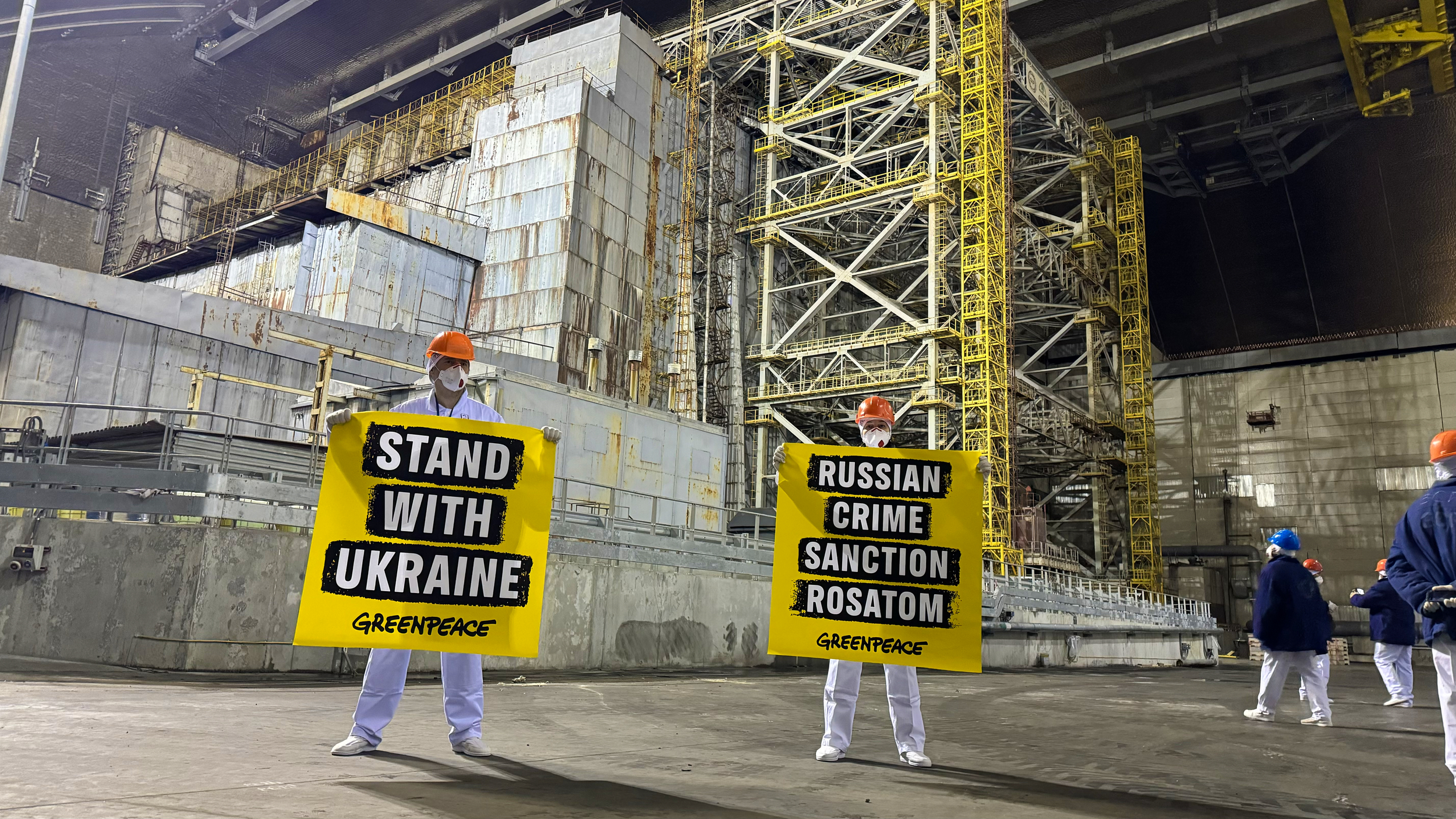
Featured image: Ahead of the 40th anniversary of the Chornobyl reactor disaster (26. April 1986), Greenpeace activists are protesting in front of the nuclear ruin, calling for stronger support for Ukraine in securing the accident site. The New Safe Confinement over the Sarcophagus and damaged reactor, was severely impacted by a Russian drone attack, can no longer reliably fulfill its function.
Source: Courtesy of Greenpeace
Author: © Pavlo Siromenko / Greenpeace