

Barcelona is preparing for Wednesday’s disruption, which will bring 25% of normal services on the Barcelona metro, tram, the FGC train and funicular network, the Rodalies regional trains and intercity buses. Schools throughout the Catalan capital will also close.
The city’s international airport, El Prat, is not required to close, but is expected to experience severe delays, with predictions nodding back to the last national strike in 2012, when around 700 flights a day were cancelled across Spain. Shoppers have also been urged by the FACUA trade union not to shop for 24 hours, but there is no legal requirement for shops to close.
The strike was called by major Spanish trade unions, including the UGT, CNT, CGT and the CCOO, who are fighting against increased house prices and an increased cost of living across the country. It is the first national strike since 2012, and it has been formally registered with the Ministry of Labour.
In the Catalan capital, posters and graffiti can be seen on almost every street corner, announcing Vaga general, 11N (“General strike, November 11”). Some posters include the website URL or a QR code for the general strike’s webpage, written in Catalan and detailing events in the lead-up to November 11.
These lead-up events include information meetings, committee assemblies, open assemblies, a workshop for banner making, and even a meeting for pensioners. The website shows clear directions on how to attend, and events organised by different strike committees are taking place all over Catalonia.
The website also has a page where people can easily sign up to participate by filling out a few personal details. Also notable is the website’s opening page, which signals Spain’s cost of living crisis with the slogan Viure ens costa la vida (Living costs us our lives), and at the bottom, viewers can see that the platform is supported by various organisations, including Catalonia’s Socialist Housing Trade Union and the CGT of Catalonia.
Other institutions have also shown their support. For instance, The Sagrada Familia Public Library, in Barcelona’s Eixample neighbourhood, closed days before the strike. Signs written in Catalan tell visitors that the library is closed in support of the strike and clarify that it is indefinite.
William Kirby, a PHD student at the University of Cambridge who specialises in Catalan literature and culture, spoke to EU Reports about the use of the Catalan language during this strike period.
“It’s not too surprising that the Catalan language has been central to mobilising people on an issue that is felt so close to home,” he said.
“The Catalan-language slogan Cap veïna fora del barri (No neighbour from outside the neighbourhood) has been appearing around Barcelona for several years, uniting diverse, working-class residents around housing rights and community survival on a hyper-local level through a shared vernacular.”
Kirby further explained the use of regional language in trade unions, telling EU Reports that “Catalan, similarly to Basque, is deployed by grassroots housing unions, such as the Sindicat de Llogateres in Barcelona, as the language of neighbourhood solidarity. It places the focus on the day-to-day precariousness faced by locals while taking a much larger fight to a whole political and economic system.”
A document displayed outside The Sagrada Familia Public Library talks about the strike’s link to the feminist movement, reading: “In Barcelona’s libraries, we suffer a double historical discrimination.” It refers to libraries experiencing both discrimination “associated with feminised professions” and “endemic shortcomings of the cultural sector.”
The use of the feminine form in the Catalan language, Kirby explained, has been prevalent in this movement. “The name of the Sindicat de Llogateres and the slogan cap veïna (rather than veí), both utilise a deliberately, marked feminine form, inserting the movement in broader feminist discourses and political struggles.”
He clarified that a lot of their political messaging “develops on the core anti-hegemonic charge of feminism.”
Schools across the capital are also closing on November 11, as teachers strike for fairer pay, and signs and posters in many schools read “General strike, November 11”.
“People as well as students are just trying to defend their rights, because we want a good future and [to] live in Spain or Catalonia with all sorts of conditions,” said Anna, a student at a public school in central Barcelona, while in conversation with EU Reports.
Another student, Leire, told EU Reports about her worries for young people’s futures.
“Young people don’t have a future here, it’s unfair, the price of everything is very high, and we are losing our culture and language because of all the tourism and expats.”
Carla thinks that it is especially important to “defend this strike, […] because if we continue like this, we’ll have to limit our dreams here in Barcelona because we won’t be able to afford life here or use public transport, which is happening at the moment.”
She also explained that her mother is a teacher and at the moment, salaries are too low to live securely in the city, adding that since they rent their home, there is a lot of uncertainty about prices increasing and whether they will be able to continue living there
Santiago also thinks that tomorrow’s strike is important. “For people like me, this strike is important because I’ve been an immigrant for a long time and the right-wing ideology movement is stronger than the left. It’s a shame for my people and equals.”
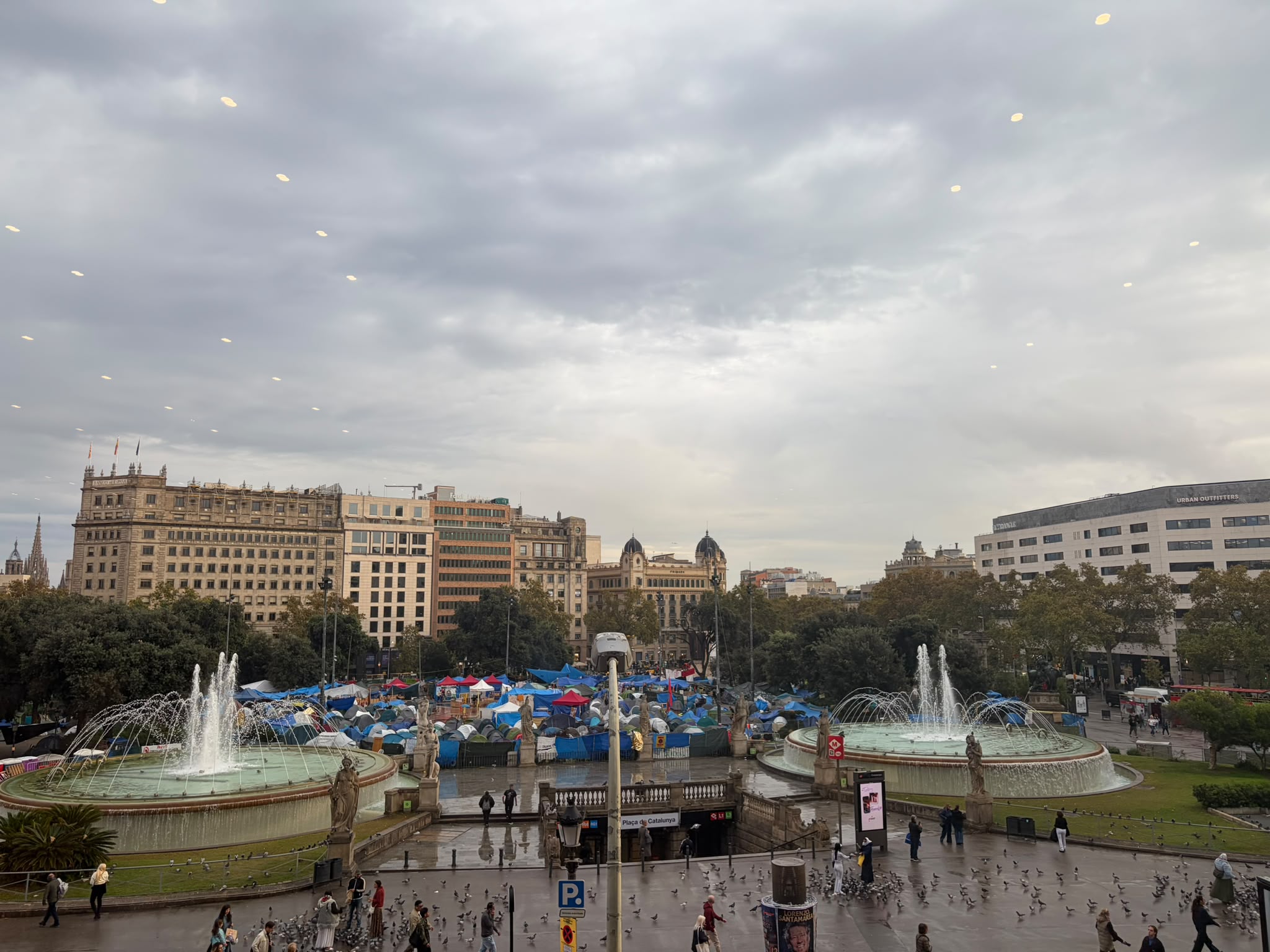
A large encampment in central Barcelona’s Plaza de Catalunya is also heavily associated with Wednesday’s strike. The encampment has been occupying the central square since the end of September, and it is guarded off with fences.
On these fences, there are posters for the general strike, along with general left-wing symbolism, such as those signalling to the left’s recent triumph in Brazil’s presidential elections, including a sign which reads “Democracia Brasileira” and another with a photo of Luiz Inácio Lula da Silva, Brazil’s incumbent president.
This general strike follows a series of protests which have taken place this autumn across Spain, signalling disapproval of increased house prices and low salaries, which began with 87-year-old Maricarmen being evicted from the central Madrid apartment she had lived in for the last 71 years.
On October 24, Barcelona also saw disruption through a youth protest, believed to also have been inspired by recent protests in France and across Europe. Whilst demands are different, some have compared recent events to the infamous series of protests during the famous May ‘68 movement.
This strike also comes at a crucial period of Spanish politics. In early October, amidst this very housing crisis, Spanish Prime Minister Pedro Sánchez announced a snap general election, which will take place on November 29.
It’s not just Barcelona which is preparing itself. Across other parts of Spain, from Madrid to the Basque Country’s Vitoria-Gasteiz, posters, graffiti and social media posts which signal the general strike are plentiful.
Featured image: The encampment in La Plaza de Catalunya
Courtesy of Rebecca Turner (own photo)