
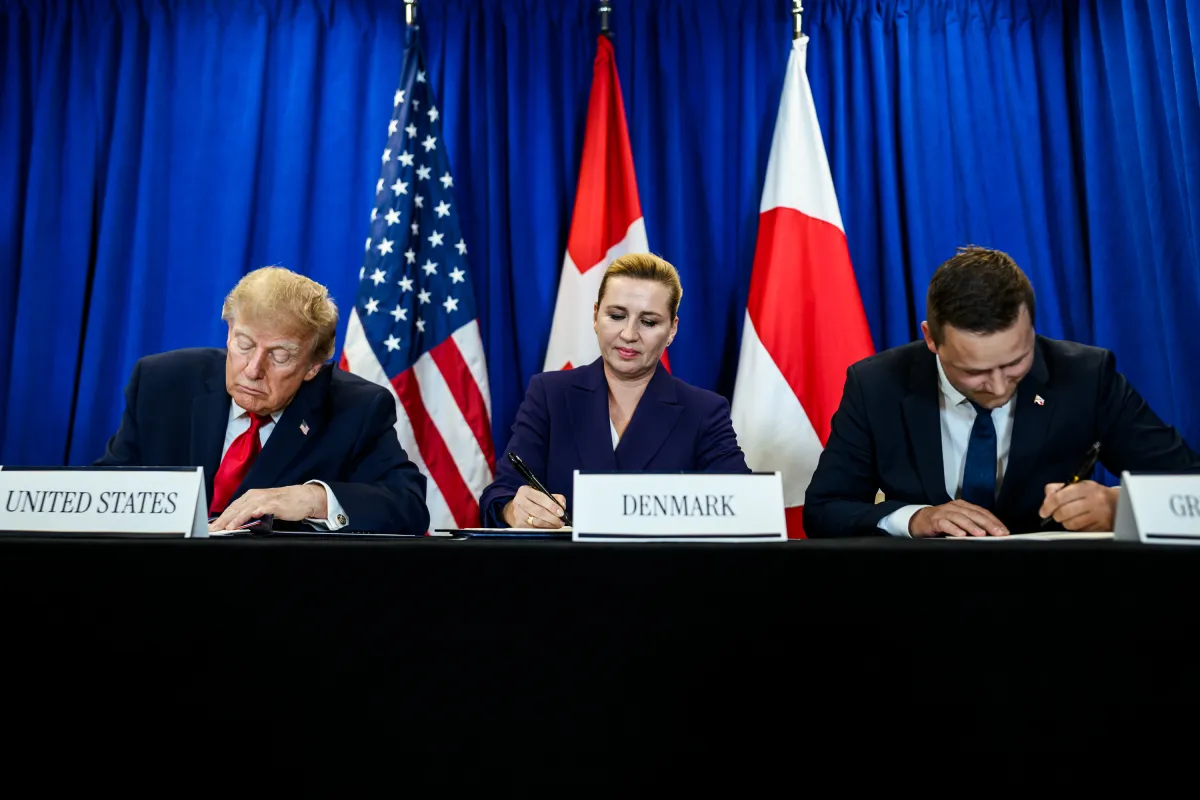

Madrid, Spain – The United States, Denmark and Greenland signed a defense agreement in New York on September 22, 2026, giving Washington a broader and more durable military position on the Arctic island than it has ever held.
Signed on the sidelines of the UN General Assembly by U.S. President Donald Trump, Danish Prime Minister Mette Frederiksen and Greenlandic Prime Minister Jens-Frederik Nielsen, the pact ends more than a year and a half of tension over Trump’s push to take control of the territory.
Trump did not get what he once demanded: ownership of Greenland. No territory has been transferred to the United States, and Greenlanders keep the right to choose their political future.
Read more: Greenland emerges as new focus of U.S. geopolitical ambitions
But the outcome follows a pattern Trump has used before: open with a demand the other side cannot accept, then present its concessions as a compromise.
The deal amends and supplements the 1951 Defense of Greenland Agreement, which regulated the U.S. military presence in Greenland, a self-governing territory within the Kingdom of Denmark. It will enter into force once Denmark and Greenland complete their parliamentary procedures.
The new pact allows the United States to expand its activities at Pituffik Space Base (formerly Thule) and authorizes new U.S. defense areas at southern Narsarsua and Mestersvig on the east coast.
U.S. forces further receive wide access rights by land, sea and air, including overflight and undersea movement in Greenlandic waters. The text also mentions the possible establishment of a “Golden Dome” missile defense system.
From Cold War pact to permanent framework
The 1951 agreement allowed Washington to establish defense areas as part of NATO’s collective defense, reflecting the Cold War logic of two allies cooperating under Danish sovereignty. The new deal goes further in three ways.
First, it is built to last. The 2026 agreement’s Article XI states it has no end date and can only be changed by mutual consent.
Second, it broadens the U.S. military footprint. Pituffik can be modernized and expanded, while Narsarsuaq and Mestersvig are designated as future defense areas.
The access rights across the island matter for Arctic surveillance, missile defense, space operations and logistics.
Third, the agreement locks in limits on rival powers. Non-NATO countries cannot establish military bases or a persistent military presence in Greenland without the agreement of the parties, and investors from outside NATO and the EU are barred from controlling or gaining significant influence over sensitive sectors including critical minerals – unless the three signatories agree.
In practice, this is mainly aimed at China and Russia, though the Peterson Institute for International Economics (PIIE) notes that the NATO-partner exemption still leaves room for several authoritarian states.
Namely, NATO partners include several dictatorships in the Middle East and former Soviet republics such as Bahrain, Egypt, and Kyrgyzstan.
Independence, with conditions
A key clause concerns a future independent Greenland. Article XI says that if Greenland becomes independent, the new state would assume all of Denmark’s rights and obligations under the defense arrangements, and the deal envisions that state firmly within NATO.
This can be presented as a security guarantee, but it also narrows Greenland’s room to choose a different geopolitical path. Brussels-based think tank Bruegel reads the pact as a Danish diplomatic victory that entrenches the status quo and makes independence less likely.
Under that framing, Trump’s demand to “own” Greenland produced the opposite of its stated goal: it may strengthen the existing Danish-Greelandic union while making U.S. military rights more secure.
Trump’s negotiation method
Negotiation theory calls this approach extreme anchoring; the first demand on the table sets the term of the debate, and even when the other side rejects it outright, the final compromise tends to land closer to it than it otherwise would.
Trump’s initial rhetoric about acquiring Greenland was the anchor; Denmark and Greenland rejected any transfer of sovereignty, and the final deal explicitly reaffirms Danish sovereignty and Greenlandic self-determination.
Yet Washington still walked away with expanded base rights, broader operational access, tighter barriers to Chinese and Russian influence, and a framework designed to survive a possible Greenlandic independence.
A new normal in the Arctic
The agreement points toward a world in which major powers seek permanent military access, veto power over foreign investment and long-term restrictions on the choices of smaller states.
Such arrangements may become more common in strategic regions: Arctic territories, maritime chokepoints, island chains and countries rich in critical minerals. Meanwhile, great powers will increasingly treat infrastructure, data, ports, mines and telecommunications as security issues.
The Greenland deal furthermore normalizes a form of alliance politics in which sovereignty remains intact on paper while strategic autonomy becomes more limited in practice. That may strengthen NATO’s Arctic posture, but it also risks turning the Arctic into a more openly divided geopolitical space.
Featured image: via White House photo gallery