
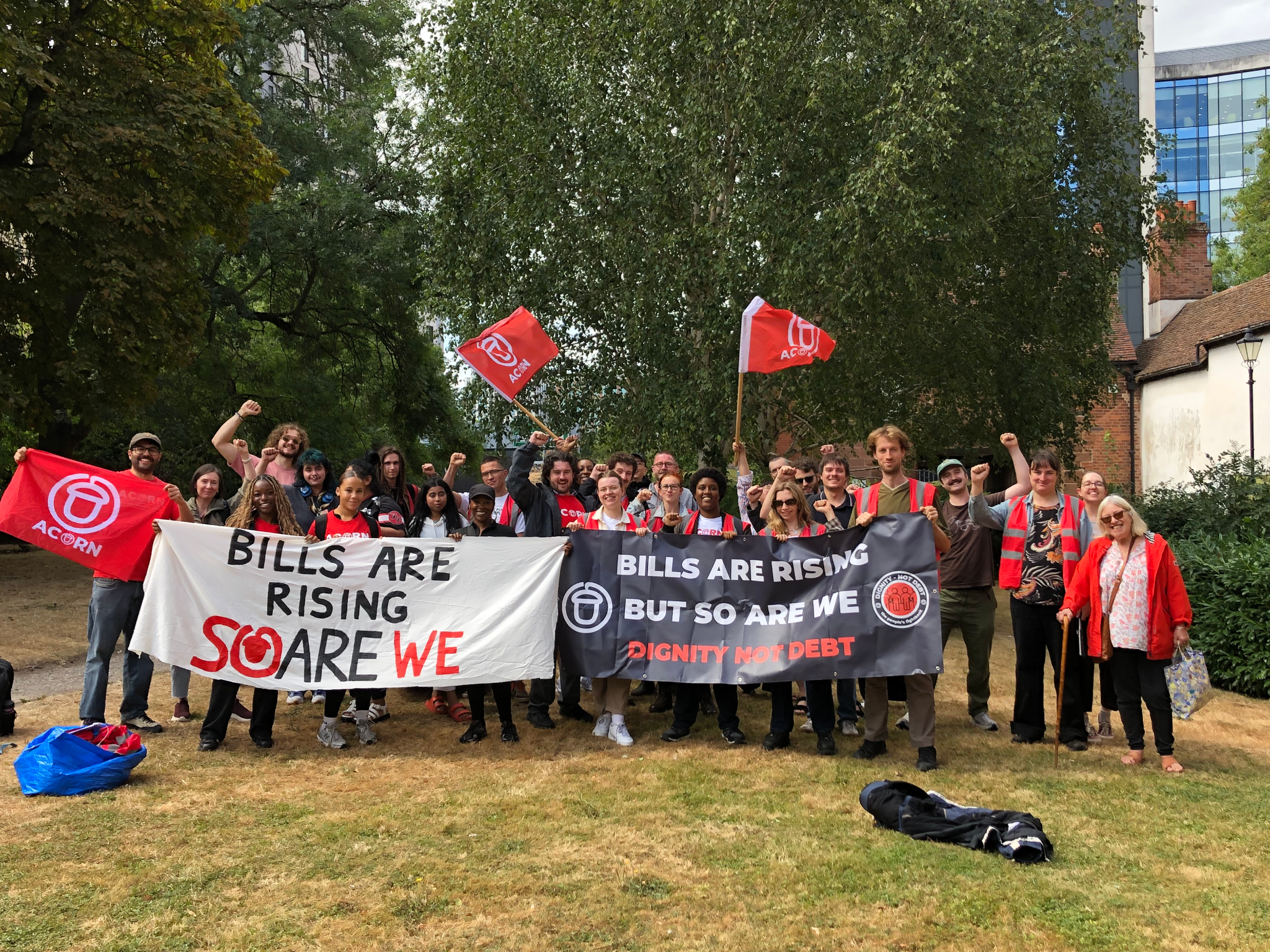

Coventry, United Kingdom – Hundreds of members of ACORN, a British mass-membership community and tenants’ union, staged nine coordinated protests across England and Wales today to raise awareness about the rising cost of living for Britons on low and moderate incomes.
The activists occupied or attempted to occupy the offices of companies that they deemed to be exacerbating and profiteering from different aspects of the cost-of-living crisis, such as rising water bills and increasing rents.
The organizations and branches targeted by ACORN members were OVO Energy South West, CDER Bailiffs North East, ARP Enforcement East of England, Greystar PLC London, Yorkshire Water, United Utilities North West, Welsh Water, Severn Trent Midlands and Octopus Energy South East.
ACORN’s press release clarified that the actions were designed to target “landlords, utility companies and the debt enforcement industry”.
In Coventry, protestors occupied the reception area and outside entrance of the offices of Severn Trent Water (STW), one of the private regional monopoly companies responsible for delivering water to households in England and Wales.
The demonstrators left the scene once STW representatives had agreed to arrange a sit-down meeting with ACORN and relented to some of the union’s demands, which included guarantees that there would be no price surging during periods of drought and that ACORN would be included in future discussions about STW’s cost-of-living policy.
STW supplies 4.6 million households and businesses across the Midlands, the South West and Wales. The protestors pointed out that, while STW reported a pre-tax profit of £590 million in 2025, there were over 35,000 separate sewage spills in waters administered by STW in the same year.
England and Wales are the only countries in the world with a fully privatized, end-to-end water and sewerage system. The companies have been subject to increasing criticism and scrutiny in recent years due to customers’ soaring water bills and the increase in sewage spillage in British waterways.
British water companies faced the launch of a record 96 criminal investigations relating to breaches of environmental permits last year and UK Prime Minister Andy Burnham recently accused the companies of treating their customers as “a bottomless source of funding” after they were permitted by water regulator Ofwat to increase customer bills.
The protestors told EU Reports that they wanted to bring attention to the alleged profiteering of private water companies during the cost-of-living crisis, which many demonstrators referred to as the “cost-of-greed crisis”.
In conversation with EU Reports, Roz, the membership officer for ACORN’s Leicester branch, highlighted the disparity between the corporate bonuses of STW’s executives and its water management.
“Despite a £2.3 million bonus for the CEO of Severn Trent, we have seen hundreds of thousands of hours of sewage spills in 36,471 separate cases. This has made people really sick and we are paying for it”.
The Guardian reported last month that STW had “doubled the size of a long-term reward scheme for its new chief executive to as much as £3.1m”.
“We believe that if we are paying for the right to water and the right to clean water, that it should be kept that way [clean]”, Roz concluded.
Employees and representatives of STW declined EU Reports‘ requests to comment on the protests.
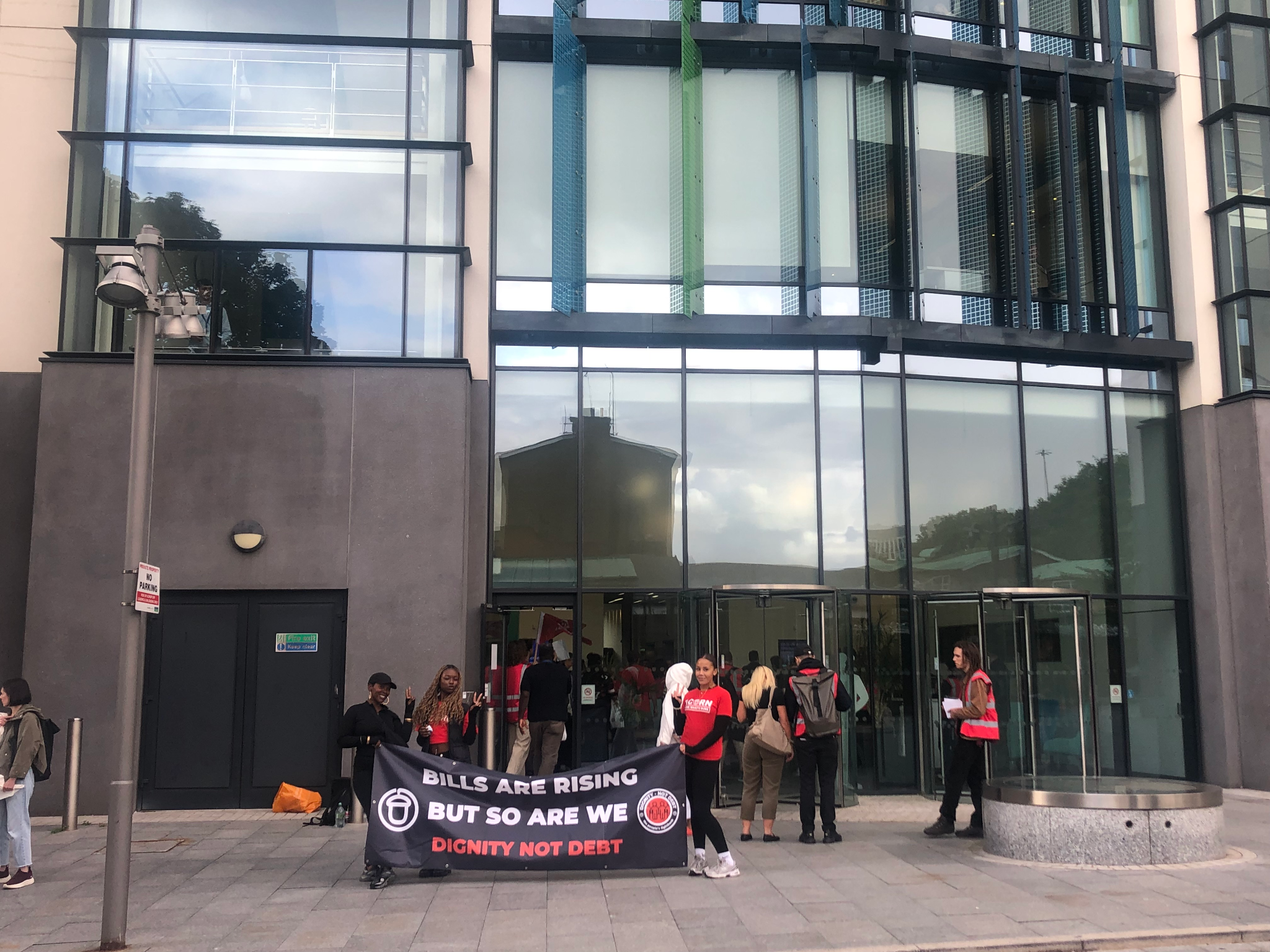
Image Source: Raphael McMahon (own image)
ACORN’s national message for a national crisis
The chair for ACORN’S local Coventry branch, Lewis, explained that STW’s policies are the symptom of a wider national problem that the union is trying to address and raise awareness about through coordinated local protests.
“Water bills are rising and many water companies use bailiffs to collect unpaid water debt, which generally impacts the poorest and most vulnerable people in our society: people on low incomes, the unemployed, single parents, migrants, disabled people, retirees”.
“ACORN is trying to stop the cost-of-living crisis from harming the most vulnerable people in our society”, Lewis continued.
Preventing this harm, various ACORN members argued, would require the current Labour government under Prime Minister Andy Burnham to nationalize essential industries such as water.
“[While] people are struggling to pay their water bill, they [private water companies] are making hundreds of millions of pounds … on a public good.”, said Paul, an ACORN member and the police liaison officer at the Coventry protest.
“We think water should be a public utility, it should be nationally controlled for everyone to use. It’s not a competitive market, it’s a natural monopoly. It makes no sense that it is being run for private profit”, he continued.
Shortly before becoming Prime Minister, Burnham indicated an interest in increasing public control over utilities, such as “water, housing, energy and transport”. However, it is unclear whether he will pursue this shift away from privatization now that he is in office.
Despite his demands, Paul and various other ACORN members praised some of the Labour government’s recent policy announcements regarding the cost-of-living crisis, particularly the capping of single bus fares at £2.
However, Vicky, an ACORN member from Leicester, urged Burnham to go further and introduce more radical measures: “I think we need rent controls, I think we need freezes on bus fares”, the activist urged.
“The obvious way forward [for the Burnham government] is water nationalisation; but until we get there, solid material change similar to our demands today is the way forward”, added Charles, the Coventry Protest’s action lead and ACORN Birmingham’s Branch Secretary.
Burnham has promised to make rising costs a key priority of his government; in the long-term, the former Greater Manchester Mayor intends to massively expand the construction of affordable social housing, reform universal credit (benefits payments) and increase investment in local economies as part of a 10 year plan to raise British living standards.
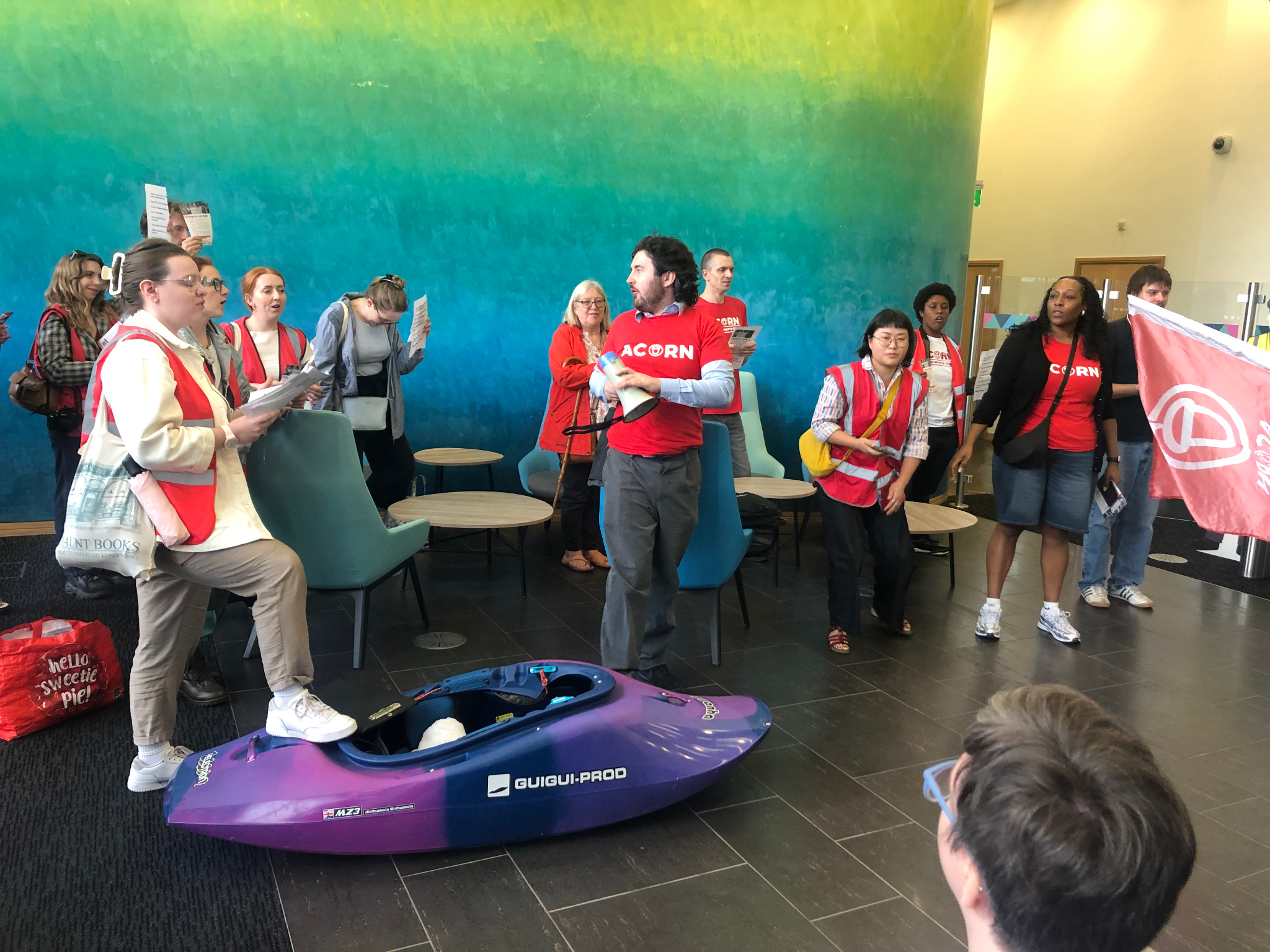
Image Source: Raphael McMahon (own image)
Burnham is not the first British leader who has been pressured to address the cost of living; the current crisis dates back to late 2021, when the price inflation of essential goods began outpacing the growth of household incomes.
Experts attribute the origin of the crisis to a variety of factors, including the economic fallout of the COVID-19 pandemic and Britain’s decision to leave the European Union (Brexit). In the years since, the Russia-Ukraine war and the US war in Iran have also become contributing factors.
Food now costs a third more than it did in 2022, and the UK’s inflation rate hit a four-month high of 2.9% in July. This month, petrol prices in the UK also hit a three-and-a-half-year peak.
The Joseph Rowntree Foundation (JRF), a charity that researches British poverty, published a report that revealed that 7.4 million low-income British families had been unable to afford essential items between January and July 2026.
This figure was the highest recorded by JRF since they started tracking the impact of the cost-of-living crisis on low income families in 2021.
Burnham has admitted that, in the face of such economic challenges, the immediate measures set out by his government will not suffice to end the crisis.
Featured Image Description: Acorn members in Coventry before their protest at Severn Trent Water’s HQ
Image Credit: Raphael McMahon (own picture)