

Russia has shown little indication that it intends to halt its full-scale invasion of Ukraine, now in its fifth year. In an address to the Russian parliament on September 30, Russian President Vladimir Putin professed a continued confidence in the Russian economy and stated that they “cannot run around the world humiliatingly begging for handouts with an outstretched hand”.
Rhetorical jabs at Ukraine’s reliance on foreign aid show a president that intends to antagonise the EU further. Despite the finalisation of a €90 billion support loan for Ukraine in April, the EU is now reconsidering using frozen Russian assets to economically strengthen the Ukrainian war effort.
The EU currently holds approximately €210 billion in immobilised Russian sovereign assets, managed primarily through the Belgian central securities depository Euroclear, with a smaller portion being held by Clearstream, another international central securities depository.
On August 27, Sweden, Poland, the Netherlands and Spain called for renewed work on using Russia’s immobilised assets for Ukraine. In their joint letter to the European Commission, they called for new mechanisms that would spread the financial and legal risks across EU member states rather than leaving any one country disproportionately exposed.
With the financial risk spread across the EU rather than lumped on Belgium, the prospect of mobilising Russian assets to then give to Ukraine may become more palatable for the EU.
The Commission confirmed that it was examining proposals for using Russia’s immobilised assets but has not committed to any specific mechanism. It told EU Reports that “at this point” its position on the assets “has not changed” since the September 11 briefing.
Why Belgium is exposed
The possibility of Russian assets being unfrozen and used by Europe carries several legal risks that would fall squarely on Belgium’s shoulders. Given that Euroclear holds roughly €185 billion in Russian assets, Belgium is uniquely exposed to blowback from Moscow.
Belgian officials have raised concerns about potential legal and political implications of using Russian assets. Foreign Minister Maxime Prévot said that “using these assets through a process amounting to confiscation would entail very significant risks”, while Belgium has demanded guarantees that it would not be left alone to deal with Russian lawsuits and claims for damages.
While the proposal to spread the assets around Europe to take the pressure off Brussels may sound like a positive, the possibility of wider legal implications across the EU could become a major issue.
The workaround’s potential issues
Rather than using the assets through Euroclear, the proposal being examined would move the relevant assets into another EU-controlled vehicle or custodian. Ukraine is keen on this proposal, with its Finance Minister Sergii Marchenko publicly expressing its desire to explore this possibility.
While it is an option that could seemingly spread the risks beyond Belgium, Veerle Colaert, professor of financial law at KU Leuven questioned whether moving the assets into an EU-controlled custodian would resolve the legal problems surrounding them.
Speaking to EU Reports, Colaert argued “the legal position of Europe, Belgium and Euroclear does not change for the better by the new proposal.”
Colaert’s argument rests on a distinction between the assets themselves and the claim attached to them. She said the Russian central bank’s assets held at Euroclear were largely debt financial instruments that have since expired, with the proceeds now held as cash.
While the cash is legally owned by Euroclear, the Russian central bank retains a claim against Euroclear, which has a contractual obligation to pay it once sanctions are lifted.
Under the proposed mechanism, the assets and the related liability would be transferred to an EU-controlled custodian. But Colaert argues that under civil law the liability cannot be transferred without the agreement of the Central Bank of the Russian Federation (CBR), which is the creditor. Without that agreement, she says, Euroclear would remain liable to repay the CBR even after the assets had been moved.
This civil law principle exists to protect creditors against the risk that their debtor would be replaced by a much less creditworthy counterparty. Under the proposed mechanism, a European regulation would override this principle on grounds of economic emergency. This raises important legal questions.
First, it is open to question whether there is in fact an economic emergency sufficient to justify such a measure. Second, this structure could be seen as amounting to an expropriation of the Central Bank of Russia: the Central Bank of Russia’s high value, unconditional claim against Euroclear would be replaced with a claim against the EU that is conditional on Russia paying an equivalent amount to Ukraine.
This replacement claim would economically have little value and could therefore be characterized as an indirect expropriation.
Colaert also argues that the proposed transfer of assets creates a separate legal problem for Euroclear itself.
“The assets are currently owned by Euroclear, so obliging Euroclear to transfer the assets to an EU custodian, legally comes down to an expropriation of Euroclear, a stable financial institution, to support EU policy goals,” she said.
This would especially be the case if the measure were not accompanied by unconditional, immediate and full guarantees covering any losses Euroclear might suffer in this context.
The EU would not only be exposed to legal challenges, but the proposal being considered by the Commission could undermine the EU’s standing as a safe area for investment.
“If foreign powers gain the impression that their reserves held at Euroclear can be redirected at will for European policy objectives, their willingness to invest in European securities may well erode,” said Colaert.
The proposal of shifting the assets from Euroclear to an EU custodian thus raises a broader question for the EU: can the risk be shared across member states or will it be transferred from one institution to another? With the Commission yet to decide, the question remains unresolved.
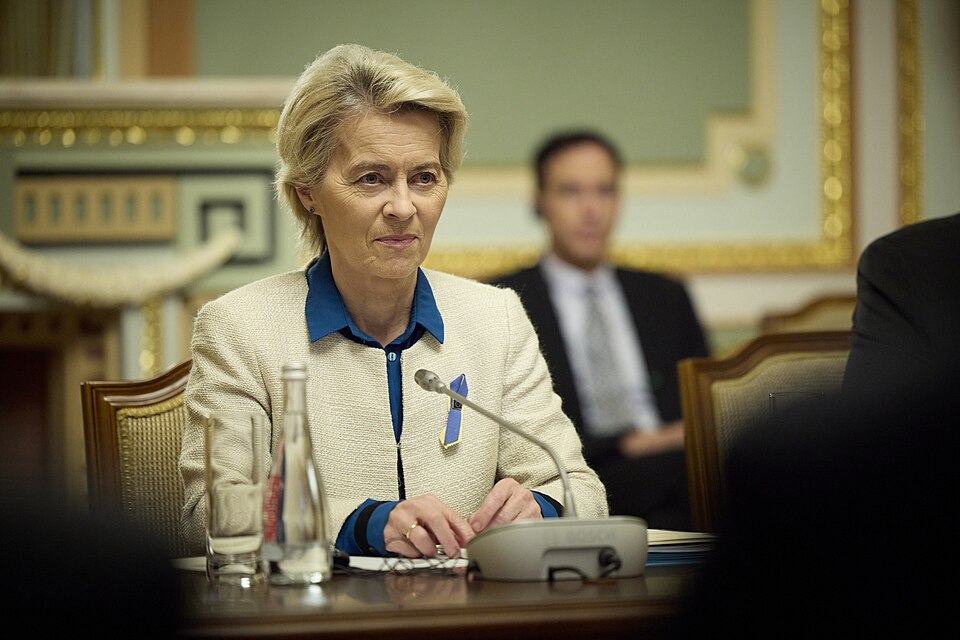
Featured image: President of Ukraine Volodymyr Zelenskyy held talks in Kyiv with European Commission President Ursula von der Leyen.
Author: President Of Ukraine from Україна
Source: Wikimedia Commons
Creative Commons Licenses