

UK Prime Minister Keir Starmer announced on June 15, 2026 that access to social media platforms such as X, Snapchat, Tiktok, YouTube, Instagram, Facebook and X will be banned for British users under 16 years old.
The measures, which will reportedly be implemented from early 2027, will also affect gaming apps and streaming platforms: under-16s will not be allowed to livestream, and the option to chat to strangers while gaming will also be removed for minors.
The government has also indicated that further restrictions, such as overnight curfews, are being considered for under-18s.
“Social media is making children unhappy, it’s making it easier for bullies to harass and abuse them, and it could even be harming their mental health”, Starmer explained in his address.
“[The social media ban] will make a huge difference. It will make our children safer. It will make our children happier. It will give them more time, more security, full freedom to grow up, more opportunity, and that, at the end of the day, is what this government is about”, the leader continued.
The ban is not totally unprecedented: in December 2025, Australia banned under-16s from accessing ten major social media platforms, including TikTok, YouTube, Reddit, Facebook, X, Twitch and Snapchat.
In the EU, Spain also moved to implement the same measures in February 2026, with Prime Minister Pedro Sanchez alleging current platform practices expose minors to addiction, abuse, pornography, manipulation and violence.
The UK’s measures, however, are being described by The Guardian as “Australia plus”, given that the British government is set to implement broader access restrictions than their Australian counterparts, who report that teens are finding ways to circumvent the ban.
The political reaction
Despite opposition from various of the affected social media platforms – such as Meta, YouTube and Snapchat – the new policy is likely to be popular amongst the British electorate, with a recent survey showing that 90% of parents supported a social media ban for under-16s.
Such popular support may also explain the British opposition’s general acceptance of the need for social media restrictions, though many prominent opposition leaders criticized the substance of the government’s proposals.
Kemi Badenoch, leader of the Conservative Party, supported the ban, stating that she thought it fantastic that “the government has finally woken up to the dangers of social media for young people”.
The left-wing Green Party also released a statement, welcoming “action to address the harms social media can cause to young people” but cautioned that “a blanket ban could leave some young people […] more isolated and cut off from support” and called for stronger regulation of social media firms that profit from addictive algorithms targeted at children.
Though right-wing Reform UK leader Nigel Farage praised the ban as “well-intentioned”, he argued that it was “unlikely to work” given the mass adoption of VPNs (Virtual Private Networks), tools that create a secure, encrypted tunnel between individual devices and the internet.
On the other hand, the leader of the Liberal Democrats Ed Davey criticized the entire plan as “rushed and ill-thought through”, advocating for the government to introduce different restrictions for different social media platforms instead of banning them outright.
Liz Kendall, Secretary of State for Science, Innovation and Technology, told the House of Commons that it was her intention for the regulations to be put to a parliamentary vote by the end 2026.
However, the main political obstacle facing the proposed restrictions may come from abroad; UK ministers have reportedly been lobbying U.S. President Donald Trump – who has a close relationship with major U.S. tech companies – to prevent American backlash to these future British restrictions on U.S.-owned platforms such as X, Facebook and YouTube.
The education sector reacts
Lee Richardson, Headteacher at Cheadle Hulme School (CHS) in the North of England, spoke to EU Reports about the pernicious effect of social media on his students and his thoughts on the ban.
“I do think it’s the right policy”, the headteacher argued. “There is no doubt in my mind that social media is an addictive item … in the same way that alcohol and cigarettes are. We don’t generally feed addictive things to our children, and for good reason”.
Richardson added that even adults struggle to control their use of social media, “and therefore how do we expect children, who don’t have the same willpower and the same maturity, to do so?”
The British teacher also cited young people’s consumption of misinformation and the detrimental effects of social media on students’ mental health as reasons to support the ban: “We see anxiety and stress in young people much more than we used to and we are also very concerned about where children are getting information from, and how they understand what is true and what isn’t … a huge amount of content generated on social media is not true, and not balanced.”
SQ Magazine reported that 76% of global internet users alleged that they had encountered misinformation on at least one social platform in each of the first three months of 2026. Meanwhile, researchers at Imperial College London found that children whose social media usage was over three hours a day were more likely to develop depression and anxiety during adolescence.
Catherine Gregory, Assistant Head and English Literature teacher at CHS, also spoke to EU Reports about the effects of social media on students both inside and outside the classroom, as well as her thoughts on Starmer’s latest policy.
“Social media is having a negative impact on young people. I am most definitely witnessing declining reading fluency, reduced stamina for complex texts, and declining critical thinking skills. So many of our students are so used to consuming short form content that they really struggle with the concentration needed for sustained reading and problem-solving,” she explained.
Gregory also argued that the repercussions of social media also transcend the classroom. “Social media can intensify feelings of exclusion and rejection. It encourages comparison [and] can make it harder for young people to develop the attention, self-regulation and executive functioning skills that are so important for success in adult life.”
Nevertheless, she expressed skepticism towards the government’s new policy of banning social media platforms entirely; she is not convinced that a blanket ban alone could solve the underlying issues.
“The Australian case tells us that many young people are still active on social media platforms despite their ban. A more effective approach may be a combination of increased restriction combined with increased moderation and accountability for tech companies,” the teacher concluded.
Over 60% of Australian children indeed still use social media despite the country’s ban, according to the Molly Rose Foundation, a UK-based NGO founded after 14-year-old Molly Russell died from self-harm after exposure to harmful, suicidal and depression content algorithmically recommended on social media.
The flagship policy of a dying premiership?
The timing of the ban’s announcement has been heavily scrutinized by elements of the British media, with some commentators speculating that it represents a last-ditch attempt by a politically-cornered Starmer to secure his legacy.
The prime minister, who led the Labour Party to a landslide election victory in 2024, has recently faced increasing calls to resign over various scandals and Labour’s poor results at the recent local elections.
Starmer is also facing the prospect of an upcoming Labour leadership challenge, as both former Health Minister Wes Streeting and Greater Manchester Mayor Andy Burnham – who is running for a seat in the House of Commons in the Makerfield by-election on June 18 – have made clear their ambitions to unseat the current Labour leader and assume the role of prime minister.
Starmer has denied that the social media ban is a way of securing his legacy, arguing that “this is a huge issue for the country.”
“[The ban] isn’t about any one individual, it is something which people have been concerned about, living with and campaigning about for years.”
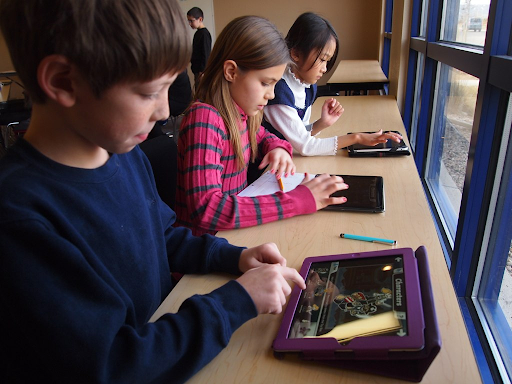
Featured Image: Schoolchildren on their iPad devices.
Image Credit: Brad Flickinger via Wikimedia Common
License: Creative Commons Licenses




.jpg)