

The burning down of the Eagle’s Nest—the mountaintop retreat in Bavaria, Germany, formerly belonging to Nazi dictator Adolf Hitler—has triggered debate within Germany over whether the site should be rebuilt, following a fire that left it in ruins on the evening of Friday, October 23.
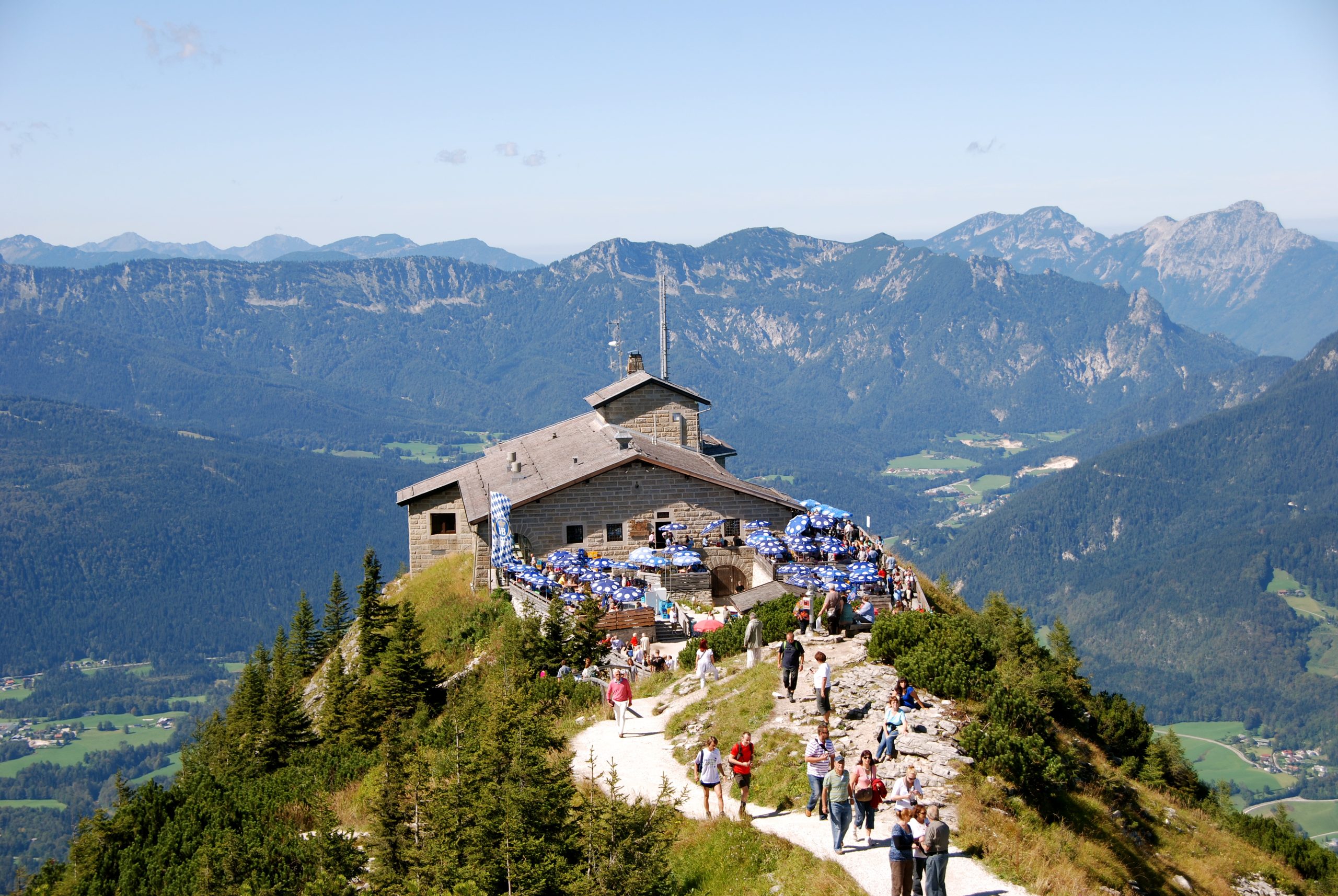
The Eagle’s Nest, known as the Kehlsteinhaus in German, sits on a mountaintop in the Bavarian alps, 1,834 metres above sea level, and was built by the Nazi government in 1938 as a residence and site of diplomatic meetings for Hitler. Twelve workers died during its construction.
Hitler himself only visited 14 times, choosing instead to spend much of his time at his separate mountainside retreat, the nearby Berghof. However, it continued to be frequented by other high-ranking figures such as his wife Eva Braun. The area as a whole featured prominently in depictions of the dictator in Nazi propaganda.
The building was occupied by Allied forces immediately after World War II, before being converted into a museum and tourist attraction during the late 1950s. The site receives more than 300,000 visitors each year.
Almost 200 firefighters, wearing heavy breathing apparatus due to the high altitudes, were rushed to the location late on October 23 in response to smoke alarms. The building was found completely ablaze, with one police spokesperson stating that it was “unlikely to be saved.”
The fire appears to have been the result of arson, with a 33-year-old man allegedly arrested in connection to the fire nearby the scene, according to The Guardian.
However, it is unclear if the individual, who is said to have suffered from mental health issues, had acted out of political motivations, and he is reportedly currently being held at a psychiatric facility.
Should it be rebuilt?
At first, German authorities had seemed clear that the site would be rebuilt after Bavarian Interior Minister Joachim Herrmann of the centre-right Christian Social Union (CSU) party told reporters that “we’re not going to leave a ruin there. It is important that we continue to do the work of remembrance.”
But the question of whether a building with such close links to Nazism should be restored has triggered some debate since, especially given the recent successes of the far-right in Germany and concerns about how this might impact the country’s culture of remembrance.
Read more: AfD-led council in Germany bans “stumbling-stone” Holocaust memorials
Various commentators have warned that reconstruction of such a site would risk inspiring Nazi sympathisers by “recreating the impact of the grandiose architecture of the dictator in this impressive setting.”
This point was acknowledged by Dr. Clare Copley, a historian of modern Germany at the University of Lancashire, who told EU Reports that, for the Nazis, architecture not only featured in propaganda, but could itself also act as propaganda.
“High-profile Nazi projects are consciously designed to communicate different facets of Nazi ideology,” she said, adding that Nazi architecture was often built using slave labour, and that the spaces were used for planning and carrying out many of their atrocities.
Meanwhile, Jens-Christian Wagner, a German historian and director of the Buchenwald Concentration Camp Memorial Foundation, told The Telegraph that such sites act as direct evidence of the crimes of the past, and that the creation of new replicas—as opposed to leaving the old remains standing—“would, in a sense, constitute ‘fake history.’”
Bavaria’s Culture Minister Markus Blume announced that a commission of experts in heritage conservation, construction, and Holocaust remembrance will be appointed to determine what is to be done with the site.
“The Kehlsteinhaus was built as a representative building of the NS regime and is inextricably linked to the Nazi regime. It is clear: the concept must be met with this historical responsibility,” Blume said on Facebook.
A long running debate
The preservation and restoration of sites associated with the Nazis has been a frequent source of controversy. Gerald Steinacher, professor of History at the University of Nebraska–Lincoln and co-editor of Contemporary Holocaust Studies, compared the debate to that around the recent conversion of Hitler’s birthplace in Austria into a police station, as well as similar debates in other countries with a history of fascism and authoritarianism.
“This is not a German, Italian or Austrian question alone,” Steinacher told EU Reports. “Spain continues to confront the legacy of Franco’s dictatorship, as the long controversy over the Valley of the Fallen demonstrates. Former communist countries in Central and Eastern Europe likewise face difficult questions about Soviet-era statues, monuments, and buildings.”
Read more: “The world will not forget”: Hitler birthplace reopens as police station
Steinacher added that across Europe, “the broader issue is the same: whether uncomfortable physical remains should be erased, left untouched, or transformed into places of critical historical engagement.”
Copley emphasized there is no “template response” for how best to deal with such sites, and that this is something post-war Germany has sought to develop ways of responding to, particularly since unification.
“Multiple factors shape how, or indeed if, a particular site’s history is ‘dealt with’,” she further told EU Reports. “Events such as the fire at Eagle’s Nest can mark a turning point in the histories of such sites as they give it renewed prominence and compel authorities to take decisive action.”
With certain exceptions, such as Hitler’s bunker in Berlin, “the idea of simply knocking down these sites is not generally seen as presenting a ‘solution’ to them,” the historian explained. This can limit critical engagement with the past, as well as being perceived as attempts to erase history.
Others have also pointed out how the transparency that the Eagle’s Nest had previously held had helped to prevent it from becoming a pilgrimage site for Neo-Nazis, unlike the Berghof, which was demolished after the war, and where, as noted by Sven Keller of the Obersalzberg Documentation Centre, swastikas have been found carved into the barks of trees.
Steinacher echoed this point, saying that “the Eagle’s Nest should be preserved and rebuilt in some form, but also developed further as a historical and educational site, with far more space for exhibitions and explanation.”
“Rather than simply demolishing structures that still exist, we should contextualize them through exhibitions, explanatory panels, museums, and documentation centers,” he added. “Democratic societies should make the history visible, explain how dictatorship became possible and connect that history to the responsibilities of democracy today.”
For now, the site of the Kehlsteinhaus remains closed and cordoned off to the public until further decisions have been reached by the commission in charge. Similarly, details around the arsonist and his possible motives are as yet to be confirmed.
Featured image: Kehlstein House, Hitler’s Tea House, Berchtesgaden, Germany
Source: Wikimedia Commons
Author: Cmgrimm
Creative Commons Licenses