
The house where infamous Nazi dictator Adolf Hitler was born has been reopened as a police station by Austrian authorities as part of efforts to prevent visits to the site by neo-Nazis and others on the far-right.
The Salzburger Vorstadt 15 building dates back to the 17th century and is located in the small Austrian town of Braunau am Inn, near the country’s northwestern border with Germany.
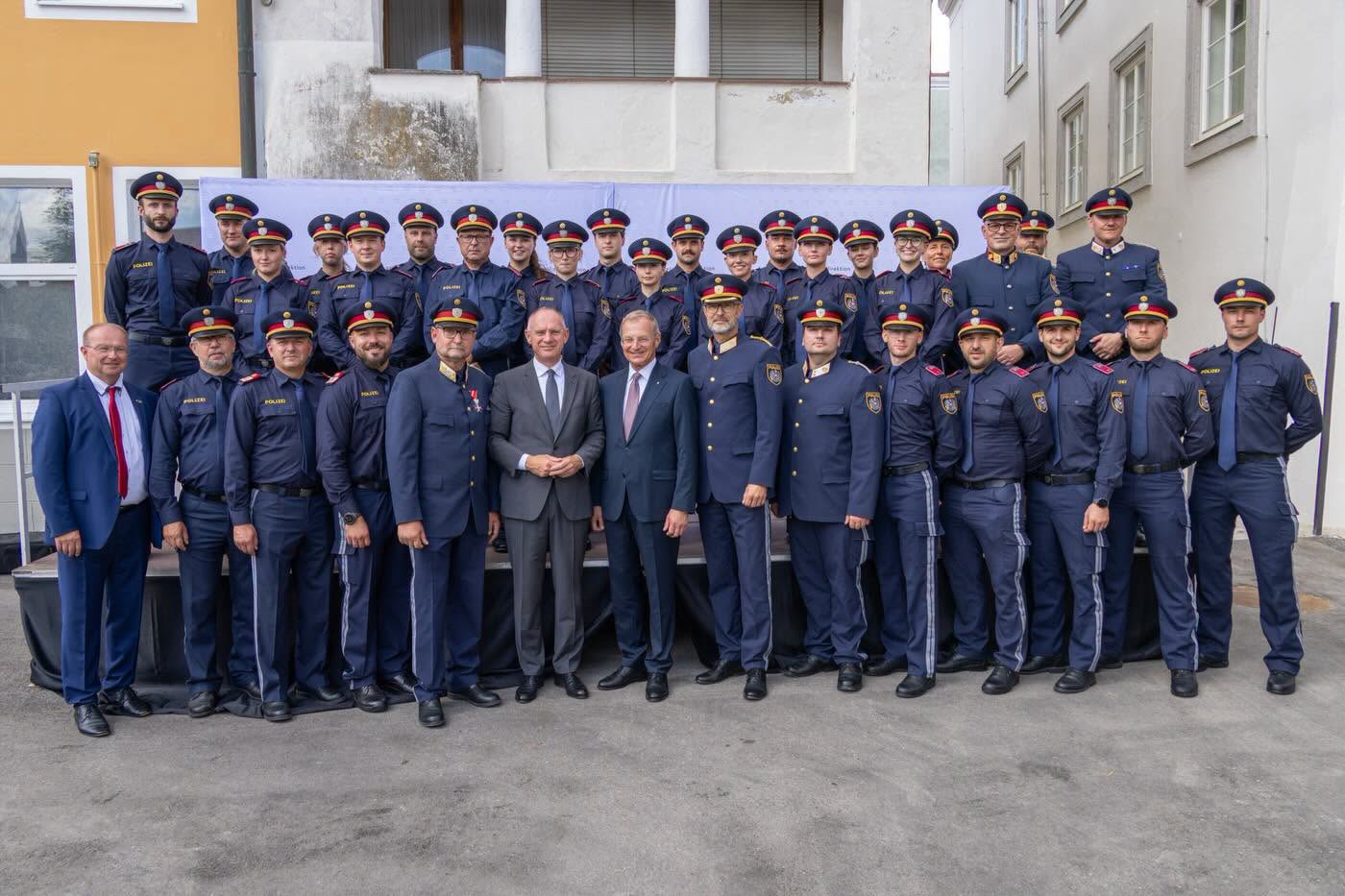
It reopened on July 22 as the headquarters for the local police and police district command, following renovations costing more than €20 million.
The opening ceremony for the new police station was attended by Austrian Minister of the Interior Gerhard Karner, who stated that Austria was taking “responsibility” for the “terrible legacy” of its past.
“This house will now become a place of democracy, rule of law, security, freedom and human dignity,” he said.
A toxic history
Hitler only lived at the address briefly. His family, who were merely tenants there, moved out just a few months after his birth in 1889, and the dictator later said he had no memories of Braunau.
Regardless, the site later gained notoriety as his birthplace, with the Nazis themselves turning it into a space dedicated to their leader following the German occupation of Austria (Anschluss) in 1938.
After WWII, the property served different purposes, including as a day care centre for a local charity and as a workshop for people with special needs, before standing vacant from 2011.
It was expropriated by the Austrian government in 2016 and appointed a commission to decide what should be done with the building, as well as how to “neutralise” any dangers of it becoming a pilgrimage site for neo-Nazis.
The wider context
The prospect of such pilgrimages by the far-right has been a contentious issue in recent years for countries with a history of fascism.
In 2019, the decision by Pedro Sánchez’s government in Spain to remove the remains of dictator Francisco Franco from his lavish mausoleum at the Valley of the Fallen, near Madrid – built partly using forced labour – triggered intense debate and an unsuccessful legal challenge by Franco’s family. Polls at the time showed that as many as 32.5% of Spaniards were against the exhumation.
In Italy, annual pilgrimages to Benito Mussolini’s birthplace at Predappio have become a major source of tourism for the town. In April 2026, however, local authorities at the nearby Riccione municipality took steps to acquire a villa formerly belonging to the dictator, seeking to prevent the same kind of phenomenon there.
Read more: Italian Council to take over Mussolini’s former residence
“The birthplaces of dictators exert an almost religious power [for neo-Nazis],” explained Oliver Rathkolb, director of the Institute for Contemporary History at the University of Vienna and member of the commission in charge of the house at Branau, to EU Reports.
Rathkolb referred to both Mussolini’s birthplace at Predappio, and Joseph Stalin’s birthplace in Gori, Georgia, as examples of places that “are being exploited by right-wing extremists and anti-democrats as political pilgrimage sites.”
Thanks in part to the legacy of “denazification” imposed by the Allies on Germany and Austria after WWII, these countries have generally been perceived as taking a much stronger stance against such glorifying ideologies – as seen with the site of Hitler’s suicide and cremation in Berlin being converted into a car park, though it has still become a hot-spot for so-called “dark tourism” in recent years.
The historian further noted that studies by the Documentation Centre of Austrian Resistance (DÖW) and by the Austrian Federal Office for the Protection of the Constitution and Counterterrorism (BVT) have found that radicalised, right-wing extremists from across Austria, Germany, and Europe have been visiting the site at Braunau to take selfies in front of it. The building, he claimed, has become “a shrine for hardcore right-wing extremists”.
A lengthy decision
The commission in charge of what would be done with the building at Braunau included leading representatives from the Jewish Community of Vienna, DÖW, several historians, and Mayor Johannes Waidbacher. It was tasked with ending this “magical, pseudo-religious attraction” given to the site, and ensuring it did not continue to attract political extremists.
Initial suggestions proposed to use the building to house a social welfare organisation, while others argued that it should simply be torn down, used as a youth centre or a museum. Rathkolb argued that this would have done nothing more than perpetuate the myth.
“Well-intentioned antifascist activities would only have increased the appeal of [Hitler’s] almost religiously charged birthplace for media-savvy actions by radical right-wing extremist groups.”
In 2023, authorities decided that the building would be used as a police station – something which Rathkolb described as “a pragmatic solution that also has a deterrent effect.”
Like in Germany, the Nazi party has been strictly outlawed in Austria since the end of WWII, as have been any open declarations of support for Nazism, the use of Nazi symbols or salutes, and any outright denials of the Holocaust.
The breaking of such laws can carry either prison sentences or heavy fines, depending on the offence. Far-right parties such as the AfD in Germany, the Freedom Party of Austria, and the European far-right umbrella party Europe of Sovereign Nations (ESN) have come under heavy scrutiny in recent years, and even faced the prospect of potential bans over alleged sympathies with Nazism.
Read more: EU moves to strip funding and status from AfD-linked European party
However, Florian Kotanko, the chair of the Contemporary History Society of Braunau, explained that not all visitors to the historic site will be political extremists. “Even a single neo Nazi is one too many, but you cannot look inside people looking at the house [and] studying the stone of remembrance,” he told EU Reports.
“I believe that the police center will hinder people from showing Nazi symbols or Nazi habits, because they will be observed on cameras and police can react immediately,” Kotanko added.
Rathkolb, meanwhile, pointed out that the renovations carried out to the building structure, including changes to the façade, have been “deliberately understated.”
His hope is that “a radical structural alteration of the façade should finally break the irrational, historical postcard aura” that has been attached to the site.
Contested legacies
The decision to reopen and renovate the building has not been without controversy, especially as costs for the renovations exceeded original estimates whilst local politicians have claimed they were excluded from the debate on the use of the site.
Following Ministry guidelines, a jury had selected the design for the renovations in 2020, with the call for entries stating that “the external redesign is intended to eliminate any memory of the Nazi era.”
According to Robert Eiter, a board member of the Mauthausen Committee Austria and a Spokesperson for the Upper Austrian Network against Racism and Right-Wing Extremism, this attempt to “de-Hitlerize” Braunau, is “an absurd plan doomed to fail.”
“The world will not forget where history’s worst mass murderer was born,” Eiter stressed to EU Reports. “Wikipedia will not change its entries. And therefore, not a single neo-Nazi less will make pilgrimages to Braunau.”
Eiter also described the renovation project as “a stark contradiction” in Austria’s official culture of remembrance.
“At the former Mauthausen concentration camp, the motto is solemnly declared every year: ‘Never forget.’ In Braunau, however, the motto is: ‘Forget as quickly as possible.’ Who can make sense of that?”
Critics have also questioned the specific use of the site as a police station, pointing to the historic role that the police played in the Nazi regime, and allegations that the Austrian state has failed to fully acknowledge its own complicity in the Holocaust.
Although a blanket judgement would be wrong, Eiter said, it becomes repeatedly apparent today that parts of the police force are blind to right-wing extremism.
“Instead of this farcical ‘neutralisation’ charade, the Republic should have opted for a more proactive use of the site, such as an international meeting place in the spirit of democracy and human rights,” Eiter argued.
Those involved in the establishment of the new police station in Braunau have themselves hit back at the accusation that this is an attempt to wipe away Braunau’s history, or that it is an example of Austria’s “victimhood narrative.”
“Parliament and the Ministry of the Interior have assumed a great political responsibility here to take the anti-fascist constitutional mandate seriously,” Rathkolb said. “The police station in Braunau, with its clear commitment to a resilient democracy, has stood as a symbol of this goal.”
“But it is up to all of us to take parliamentary democracy seriously and protect it with all legal means. Especially in light of rising global anti-democratic trends.”
Image source: Gerhard Karner via Facebook.