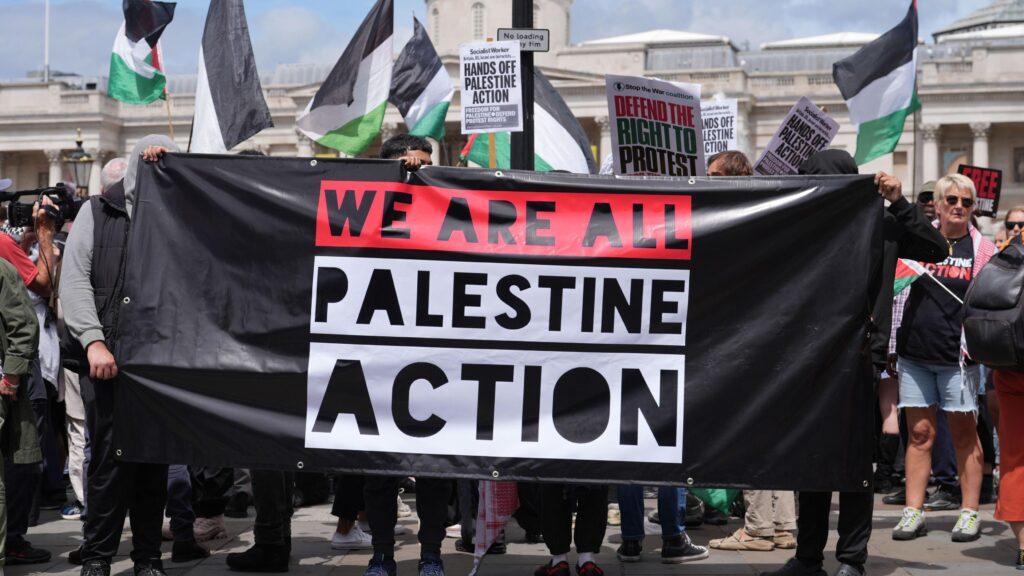

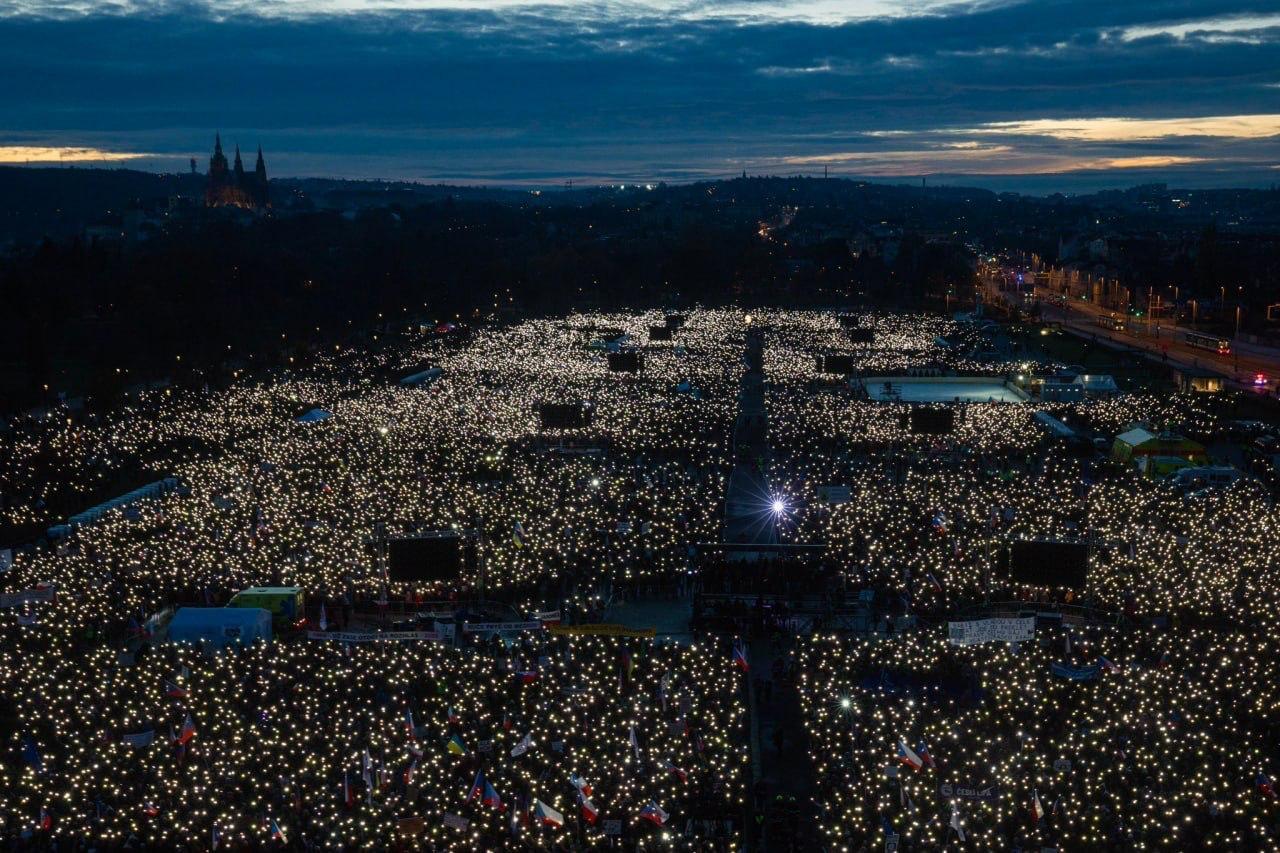
Hundreds of thousands of people gathered on Prague’s Letná Plain on Sunday, November 15 to protest against the government of Prime Minister Andrej Babiš in the largest Czech demonstration since the 1989 Velvet Revolution, which brought down Communist rule in Czechoslovakia.
Organisers estimated attendance at Sunday’s protests to be around 350,000-450,000. The immediate demand was the withdrawal of legislation which would see television and radio funding come under government control.
The motion, put forward for a vote at 4:36 on October 24, would abolish television and radio licence fees and instead fund public broadcasters directly from the government budget.
Reuters has reported that Babiš’ government argues that they are “merely meeting a promise to lighten the financial burden on people”.
Protesters have pushed back against this, arguing that governments could use funding decisions to pressure journalists, punish critical reporting, and gradually weaken independent media.
Read more: Czech public media workers strike over funding reform amid fears for press freedom
Both the proposal itself and the way it was announced have drawn backlash from members of the public.
Lucie Hemrová, a 35-year-old resident of the Czechia’s Vysocina region who could not attend the protest but supports its aims, told EU Reports “the protests now are ignited by their voting in parliament because they planned a vote for 4:36 in the morning! Nobody knew, it was insane.”
In the country, she added, most citizens pay their television licence each month “to ensure that the government cannot squeeze money if the television channel does not mainly share their views”.
For Hemrová, the government’s claims that state funding would reduce the financial burden for low-income families who would ordinarily pay their television licences directly are a PR tactic, as the money “will still be paid from taxes and now be under full control of the government”.
“Just look at Slovakia, Poland or Hungary”
Concerns about Babiš’ government appear to extend well beyond the country’s media landscape, however.
Protesters and their supporters speaking to EU Reports also referred to social inequalities, sovereignty and defence concerns, and fears that Czechia will follow the paths of some of its neighbouring countries.
Tomáš Prajzler, a 46-year-old small business owner based near Prague who attended Sunday’s protest, drew on the media landscapes in the neighbouring nations to illustrate his concerns: “Just look at Slovakia, Poland, or Hungary, and you can see where it leads when governments try to dismantle public media.”
Students and staff from the Prague-based Film and TV School Academy of Performing Arts (FAMU), considered one of the oldest film schools in the world, also gave speeches during a demonstration at Náměstí Republiky, Prague’s historic square, on November 10.
Monika, a screenwriter and recent addition to FAMU’s teaching faculty, described her experience living in Poland under the Law and Justice (PiS) government.
“It all began on December 30, 2015. It wasn’t exactly at 4:30 am, but it was the day before New Year’s Eve. The Polish Sejm [lower house of Parliament] passed a law giving the government control over state television and radio. Over the next eight years, public media became a mouthpiece for the ruling party. It served not only to advance the party’s interests but also to attack its critics and smear anyone the government labelled an enemy,” she said in a speech.
“It seems that Andrej Babiš’ current government is following the same path as Orbán, Kaczyński, and Fico,” she added, referring to the former Hungarian Prime Minister Viktor Orbán, Sejm member Jarosław Kaczyński, and Slovakian Prime Minister Robert Fico.
“I do not want us to turn on Czech Television or Czech Radio in a year or two and find that they have become machines of propaganda, lies, and hatred. I don’t want us to be running away from the police at peaceful demonstrations and being afraid of them.”
Students take to the streets
Josef, a FAMU student who also spoke at Náměstí Republiky, shared his own concerns that “the student body is effectively losing the ability to influence the course of society in the future as a result of the weakening of the media.”
Meanwhile, Jakub, a PhD student and teacher at FAMU, revealed that as a screenwriter, he struggles economically with “about five jobs just to make ends meet” and is concerned that Czechia is in “the midst of an unprecedented information war.”
“Russia and other foreign powers are trying to undermine trust in our institutions through propaganda and disinformation. And what is our government doing? It wants to destroy public media–the only reliable infrastructure that protects us from this information war.”
Kristýna, a secretary in FAMU’s screenwriting department, told EU Reports that she and her colleagues “all took part in the AMU (FAMU’s parent academy) march from Mariánské Square to Czech Radio and on to Wenceslas Square during the strike” on November 3.
She described the first march as being very strong, with many young people marching throughout Prague.
“We picked up the Czech Radio employees at the main building, at the back entrance, because a Communist Party demonstration had been reported at the front entrance, probably to block our way. There, people were dancing and singing along to classic songs from Czech Television films; there was even a baking pan making the rounds with cake.”
She added that there was widespread support while the protest went on, with residents waving at protesters from their home’s windows, “including office workers and mothers with small children.”
However, students and young people seemed “very skeptical” that the protests would achieve anything, according to Kristýna. “I joined during the demonstrations against the first Babiš government but almost nothing happened. He really doesn’t care.”
An oligarch and his coalition partners
Other protesters speaking to EU Reports also voiced their concerns about Babiš himself, who ultimately rejected the protesters’ demands on November 15.
A Prague-based small property developer told EU Reports on condition of anonymity that Babiš is “an oligarch, one of the richest people in the country”, expressing concerns over the relationship between his business interests and political power.
Babiš has faced longstanding legal proceedings over the alleged fraudulent acquisition of approximately €2 million in EU subsidies in connection with the Stork’s Nest conference centre.
In June 2025, Prague’s High Court overturned an earlier acquittal and instructed the lower court to find the defendants guilty. But in March 2026, lawmakers voted against lifting Babiš’ parliamentary immunity, suspending proceedings against him.
Babiš denies wrongdoing and maintains that the case is politically motivated.
Separately, in September this year, the European Commission suspended certain subsidy payments to Agrofert, the conglomerate founded by Babiš, over concerns regarding a potential conflict of interest. Both Babiš and Agrofert maintain that the arrangements governing the company comply with legal requirements.
Nonetheless, these developments have damaged Babiš’ credibility in the country he governs. The property developer was also critical of the concentration of power within Babiš’ ANO party, describing its other parliamentarians as “only useful idiots”.
Having secured 80 of the Czech Chamber of Deputies’ 200 seats in the October 2025 parliamentary elections, Babiš, who had also served as PM from 2017 to 2021 and finance minister from 2014 to 2017, formed a coalition with two junior partners, SPD and Motoristé.
Although the two parties hold only 28 parliamentary seats between them, Babiš depends on their support to govern, giving them political leverage that their critics have accused them of exploiting to push Babiš’ government further to the right.
For Hemrová, the coalition has worsened matters considerably for the Czechia’s democratic processes. “I’ve hated Babis and his party for a long time, basically since they started. But now with SPD and Motoristé in coalition it is a nightmare.”
She described Babiš as “a populist” who “steals and uses power to get more money”, but SPD and Motoristé as “the real right wing, against EU, NATO, pro Russia.”
Defence fears and a familiar fight
Fears also extend to national security. Apart from a handful of staff officers, Czech troops are not taking part in Koalicja 26.2, a UK- and French-led exercise in Poland where 11 European armies are training to help secure Ukraine after the war.
SPD leader and Chamber speaker Tomio Okamura said the coalition had agreed Czech soldiers would not train in support of Ukraine, a decision President Petr Pavel criticised. Hemrová summed up the government’s logic as: “we want peace, so why learn to fight?”
The property developer shared this concern. “There are almost certainly government parties and people who are directly or indirectly funded by Russia. They openly repeat Russian propaganda every day. Our current Minister of Defense is a guy from the party which pretty much reposts and repeats Russian propaganda word by word with ridiculous claims.”
He wants those outside of Czechia to understand that public TV correctly reports and calls out these claims, which is why, in his view, the government is openly attacking and seeking to control what will be broadcast going forward. “Pretty much turning it into Russian state TV.”
Sunday’s protests may have been triggered by proposed changes to media funding, but many who took part shared a conviction that independent media is vital to uphold not only free speech but a free society.
Prajzler emphasised that protests transcend media financing, and that what stands out most to him in current Czech affairs is “what is currently happening at the Ministry of Defense, where SPD people are actively trying to undermine our defense capabilities.”
Having taken part in several protests during the first and second Babis administrations, Prajzler sees being active to protect democracy as his “civic duty.”
The current dispute over public broadcasting is not without precedent in the Czech Republic. In January 2001, an estimated 100,000 people gathered in Prague’s Wenceslas Square in support of Czech Television journalists protesting against the appointment of Jiří Hodač as director-general amid concerns over political interference.
The demonstrations were followed by Hodač’s resignation and subsequent changes to the legislation governing public television.
Sunday’s demonstration took place just two days before the 37th anniversary of the Velvet Revolution. In November 1989, when thousands gathered on the same Letná Plain to demand political reform, free elections, and an end to Communist rule in Czechoslovakia, one of their demands was also an end to media censorship.
Featured image: Siegfri41835106 via x