


Dublin, Ireland – Several commercial flights in Poland, Spain, Italy, and Bulgaria were affected on Tuesday, November 3, after anonymous warnings about explosives on board.
The Panama-flagged cruise ship Crown Iris was also targeted this Tuesday by a bomb threat while sailing from Athens, Greece, to Haifa, Israel.
Carrying more than 900 passengers and 500 crew members, the ship was forced to change its route to the port of Syros, where coast guard officers and detection dogs were deployed. Authorities later confirmed that it was also a false alarm.
According to the Greek news agency ANA-MPA, the Coast Guard confirmed that an unidentified caller contacted the cruise’s captain via radio, signaling that an explosive device was placed on the ship’s hull.
At least two flights to Warsaw, two to Sofia, two to Rome, and one to Murcia Airport were severely affected. The Guardian later revealed that following thorough inspection by authorities, all threats were ruled out.
Yet, the situation led to airport closures, evacuations, and other disruptions, with no injuries reported.
The affected flights
Although no hacker group has claimed responsibility for the false alerts, the incidents highlight a growing wave of cyber disruptions.
In recent hours, digital attacks have moved beyond commercial aviation, affecting not only airline operations but even smart home appliances like connected refrigerators.
Tuesday’s threats originated from points within Europe and were directed toward other countries in the region, disrupting operations across numerous European airports.
Poland
In Poland, a LOT Polish Airlines flight traveling from London Heathrow Airport to Warsaw Chopin Airport was diverted to Warsaw Modlin Airport following a bomb threat.
The plane had around 180 people on board and landed safely at Modlin at 10:01 a.m., seven minutes after the alert was issued. Authorities temporarily closed the airport to inspect the aircraft, and passengers were later transported by bus to Chopin Airport.
Another Scandinavian Airlines flight from Copenhagen received a similar threat.
“We inform you that at 12:21 the bomb alert was canceled. After the completion of the relevant services, Warsaw Modlin Airport returned to normal operation (…) the incident affected the implementation of air operations,” the airport stated in a press release after confirming the emergency.
Spain
In Spain, the Región de Murcia International Airport halted operations for nearly two hours following a bomb threat on a Ryanair flight from Manchester.
The aircraft, carrying around 120 passengers and crew members, landed and was parked in an isolated area of the airfield. The Spanish government delegate in Murcia, Francisco Lucas, confirmed the incident on X, stating that security protocols were activated following the alert.
“The 114 passengers and seven crew members have disembarked and are undergoing security checks,” he said.
Because of the disruption, a flight arriving from Gran Canaria also had to change its destination to Alicante.
Bulgaria
In Bulgaria, Chief Secretary of the Interior Ministry Lyubomir Nikolov confirmed to local media, including Bulgarian National Radio (BNR), that two flights arriving in Sofia were targeted with false email threats.
The alerts affected a Wizz Air flight from Bergamo, Italy, with around 170 passengers and a Ryanair flight from Dublin, Ireland, with around 190 passengers on board.
Italy
In Italy, the situation escalated at Rome Fiumicino Airport after two incoming Ryanair flights, one from Lisbon, Portugal, and the other from Dublin, Ireland, were victims of similar warnings.
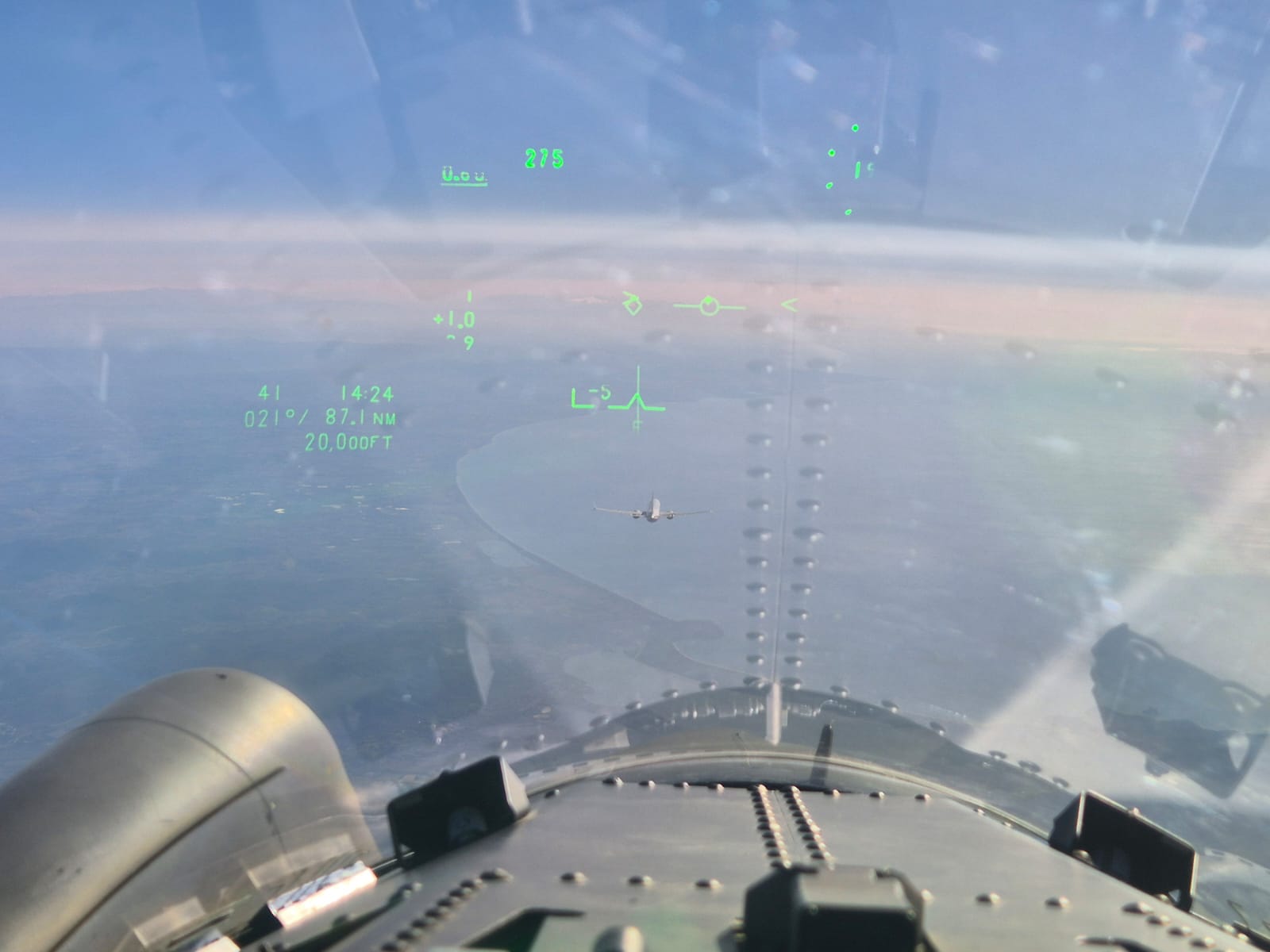
The flight coming from Dublin was escorted by Italian Air Force fighter jets as a precautionary measure, and emergency protocols were activated. Italian authorities also later confirmed the false alarms.
Featured image: via Naomi O’Leary on X