
Pope Leo’s 12-day journey through Uruguay, Argentina and Peru this month filled the streets with millions and took nearly every headline. But the Pope was not the only traveller from Europe’s smallest state to cross the Atlantic this year.
From Guatemala City and Mexico City to the floor of the UN General Assembly and a dinner in Manhattan, the Pope’s Secretary of State, his envoys and the lay institutions he charters carried the Holy See’s agenda through the Americas.
Taken together, they show how a state of about 44 hectares inside Rome keeps one of the widest footprints in the Western Hemisphere.
A city-state with a hemispheric reach
Vatican City is Europe’s smallest country, with a few hundred residents. Its reach comes from the Holy See, the Church’s central government and a sovereign subject of international law.
The Holy See sends nuncios, signs treaties and sits as a permanent observer at the United Nations.
That machinery points naturally toward the Americas. Latin America is home to around 40% of the world’s 1.42 billion Catholics, according to Foreign Policy.
Parolin’s summer: Guatemala and Mexico
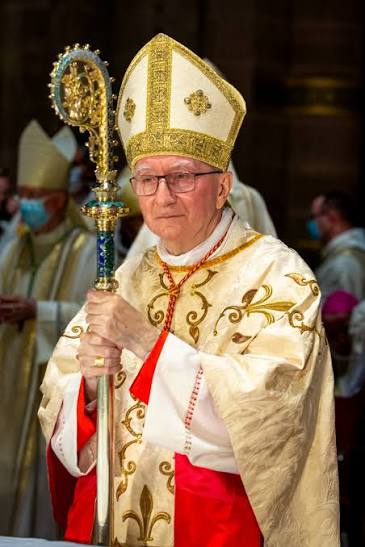
The Holy See’s busiest traveller to the Americas this year was not the Pope but his Secretary of State, Cardinal Pietro Parolin. From 1 to 4 August he was in Guatemala to mark 90 years of diplomatic relations with the Holy See. He celebrated Mass in the capital’s cathedral and addressed a national gathering of clergy. The trip also helped prepare a beatification held there in November.
He then flew to Mexico for 4–6 August. At the National Palace, President Claudia Sheinbaum renewed her invitation for Pope Leo to visit, and Parolin told her the Pope “is very eager to come.”
Mexico’s bishops said the visit had rekindled their hopes.
New York in September: the UN and the Pro Pontifice dinner
Parolin returned to the Americas from September 20th to 26th to lead the Holy See’s delegation to the 81st UN General Assembly. On September 21st, the feast of St Matthew, he said Mass at the Church of Our Saviour in Manhattan. He was joined by Archbishop Christophe-Zakhia El-Kassis, the Holy See’s new permanent observer to the UN.
His week was full. He spoke at high-level meetings on artificial intelligence and the right to development, and on pandemic preparedness, where he called universal health care a moral imperative.
Later in September he addressed the General Debate. He urged an end to wars, respect for international law and the responsible use of AI, and he warned that self-defence does not justify an arms race.
Catholic social teaching meets the technology of money
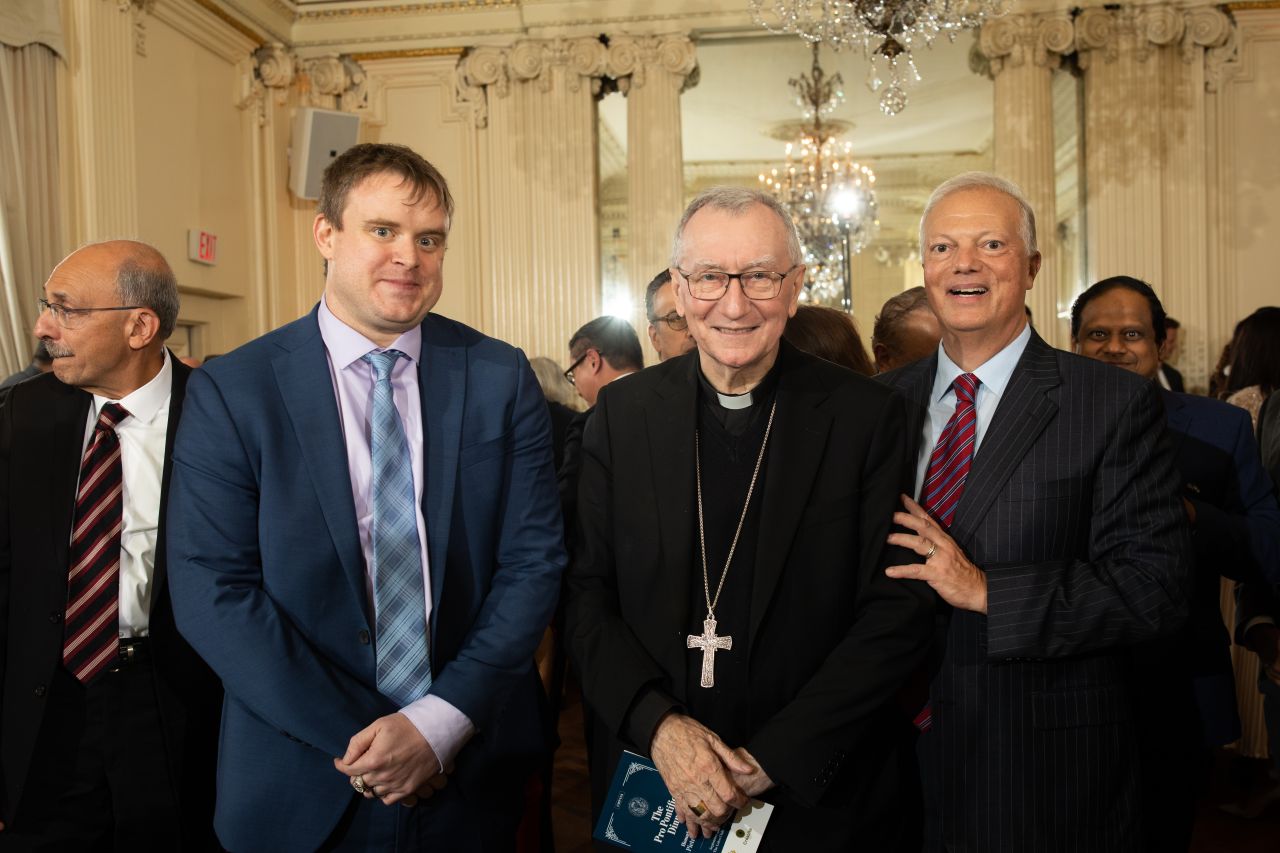
The night before, Parolin was guest of honour at the Pro Pontifice dinner of CAPP-USA. CAPP-USA is the American arm of the Centesimus Annus Pro Pontifice Foundation, which St John Paul II established in 1993 to spread the Church’s social teaching. The parent foundation is incorporated in Vatican City State, which makes the dinner a small export of Europe’s smallest country.
At The Lotos Club, Parolin told guests that the world’s fragmentation is rooted not in technology, freedom or diversity. Its root, he said, is a lost common understanding of what a human person is. Citing Pope Leo’s encyclical Magnifica Humanitas, he said dignity belongs to people, not to systems or algorithms.
Guests included US Ambassador to the UN Mike Waltz and Knights of Columbus Supreme Knight Patrick Kelly, and Archbishop El-Kassis gave the benediction.
The evening’s presenting sponsor was Crescite, a Tennessee-based, faith-based digital-asset company led by CEO Eddie Cullen, formerly director of Fordham University’s incubator program, and chairman Karl Kilb.
Crescite argues that the core principles of Catholic social teaching should guide how digital assets are designed and governed: human dignity, the common good, solidarity and care for the poor. Its questions are practical ones that matter across Latin America. Can a parent working abroad send money home for less? Can a small business find capital?
A martyr beatified while the Pope was in Uruguay
On 7 November, a day after Pope Leo landed in Montevideo, another papal mission was under way more than 6,000 kilometres away. Cardinal José Francisco Robles Ortega, Archbishop of Guadalajara, presided as the Pope’s delegate at the beatification of Fray Augusto Rafael Ramírez Monasterio near Antigua, Guatemala.
The Franciscan friar was killed on 7 November 1983, during Guatemala’s civil war, after refusing to break the seal of confession. He is the first Guatemalan priest raised to the altars. Pope Leo approved the decree recognising his martyrdom in January.
That same morning, Cardinal Marcello Semeraro, who heads the Vatican’s Dicastery for the Causes of Saints, beatified 80 martyrs in Santander, Spain. On one Saturday, Rome’s calendar ran on both sides of the Atlantic at once.
A small state, a long reach
More visits are being lined up. In October, Archbishop Paul Gallagher, the Vatican’s foreign minister, said a papal visit to the United States was “very likely” in the not-too-distant future, with the timing shaped by the US election cycle. The Holy See had already ruled out a US trip this year, and Mexico’s invitation remains open.
For Europe, the lesson is one of scale. Europe’s smallest state works across a whole hemisphere through a cardinal’s diplomatic calendar, a papal delegate at a martyr’s beatification and a Vatican-chartered foundation at a New York dinner. Pope Leo’s trip was the most visible part of that work. Most of the rest goes on in places the cameras rarely reach.
Article’s featured photo: Eddie Cullen, Cardinal Pietro Parolin and Karl Kilb