
Around 40 international delegations including European Commission President Ursula von der Leyen travelled to Budapest on Friday, October 23 to mark 70 years since the 1956 Hungarian Revolution, in a visit that signals a new chapter in Hungary’s relationship with the EU after years of political tension.
The programme featured ceremonies at Hungary’s Parliament, speeches, remembrance of the victims and a gala performance at the Hungarian State Opera.
Von der Leyen particularly paid tribute to the revolutionaries, praising their fight for freedom, democracy and justice as values that remain at the heart of Europe today.
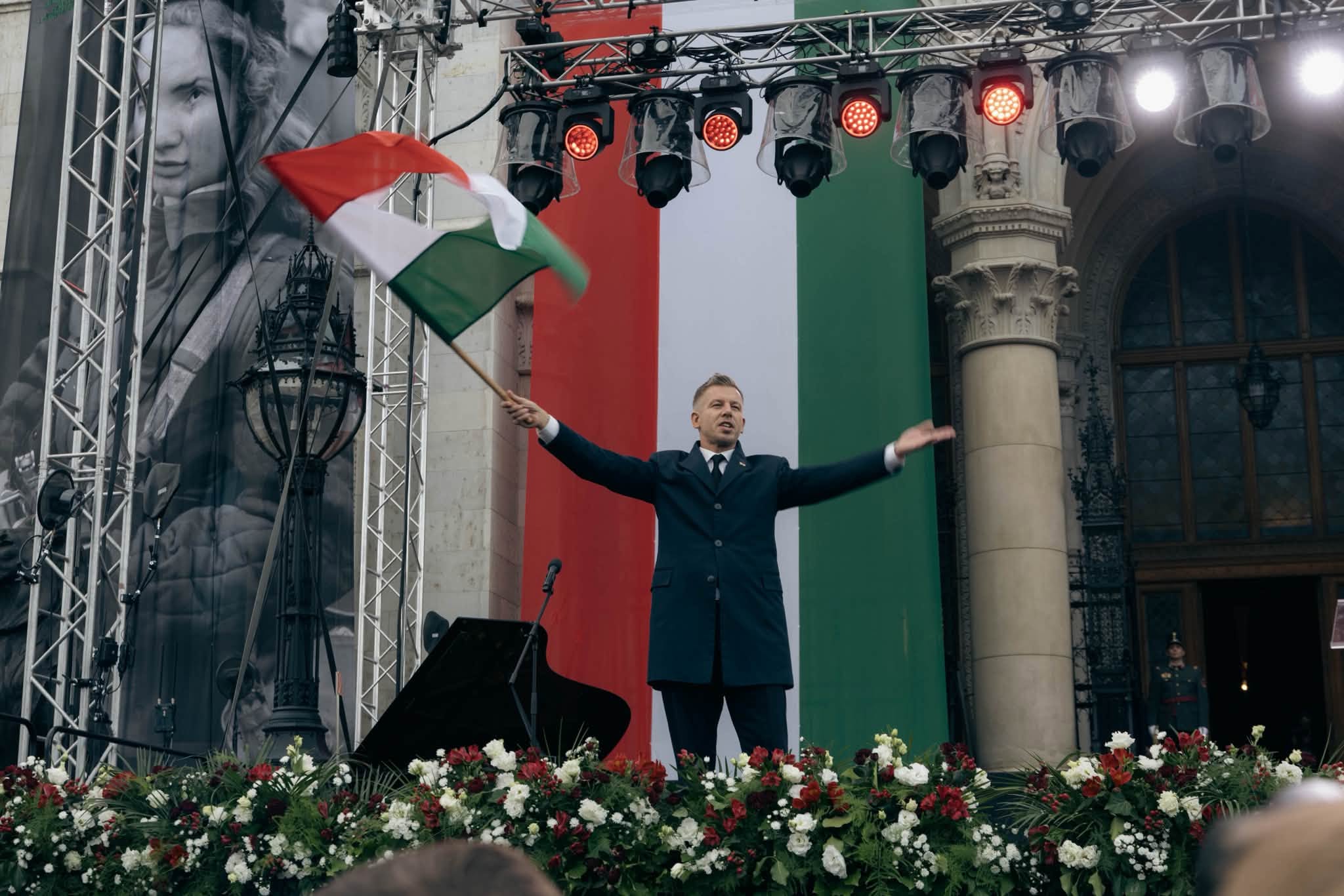
Prime Minister Péter Magyar began the day by laying flowers at the graves of Hungarians killed during the uprising, before attending a ceremonial flag-raising in Budapest’s historic Kossuth Square.
The flag in question, a symbol of the Revolution, bears a hole where protesters cut the Rákosi coat of arms, the communist state’s official emblem, from the national tricolour in defiance of its authority.
Norway’s finance minister and former NATO Secretary-General Jens Stoltenberg made commemorative remarks and invoked a personal connection: his parents travelled to the Austrian-Hungarian border in 1956 to help refugees escaping the Soviet crackdown. “My parents told me when I was a child about the bravery of the Hungarian people,” he recalled.
On October 22, Magyar announced that his government plans to establish a museum dedicated to the 1956 revolution to create a “worthy sanctuary” to remember the revolutionaries’ courage and their fight.
A change in government has prompted warmer Hungary-EU relations
The commemoration comes amid thawing relations between Hungary and the European Union, which were strained under Viktor Orbán’s rule due to frequent clashes over democratic standards, judicial independence, corruption and relations with Russia.
In April 2026, Magyar’s centre-right and pro-European Tisza party defeated Viktor Orbán’s Fidesz party, ending Orbán’s 16 years in power.
Magyar’s government has since moved to repair relations with the EU, including taking steps to strengthen judicial independence and tackle corruption. It has also sought closer relations with Ukraine and formally identified Russia as a security threat.
Following these reforms, the EU agreed to unlock €16.4 billion in previously frozen funding and lifted restrictions affecting Hungarian universities’ participation in Erasmus+ and Horizon Europe.
The 1956 Hungarian Revolution
On October 23, 1956, Hungarians rose up against their Soviet-backed communist government.
What began as students adopting sixteen demands related to political freedom and working and living conditions soon snowballed into a nationwide protest which quickly gained momentum.
But on November 4, Soviet forces invaded Budapest and crushed the uprising. Thousands of protesters were killed and around 200,000 Hungarians fled the country, which remained under Soviet rule until 1989.
Nonetheless, the 1956 Hungarian Revolution took on international significance as one of the first major popular uprisings against Soviet control in Eastern Europe during the Cold War.
Featured image: Péter Magyar via X