
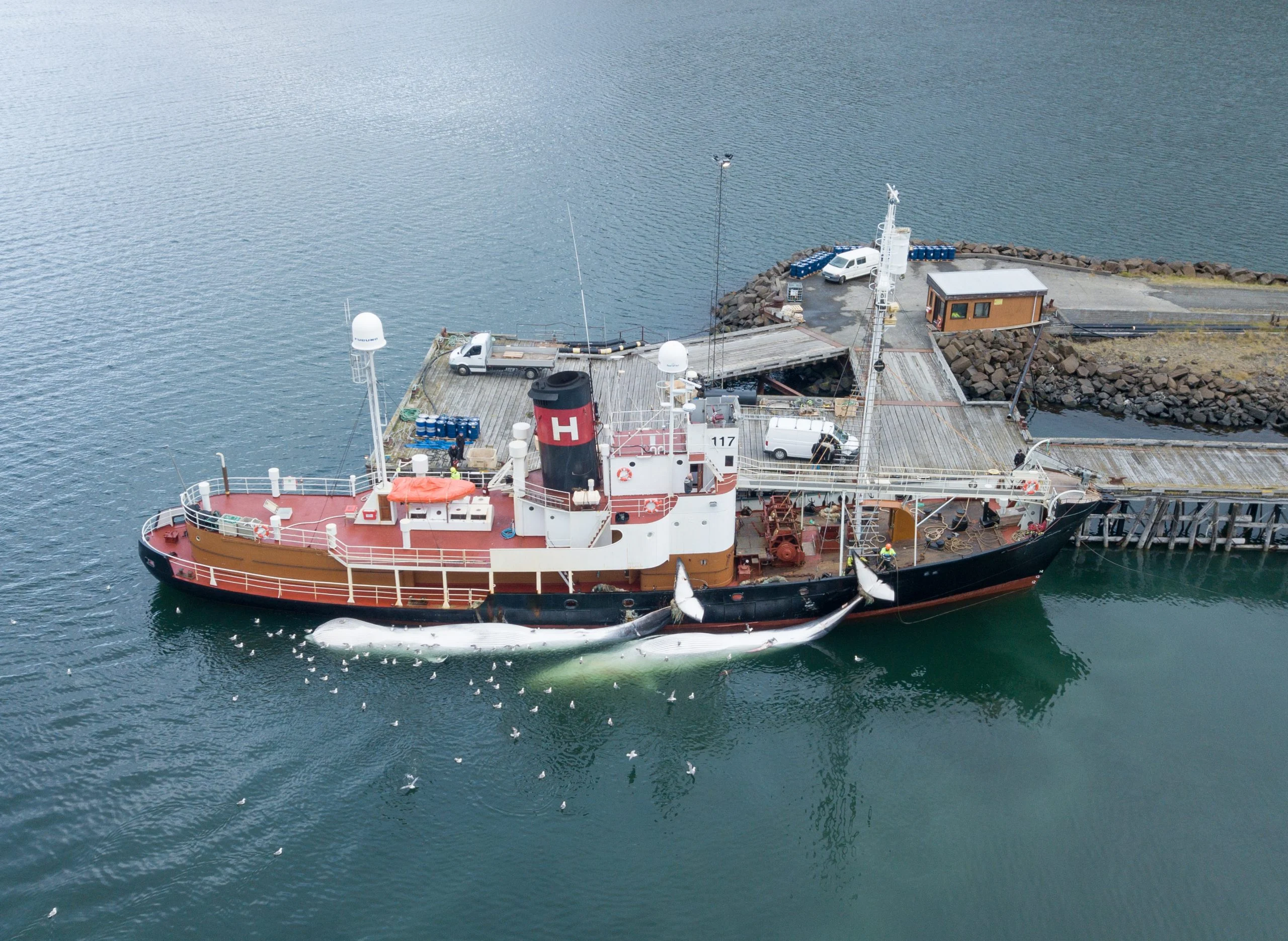

Iceland is set to ban commercial whaling, following an announcement by the government that it will be putting forward a bill outlawing the practice in 2027.
Commercial whale hunting in Iceland restarted earlier this summer, after having been placed on hold over 2024 and 2025. The island-nation in the North Atlantic is currently one of only three nations in the world which still allow the practice, alongside Norway and Japan, in defiance of a global moratorium by the International Whaling Commission that has been in place for the past four decades.
The bill being proposed by the Icelandic government will be voted on in February of 2027, with Iceland’s Althing (Parliament) to consider whether a permanent ban should be implemented, as well as “the constitutional issues that need to be considered in this regard, including with regard to freedom of employment and property rights.”
Icelandic Minister of Industry and Trade Hanna Katrín Friðriksson had previously described the practice as outdated, stating: “My vision is that we stop this hunting. There is no market for this fishery, there is a lot of conflict and this is something that is a child of its time.”
The impact of whaling
As many as 80 Fin whales – a species listed as vulnerable by the International Union for Conservation of Nature – have so far been caught and killed by Iceland’s sole whaling company, Hvalur, which has a quota of up to 150 kills by the end of September.
Animal rights campaigners have welcomed this step by the Icelandic government, adding that a ban of the practice cannot come soon enough.
Elisa Allen, vice president of programmes at PETA, has noted that whales are complex, social animals, which can take hours to die after being blasted with exploding harpoons.
“Most of the world long ago rejected this barbarism, recognising that tradition can never justify cruelty,” Allen told EU Reports. “It’s time now for Iceland to send a powerful message to Norway and Japan that this practice belongs in the history books, not our oceans.”
Wendy Higgins, director of international media at global nonprofit Humane World for Animals, further emphasized the level of suffering caused to the animals involved.
“In this year’s hunt, we have continued to see whales subjected to protracted and painful deaths, with one whale taking 31 minutes to die,” Higgins told EU Reports.
“We have also continued to see pregnant females killed, and their dead babies cut from their carcasses at the whaling station. Whales are highly intelligent, socially complex mammals who rely on multigenerational bonds. Commercial whaling severely disrupts these communities.”
Higgins also emphasized the effect such a ban by Iceland could have on Norway and Japan.
“If Iceland does ban whaling, that will make Japan and Norway even more isolated than they already are,” she added. “I do think that a ban in Iceland, and the international applause that will inevitably create, could have an impact on public awareness and opinion within Japan, which is already shifting away from support for whaling.”
The Humane World for Animals leader stressed that, like Japan, whaling company CEO Loftsson in Iceland has tried to “play the culture card” to justify the practice.
“People in Iceland don’t welcome too much outside interference, so if a country like Iceland, with similar narratives around culture and national pride, chooses to end whaling and begin a new era of whale protection, that will be hard for the Japanese public to dismiss.”
Public opinion and consumer demand in Norway have been declining. A July 2026 report by Whale and Dolphin Conservation (WDC) found that only about 1% of Norwegians eat whale meat regularly, with no respondents under 35 years old reporting regular consumption. What’s more: 73% of 18-24 year olds said they’d never eaten whale meat, up from 41% in 2019.
Attitudes toward the hunt are likewise shifting. The same poll found that more Norwegians supported joining international conservation agreements and ending whaling (36%) than opposed it (33%), with support highest among young people. 65% also said it was unacceptable for whales to not die instantly, and 64% objected to the killing of pregnant females.
“If Iceland ends whaling, that will massively increase public pressure on the Norwegian government, particularly among younger voters and future youth voters,” Higgins said.
Is a ban likely?
Whether the proposed bill will actually be voted into law remains uncertain, especially given the crucial role that the fishing industry played in Iceland’s recent referendum in which it rejected EU membership.
Read more: Iceland rejects EU membership in knife-edge vote
Whilst whaling itself makes up only a small part of this, with around 150 seasonal jobs based around the practice, the fishing industry as a whole remains a key part of Iceland’s economy, as well as of Icelanders ideas around national sovereignty.
Whaling had previously been a roadblock for Iceland when it had first entered into talks around EU membership, which ran from 2009 until discussion was frozen in 2013, and it was widely anticipated that the practice would have been forbidden had Iceland chosen to move forwards with joining the Union.
Higgins further points out that a ban on whaling is only part of the proposed bill, and that there remains a question about whether such a ban will include the government withdrawing existing whaling permits, as well as whether it could legally do so.
Currently, Hvalur’s permit for whaling, which was renewed in 2024, runs until 2029.
The company’s CEO, Kristján Loftsson, remains confident, noting that proposed bans on whaling had been put forward on numerous instances in previous decades – mostly recently, Parliament debated a similar bill in October 2023 – but these had all gone nowhere.
“I think we have good support for whaling in Iceland,” he told Reuters.
Others across the international whaling industry also remain belligerent, despite speculation as to how a ban in Iceland would affect the other countries involved.
“Iceland halting whaling would have no impact on Japan,” said Ken Kato, a Tokyo-based businessman. “Public opinion there has no meaning on the situation here; this is our culture, and nothing will change that.”
Featured image: via Whale and Dolphin Conservation