
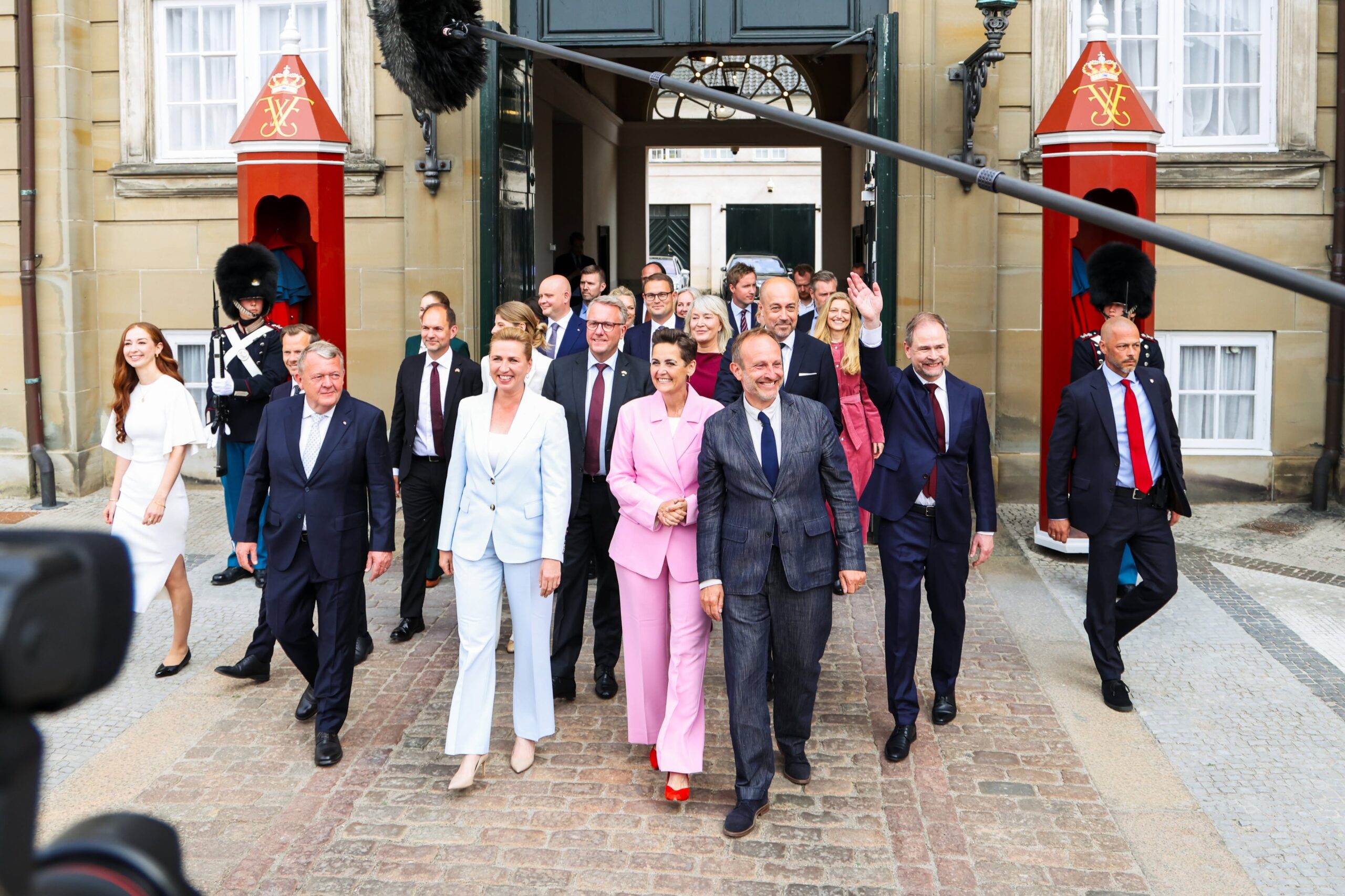

Danish Prime Minister Mette Frederiksen has successfully won a third term in office after bringing together a new governing coalition following the snap election on March 24.
This comes after more than two months of negotiations around a new governing coalition, whereby the governing Social Democrats (SD) emerged as the single largest party despite receiving their worst share of the vote since 1903.
Read more: Europe holds the line: Centrists back in a week of high-stakes votes
Coalition negotiations ran from March 25 to June 1 – the longest in the country’s history.
Whilst Frederiksen had remained as caretaker Prime Minister throughout, it had seemed as if she would be unlikely to stay in this position after Lars Løkke Rasmussen, leader of the centrist Moderates and widely regarded as the likely kingmaker, gave his backing to Troels Lund Poulsen, leader of the centre-right Venstre party.
Danish King Frederik X invited Poulsen on May 8 to take the lead in coalition talks, a move widely read as a rightward shift in Danish politics. But Poulsen too failed to unite the right-wing parties.
The far-right Danish People’s Party made its participation conditional on excluding the Moderates, and demanded radical policy commitments including “measures that will lead to Muslim net emigration from Denmark.”
Read more: Denmark’s political deadlock breaks with its centre-left consensus
But late on June 1, it was confirmed that Frederiksen would indeed be leading a new four-party coalition comprising the SD, the Social Liberals, the Green Left and the Moderates.
In a statement, the Danish Royal Household announced that Frederiksen had spoken with the King and had reached agreements with parties from across the left.
“I have been to see his majesty the King and announced that a government can be formed after long negotiations,” Frederiksen confirmed to reporters afterwards.
The new coalition has pledged to halve VAT on food, abolish the highest tax bracket, increase defence spending, and play a more active role in Europe: “We are no longer on the periphery of European cooperation. Denmark is now a core European country.”
They have also pledged free dental care, tougher environmental regulations, and EU-level regulations of tech giants, “including action against addictive design, a European age limit for social media and higher tax contributions from large tech firms.”
The cabinet will include kingmaker Rasmussen, who will continue in his role as foreign minister.
Whilst a government has now been formed, some have speculated on whether it will survive a full term given such lengthy negotiations.
Poulsen has offered his congratulations to the incoming government. “Of course, I would have preferred a blue government over a red one, but on behalf of the country, it is positive that we now have a government that can help make the necessary decisions,” he said on X.
“In Venstre, we are of course ready as a constructive and critical opposition,” he added. “I and Venstre will do our part to ensure that Denmark continues to grow richer, so that we can actually afford real investments in our competitiveness, welfare, and security.”
Featured image: New Danish government coalition
Source: Mette Frederiksen via Facebook