
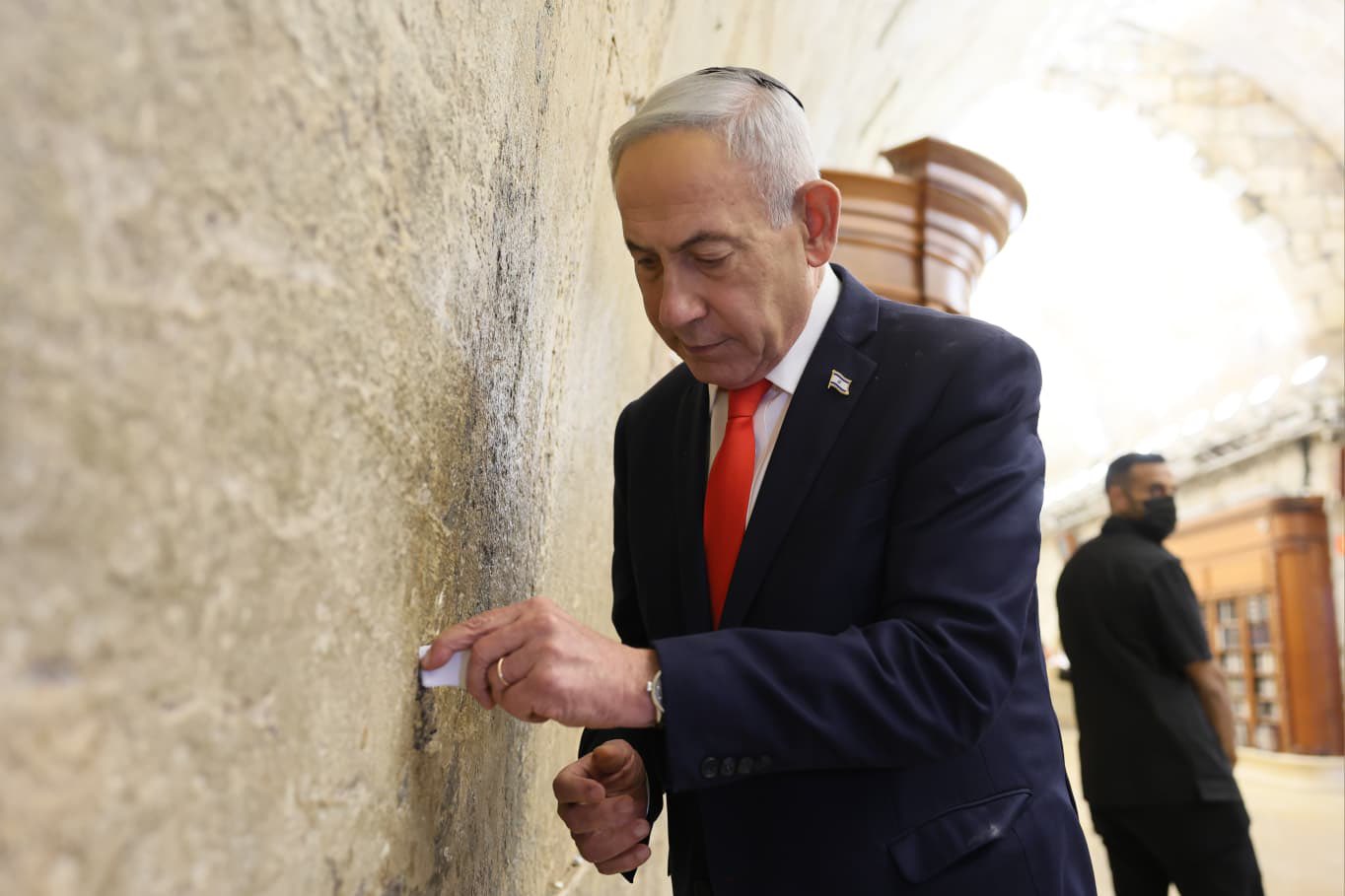

Israel’s election produced no clear winner, opening what could be weeks of coalition negotiations and raising a pressing question for Europe: could a change in leadership repair relations strained by the war in Gaza?
Prime Minister Benjamin Netanyahu’s Likud party and its allies won 53 seats in the Knesset, while the opposition led by former military chief Gadi Eisenkot earned 48. Neither bloc reached the 61 of 120 seats needed to form a government.
The big surprise was the rise of the Arab parties, which won 19 seats and could now decide who governs.
One day after the vote, the European Union said it was ready to work with the next government on the basis of a longstanding relationship and commitment to democratic principles. Analysts, however, expect a post-Netanyahu government to change Israel’s tone towards Europe more than its policies.
“Netanyahu is not winning. Nobody is winning,” said Roie Yellinek, CEO of Geopolitics Lab, a political consultancy based in Jerusalem, while in conversation with EU Reports.
While Likud remains the biggest political party in numbers, that does not guarantee Netanyahu the premiership, as he will likely need to form coalitions to do so. On the other hand, the opposition led by Gadi Eisenkot, a former military chief who lost a son during the war in Gaza, would also face an obstacle to form a coalition, especially due to the resistance in cooperating with Arab parties.
“The Arab parties are going to be the kingmakers. […] If they decide not to support anyone, we will probably end up having another election,” Nathan Klabin, a journalist and geopolitical analyst based in Israel, told EU Reports.
Before the elections even started, expectations were high towards the opposition, which was hopeful it could bring a different face to Israeli politics. Although Eisenkot represents a change in names and politics, his policies would largely remain the same; he criticizes the violence towards Palestinian people in the West Bank during the Netanyahu administration, but also opposes the creation of a Palestinian State.
“Netanyahu represents a messianic right wing. He is associated with religious nationalist parties. […] Eisenkot represents a much more secular, much more pragmatic right wing,” Klabin stated.
Yellinek, on the other hand, believes that the changes will not be major even if Netanyahu is ousted. “It’s different in style and it’s different in approaches. […] The real differences will be minor.”
The stakes for Europe are increasingly considerable. The European Union is Israel´s biggest trading partner, with bilateral trade in goods reaching €43.3 billion in 2025, and accounting for 31.7% of Israel’s total trade.
Yet, views on Israel are far from uniform within the bloc, and that divide has become clearer as the war in Gaza has drawn heavy international criticism. Spain, Ireland and Slovenia called for the suspension of the EU-Israel Association Agreement in April, which forms the basis of political and trade relations between the two sides, citing allegations of violations of international law and possible war crimes in Gaza and Lebanon.
EU foreign ministers did not agree to the suspension.
Outside the EU, the UK—which is itself a historical Israel ally whose government issued the Balfour Declaration in 1917, establishing the groundwork for a Jewish homeland in Palestine—announced plans to ban imports of goods produced in illegal Israeli settlements in the occupied West Bank in September. The country also recognized the Palestinian State in 2025.
While the EU is open to dialogue, it remains unclear how willing Israel’s next government will be to change direction and make concessions, or whether the new prime minister can reset relations with the bloc.
“Netanyahu carries an enormous amount of political baggage. […] The mere fact that Netanyahu is no longer in power would make dialogue possible again, particularly because European leaders would no longer have to justify sitting down with him to their domestic audiences,” he said.
Yellinek agrees that Netanyahu has become an increasingly difficult partner for European governments, though it doesn’t necessarily mean that a new Israeli government would be more aligned with Europe’s positions.
As Israel enters what could be weeks of coalition negotiations, the question for European leaders is not simply who will replace Netanyahu, but whether his successor will be willing to change the policies that have brought relations to this point.
“The real thing is not going to change. Maybe, and I really hope so, the tone will be a little bit different,” Yellinek concluded.
Featured image: Benjamin Netanyahu via X