
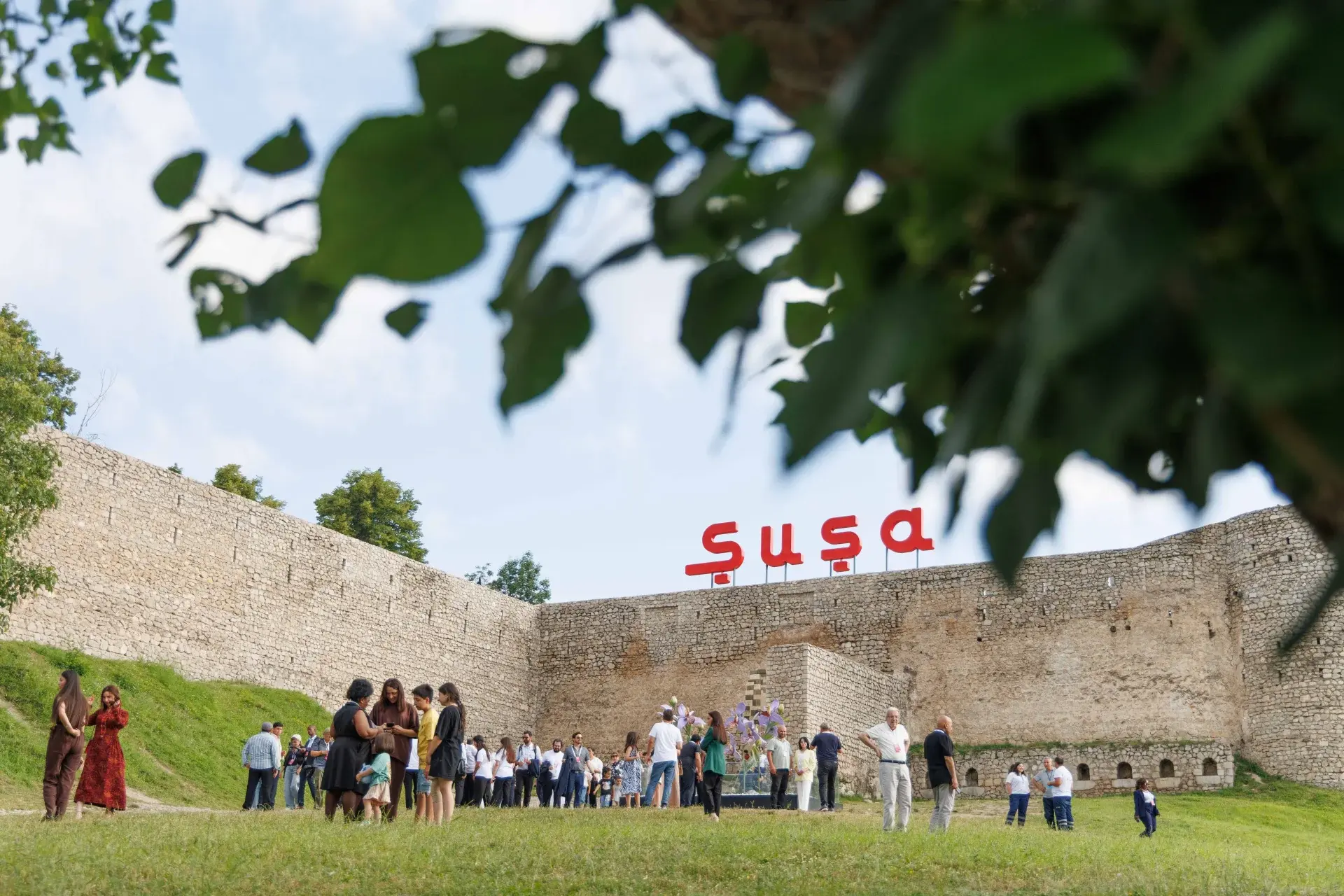
The road to Shusha, a strategic city located in the mountainous Upper Karabakh region, tells Azerbaijan’s recent history better than any official speech.
While soldiers still watch over the surrounding mountains that serve as a natural limit with its neighbour, entire neighborhoods remain empty while de-mining operations continue after decades of conflict.
Yet just a few kilometers away from these ghosts of war, cranes dominate the skyline as the region welcomes international visitors to restored landmarks that, until recently, stood at the heart of one of the South Caucasus’ longest-running territorial disputes.
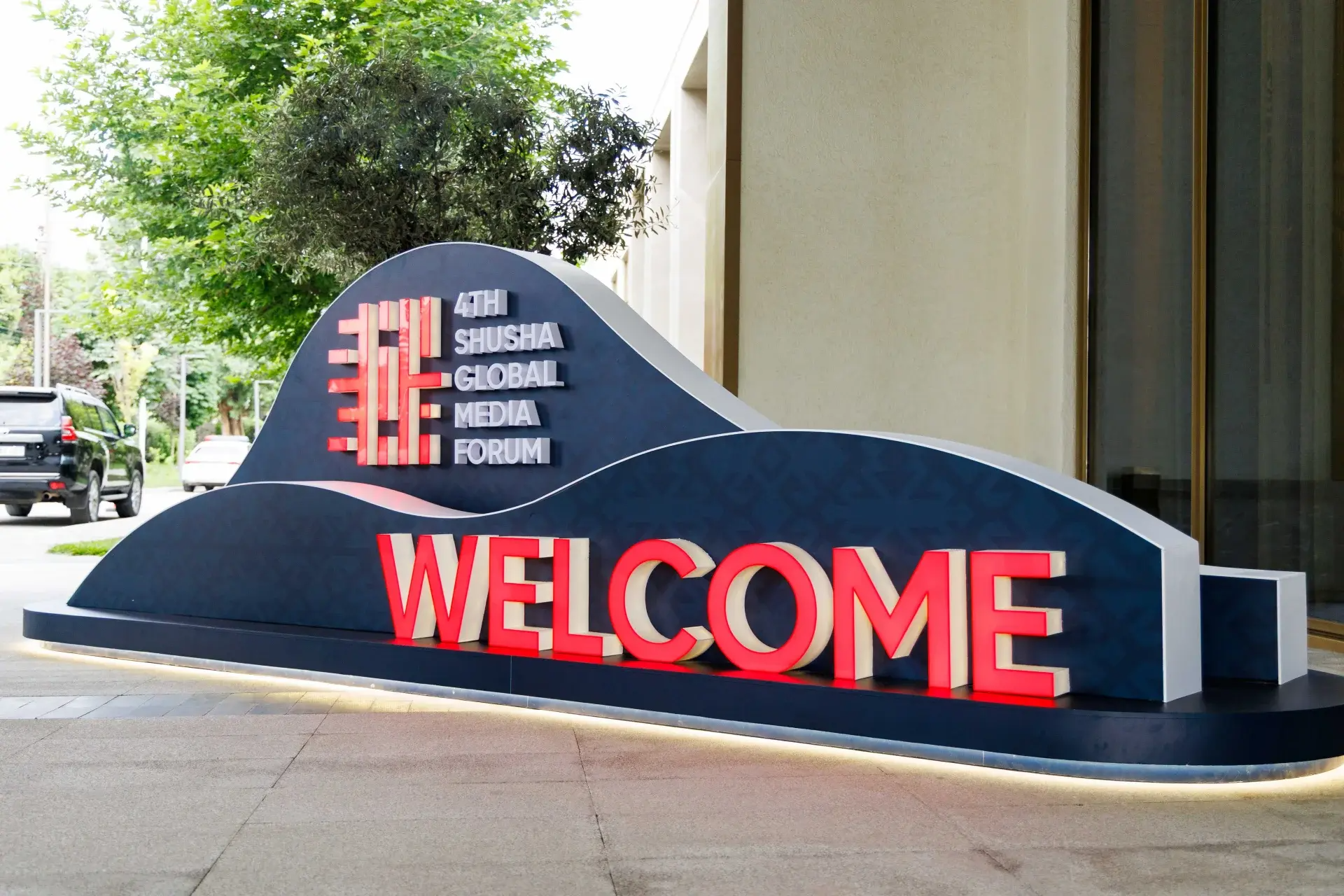
That contrast framed this year’s Shusha Global Media Forum, where more than 140 journalists, editors, media executives and policy experts from over 50 countries gathered to debate artificial intelligence, misinformation and the future of journalism.
Beneath the official agenda, however, another story unfolded: Azerbaijan’s push to position itself as a hub for diplomacy, connectivity and international dialogue, in an intent to leave behind nearly four decades of conflict.
Shusha: From imperial territorial dispute to international hub
Located in the Caucasus Mountains, the small resort town of Shusha sits at one of Eurasia’s most vital strategic crossroads, bordered by Russia to the north, Iran to the south and Turkey to the west.
For centuries, the peoples of the region found themselves caught between competing empires – the Persian, Ottoman and Russian – each seeking control over a corridor between the Black and Caspian seas linking Europe, the Middle East and Asia.
The Soviet Union was the last imperial power to dominate the region.
Although Azerbaijan, the first secular republic from the Muslim World, regained its independence in 1991, Soviet influence remains deeply embedded in everyday life. From language and cuisine to architecture and social customs, it creates a unique cultural synthesis that still shapes the country’s identity, particularly in the capital, Baku.
Another legacy of Soviet rule was the decades-long Nagorno-Karabakh conflict with neighboring Armenia, which ended with the peace agreement signed on August 8, 2025, at the White House in Washington D.C.
Negotiated by U.S. President Donald Trump, this historical understanding formalized the dissolution of the enclave following the last Azerbaijani military offensive, laying the groundwork for the reopening of the borders and mutual sovereignty recognition after almost forty years of war, distrust and cross accusations.
Read more: Armenia aligns with U.S. and EU; Russian disinformation threat looms ahead
Like the other cities from this mountainous region, Shusha still bears visible scars of war and displacement.
From the ancient walls of the Shusha Fortress, Azerbaijan’s national flag overlooks a landscape where abandoned buildings seem frozen in time while creating a strong contrast with the rapid reconstruction efforts in areas such as the Karabag Street, which leads to the famous Govhar Agha Mosque.
The geopolitical dimension
Given Azerbaijan’s strategic value and recent history, discussions at the forum inevitably took on a geopolitical bent, particularly during President Ilham Aliyev’s marathon question-and-answer session, confirmed only a day before the event.
For nearly four hours, Aliyev – who has been in power for more than two decades after succeeding his father, Heydar Aliyev – answered dozens of questions covering virtually every aspect of Azerbaijan’s foreign policy, from regional security and transport corridors to energy exports, relations with the European Union as well as the Global South.
Throughout the exchange, he repeatedly returned to Azerbaijan’s strategic geography.
“The situation in the Middle East now makes this corridor more attractive,” he said, referring to transport routes crossing the country that have gained renewed importance amid the wars in Iran and Ukraine.
Aliyev specifically referred to Azerbaijan’s increasing role in the provision of gas and oil to Europe, at a time when the country’s ties with institutions such as the Council of Europe are deteriorating.
He highlighted that Azerbaijan began supplying natural gas to Germany and Austria this year, expanding exports that already reach 16 countries through its pipeline network. Further growth, he argued, will depend on “long-term commitments” from European partners.
Referring to the military operation that restored Azerbaijani control over the Karabakh region, Aliyev concluded: “We stopped when we needed to stop. That is important.”
A swing state: Azerbaijan’s growing international relevance
Outside the formal sessions, another idea surfaced repeatedly in conversations with analysts attending the forum: Azerbaijan’s growing relevance not only in an increasingly contested Eurasian landscape but also in the global geopolitical arena amid the intensifying competition between great powers.
Speaking with EU Reports, Washington-based analyst Ken Moriyasu described Azerbaijan as one of eight Eurasian “swing states” whose strategic choices could increasingly shape competition among the United States, China and Russia.
Much like swing states in U.S. presidential elections, these middle powers including Armenia, Azerbaijan, Hungary, Kazakhstan, Mongolia, Pakistan, Turkey and Uzbekistan, sit along the main corridors linking Europe and Asia, many of them rich in natural gas, oil and critical minerals.
Viewed through that lens, the Shusha Global Media Forum appeared to be more than an annual conference on journalism.
As the bus to the Fuzuli Airport took a wrong turn through the roads of Karabakh –offering an unexpected final glimpse of abandoned villages, reconstruction sites, military checkpoints and curious, friendly locals surprised by the diverse delegation – the contrast that had defined the previous four days came into focus once again.
Featured image: Courtesy of Cecilia Degl’Innocenti