
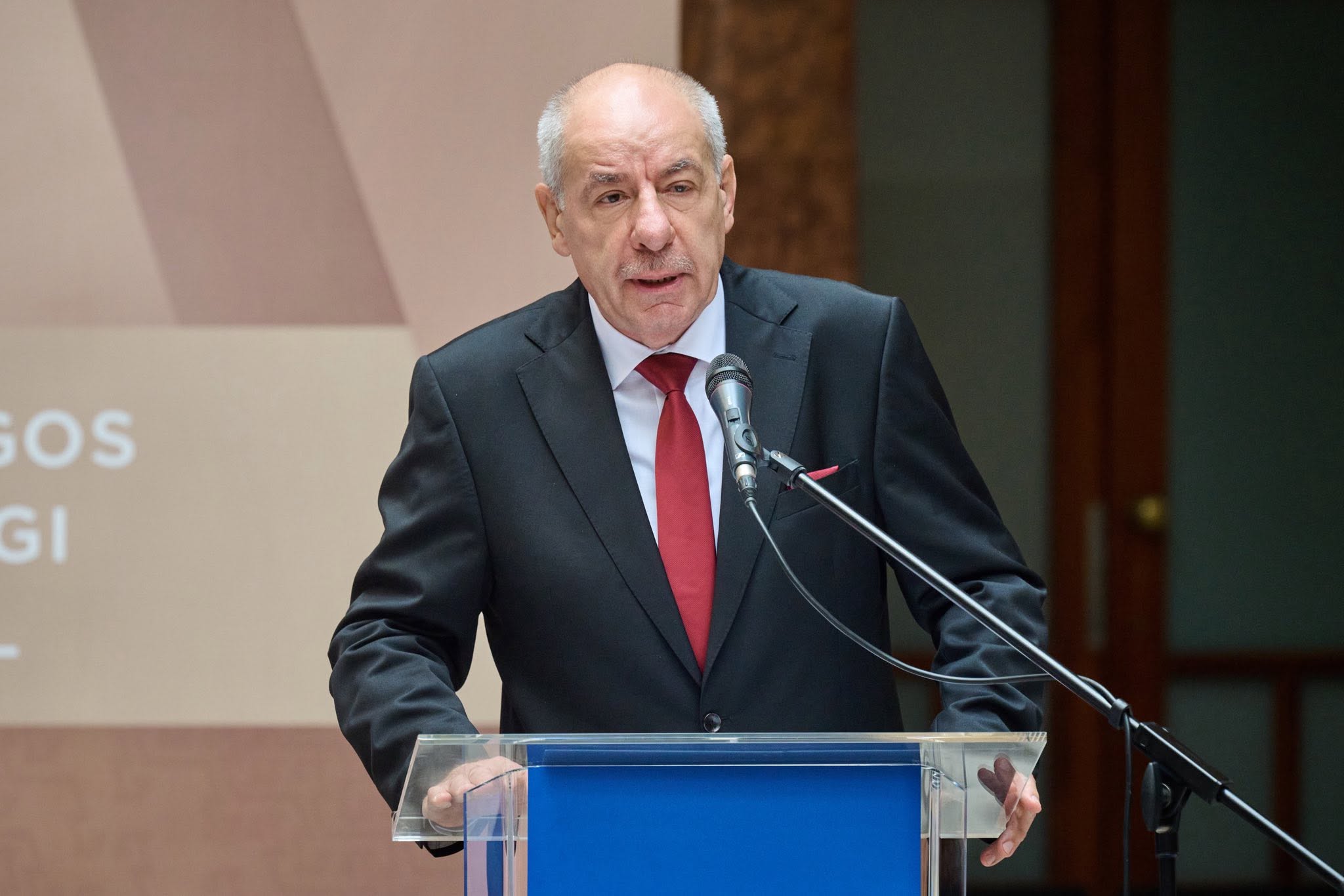

Hungarian President Tamás Sulyok has been removed from office following the passing of a constitutional amendment to strip him of his position earlier in July.
The amendment, which was passed by Hungary’s National Assembly on July 13, was put forward by Prime Minister Péter Magyar as part of an effort to dismantle the previous regime, led by Viktor Orbán.
Read more: Demonstrators protest attempted removal of Hungarian president
It passed with 139 Parliament members voting in favour, whilst just six voted against. Members of the far-right national conservative Fidesz party, led by Orbán, chose to boycott the vote.
Fidesz have described the motion as “the end of constitutional democracy and the beginning of tyranny in Hungary.” Human rights groups have also criticized the move, claiming that this rushing through of constitutional amendments was itself reminiscent of the Orbán regime.
Also included in the amendment were term limits for MPs, reforms to the judiciary, and measures to investigate corruption and financial abuses under Orbán, who served as prime minister from 2010 to 2026 consecutively.
Sulyok out
Sulyok, who was nominated by the Fidesz-KDNP bloc in 2024, had been accused by Magyar of facilitating the corruption and authoritarianism seen under Orbán, and of serving party interests rather than representing the nation as a whole.
There had been speculation as to whether the move would be contested by Sulyok, after the now-disgraced president argued that the amendment was “personalized legislation”, with no legal basis.
Ultimately, however, Sulyok, who occupies a mostly-ceremonial role, can only block parliamentary legislation by sending it to the Constitutional Court for review. Magyar claimed that any attempts to do this would merely be stalling for time and would be grounds for impeachment.
Following this, Sulyok agreed to sign the amendment into law on July 18, stating that he had no constitutional means to use against it. “[It] violates constitutional principles but was adopted by the Parliament, as the constitutional amending authority, in the framework of a lawful procedure,” he said.
“I am fulfilling my obligation under the Basic Law, after carefully considering my legal options and my conscience. My signature is the final seal of my obligations as President of the Republic.”
His term in office was then formally brought to an end on Monday, July 20.
Who is next?
Ágnes Forsthoffer, vice president of Magyar’s centre-right Tisza party, is to serve as acting president until a new election is held.
Magyar had initially nominated Jewish chess grandmaster Judit Polgár for the position of interim president, stating that she is someone who could provide unity for Hungarians, as someone whose name was synonymous “with talent and perseverance for decades.”
“Our country needs unity, peace and a president in whom every Hungarian can be proud,” he added. “The president’s duty is to serve and to represent every Hungarian. She is a Hungarian whose achievements inspire respect and admiration at home and across the world.”
Polgar is the only woman in the world’s top 10 chess players, and is the subject of the Netflix documentary, Queen of Chess.
Polgar turned the offer down the following day, however, stating: “I do not feel enough strength within me to take on the historic responsibility of uniting a divided nation.”
Among the others to have already expressed interest in the role are Gábor Iványi, a methodist pastor currently undergoing criminal proceedings, former judge Adrienn Laczó, Lutheran bishop Tamás Fabiny, and former prime ministerial candidate Péter Márki-Zay, who has previously gone on record saying that the presidency should be directly elected by the people.
“If there is such a thing, and if the people ask me to do so – the people may be you, or they may be someone else – then I will be very happy to represent you there one day,” Márki-Zay stated.
Currently, the president is elected by the members of the National Assembly rather than by the people directly. Candidates require the backing of one-fifth of members to be nominated, meaning that Tisza and Fidesz are the only two parties able to independently put forward a candidate.
However, Magyar has suggested that following this, the government will be seeking to bring into effect a new constitution, to be ratified by the people, that could include direct elections for the presidency.
As it stands, the next election by members of the National Assembly is expected to take place within 30 days of Sulyok leaving office. Hungary will have a new president in place by the end of August.
Featured image: Tamás Sulyok via Facebook