
A 10-year-old girl and a 14-year-old boy became the latest children brought home from Russian-occupied Kherson Oblast on July 8, returned through Ukraine’s Bring Kids Back UA initiative with the support of the charity Save Ukraine.
“They endured the fears of occupation, pressure, and uncertainty – things that should never be a part of childhood. Fortunately, they are now safe,” said the head of the Ukrainian Regional Military Administration in the southern city of Kherson via Telegram.
Since 2022, thousands of children from occupied territories have been deported to Russia or Russian-controlled areas. According to Ukrainian authorities and international investigators, many have been separated from their families and placed into a system of adoption, re-education and militarisation designed to weaken or erase their Ukrainian identity.
One of the regions most heavily affected is Kherson Oblast. Russian forces occupied much of the region in February 2022 before illegally annexing it later that year. And although a Ukrainian counteroffensive liberated the city of Kherson and the western bank of the Dnipro River in November 2022, large parts of the oblast remain under Russian occupation.
Earlier, on June 17, 13 children aged 3-17 were also returned from Russian-occupied areas of Kherson; some had been taught to dig trenches, handle firearms and throw grenades during their time under Russian control.
The adoption pipeline
Children separated from their parents and caretakers are subjected to adoption by Russian families and re-educated, according to a UN Human Rights Council (UN HRC) report. Given Russian citizenship and with no measures in place to facilitate their return, those with medical conditions are often left untreated, while indoctrination has been commonly reported.
One mother noted to the UN HRC that by the time of her child’s return, he had forgotten how to speak Ukrainian and said his favourite song was the Soviet Army song “The Soldier Walks the City”. Other children who spent time in Russian institutions post-deportation were told that Ukraine no longer exists.
“Once children are adopted, they can have their names, birth dates, and places of birth changed, effectively erasing their Ukrainian identity,” noted a Yale Humanitarian Research Lab spokesperson to EU Reports.
“Russia’s government developed a system, both legally and logistically, where ‘temporary guardianship’ becomes a pipeline for adoption.”
Meanwhile, the Office of the Parliamentary Commissioner for Human Rights of Ukraine, stressed to EU Reports that obtaining a Russian passport for teenagers is compulsory “as without it they cannot receive medical care, obtain certificates, or even move between cities.”
The true scale
The deportations extend far beyond Kherson Oblast. According to the latest figures shared by Ukrainian officials at a July 9 press conference, 20,610 children have been deported or forcibly transferred since the full-scale invasion began, although Moscow has alleged Ukrainian childrens’ “relocation” lies in evacuation programmes.
Independent researchers have identified more than 210 locations across Russia and Russian-occupied Ukraine where Ukrainian children have been taken, stretching from western regions to Siberia and the Russian Far East. Belarus has also been implicated, with investigations finding that Ukrainian children have been transferred to camps and institutions there.
Locating the children remains one of the greatest obstacles to securing their return. The UN Independent International Commission of Inquiry on Ukraine says Russia has failed to establish or share a registry of transferred children, making it extraordinarily difficult to determine their whereabouts.
The Commission submitted 39 written requests to Russian authorities for details on transfers and locations, and received no responses.
Re-education, militarisation, and indoctrination
Re-education, militarisation, and indoctrination are best understood not as isolated incidents, but as overlapping elements within a broader system of control reported by Ukrainian officials and international investigators in occupied territories.
Within occupied territories, education systems have been restructured under Russian federal standards. Subjects including Ukrainian language, literature, and history have been removed from curricula and “replaced with Russian analogues with a strongly propagandistic character,” the Parliamentary Commissioner’s office told EU Reports.
The Ukrainian language was formally removed from the federal education framework in December 2025.
Children have also been brought into state-aligned youth and paramilitary organisations. Movement of the First, modelled on the Soviet-era Young Pioneers, was created by the Kremlin in 2022 to instill children with “traditional Russian spiritual and moral values”; Yunarmiya, a separate organisation run by Russia’s Ministry of Defence, gives children explicitly militarised training.
More than 344,600 children in occupied territories, including Crimea, are involved in Movement of the First, with more than 44,000 members of Yunarmiya, as per the Commissioner’s office. In Crimea alone, the number of cadet classes increased 102-fold between 2015 and 2025, from 3 to 306.
The Commissioner’s office also described children being taken to camps in Russia under the guise of recreation.
“The United Russia party is taking children from the temporarily occupied Kherson region to Novorossiysk – thousands of children who are isolated from their families and subjected to propaganda of the Russian world.”
International and Ukrainian human rights bodies have furthermore documented allegations of abuse in institutional settings. The Commissioner’s office recorded among the violations in occupied territories “the rape of Ukrainian children by Russian military personnel”, though verification remains limited due to restricted access.
The identity erasure
The most persistent allegation is not only physical transfer, but administrative and cultural assimilation.
Russian citizenship has in many cases been issued to children in occupied territories through simplified procedures introduced after annexation. This creates dependency, where access to services becomes tied to Russian documentation.
The Commissioner’s office was direct about the long-term goal: “The policy of the Russian Federation in the temporarily occupied territories of Ukraine is a systemic state policy with signs of genocide aimed at destroying the Ukrainian nation through its children.”
Teenagers in occupied territories who express pro-Ukrainian views face serious legal consequences. Those who express a pro-Ukrainian stance on social media or refuse to sing the Russian anthem become subjected to fabricated criminal cases, including accusations of sabotage and extremism, the Commissioner’s office added.
What Europe is and isn’t doing
European Union member states and allied institutions have expanded sanctions targeting individuals and entities involved in child transfer and assimilation structures. On May 11, 2026, the EU imposed sanctions against 16 individuals and seven legal entities responsible for the systematic illegal deportation and forced assimilation of Ukrainian minors, including asset freezes and travel bans.
Politically, European governments have repeatedly called for the unconditional return of all Ukrainian children, supporting initiatives such as Bring Kids Back UA – launched by Ukrainian President Volodymyr Zelenskyy in 2023 – and the 49-member International Coalition for the Return of Ukrainian Children.
Beyond the region, Qatar has played a crucial intermediary role, with more than 100 children having been returned through Qatari mediation. The Commissioner’s office explained that Doha stepped in precisely because “diplomatic relations between Ukraine and the Russian Federation have been severed.”
However, implementation remains constrained by limited access to occupied territories, lack of cooperation from Russian authorities, and fragmented verification systems: arrest warrants have been issued, sanctions have been imposed, and investigations continue.
But the core structural problem remains unchanged. “The longer children remain isolated from the Ukrainian and European legal field, the deeper their trauma becomes. After returning, these children will require not only financial assistance but also long-term psychological rehabilitation,” the Commissioner’s office explained.
Without a transparent registry of transferred children, tracing is partial. Reunification is fragmented, and for many families, the search remains open-ended.
For many families, then, the war is no longer being fought over territory alone, but over whether their children will come home at all – or as the people they once were.
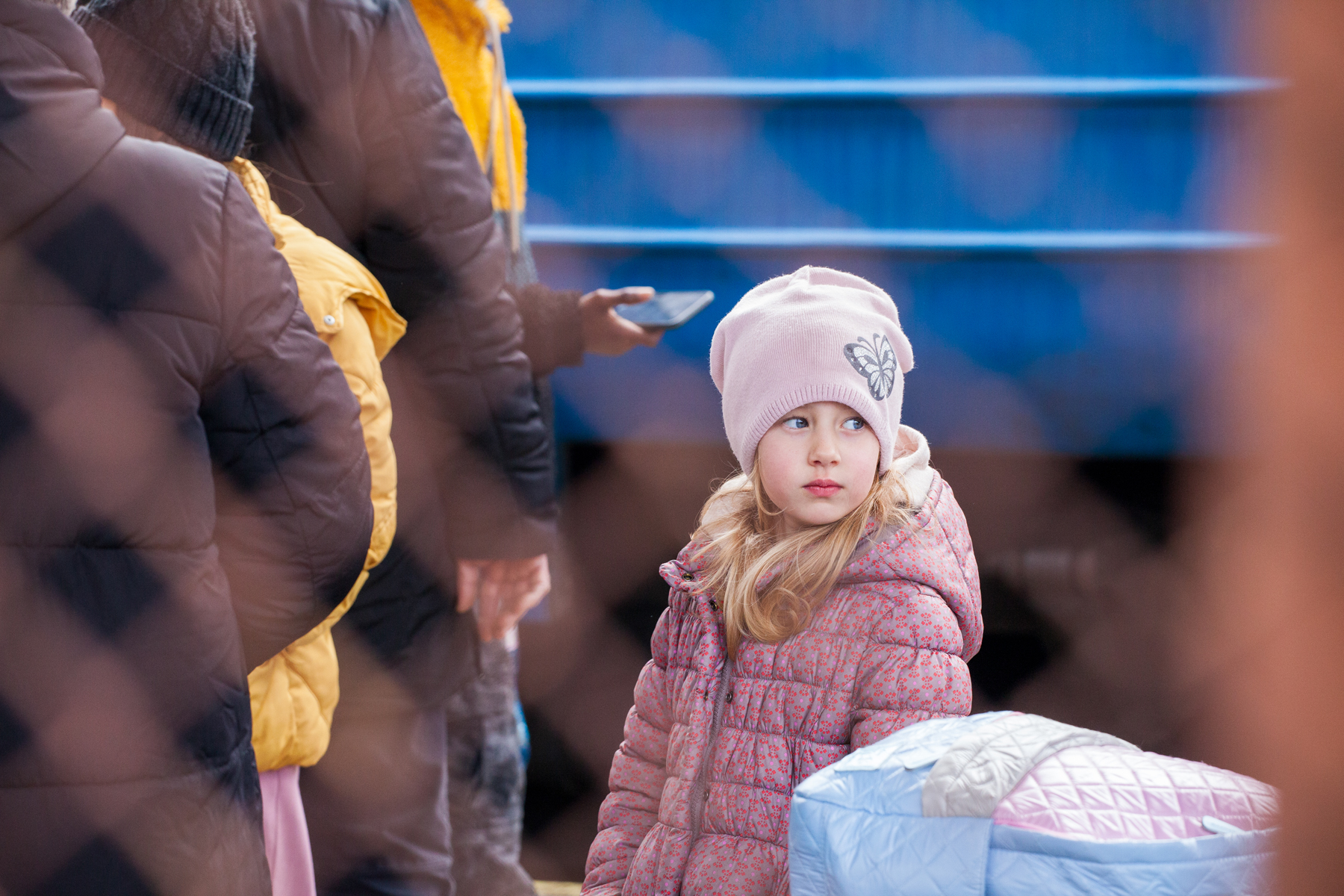
Featured image: Ukrainian children are fleeing Russian aggression, February 27, 2022.
Source: Wikimedia Commons
Author: Mirek Pruchnicki
Creative Commons Licenses