
“He was waiting for his niece to be born, he wanted to give her these small earrings… and now he doesn’t even know she exists,” said Lina Sachenok, a 31-year-old mother of two in a village near Kyiv.
Her younger brother, Yevheni Sachenok, had been serving as a Ukrainian soldier in Donetsk when he officially went missing in February 2023.
Lina is just one of thousands of Ukrainians living in limbo, waiting in the dark for answers about the fate of their loved ones.
According to the International Commission on Missing Persons (ICMP) more than 80,000 people in Ukraine have been officially listed as missing since the 2022 invasion, excluding confirmed deaths. This includes roughly 58,000 soldiers, 20,000 civilians and nearly 19,550 children. The numbers continue to rise.
Some families have more certainty that their loved ones are alive, but still grapple with the agonising uncertainty of whether they will ever be reunited.
“My husband was a businessman, snatched in broad daylight right off the street,” said 53-year-old Aishe Kurtametova, now residing in Lviv.
Her husband, Halil, was detained by Russian authorities for his role in pro-Ukrainian protests in the occupied Crimea shortly after the 2022 invasion.
While Aishe was told that he was sentenced to eight years in prison for allegedly financing an illegal battalion, she does not know where her husband is or what condition he is in.
“He was thrown from one prison to another, and now he is being transferred, but I have no idea where. I don’t know where he is or what has happened to him,” Aishe told Open Democracy.
Two months after Halil was taken, Aishe’s son Appas was also convicted on the same charges.
“Since Appas’ imprisonment, keeping in touch has been difficult because he is in Russian territory and has been moved between colonies,” explained Aishe.
Despite the efforts of international organizations and national NGOs, Ukrainian families whose relatives are imprisoned or missing face profound psychological challenges.
“I found out my brother was missing before the official notice, when a neighbor apologized to me on the street, as we were already coping with our uncle’s imprisonment, and now another loss,” recalled Lina.
“Because of the constant communal chatter, my mom didn’t leave the house for three months,” she added.
Aishe described a feeling of paranoia and confusion as to why two members of her family had been arrested by Russian forces.
“I feel targeted because I cannot explain two men facing identical fates and charges—Appas first, then Halil,” said Aishe.
The human impact of prisoner returns
While tens of thousands of Ukrainians remain missing, fewer than 6,300 prisoners have been returned home as of December 2025.
Prisoner exchanges have become a grim ritual for the families of the missing. Since the first swap in March 2022, there have been as many as 70 exchanges, according to Ukrainian government sources cited by local media.
They occur irregularly, several times a year at undisclosed locations with third-party mediation, and their frequency fluctuates, with periods of multiple swaps followed by long pauses.
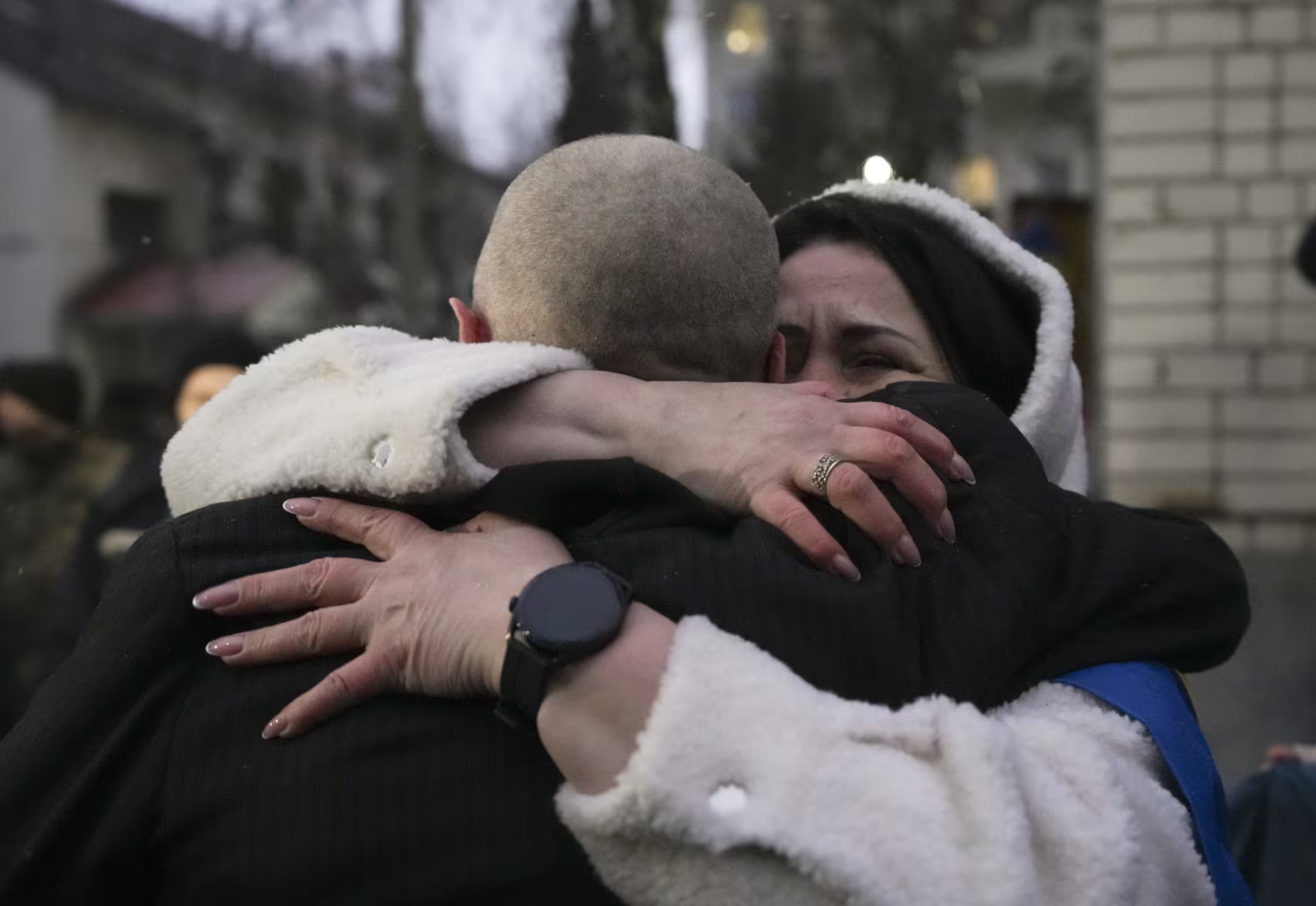
For families of the missing, the exchanges provide hope.
Lina’s 10-year-old son, Mark, attends every POW exchange with his grandmother, clutching a Ukrainian flag and a photo of his missing uncle.
Aishe also follows the mass prisoner exchanges with baited breath. She hopes that one day her son or husband will appear among the dozens of men released by Russia.
“I had high hopes for the last prisoner exchange, which was supposed to include 1,000 people, even though only 157 were released,” said Aishe.
The exchanges are often traumatic for both families of missing people and freed prisoners, according to rights organisations.
Families can inadvertently trigger distress in returned prisoners, whose mental health remains fragile after captivity, according to Olena Belyachkova, a coordinator at the Media Initiative for Human Rights.
Simple inquiries from relatives still waiting for loved ones to return from captivity can retraumatise recently freed prisoners, who are forced to relive their experiences and often face survivor guilt.
Belyachkova also noted that returned POWs often give false hope to families of the missing, telling them they have seen their loved ones as they cannot say no after years of forced subservience.
“While the intention is noble, it is often unconscious and unreliable, as POWs, due to torture and pressure from Russian captors, are forced to say ‘yes’ even when they cannot confirm anything,” explains Belyachkova.
For some families, the testimony of former comrades carries more weight than official documents, leading them to continue an often hopeless pursuit of missing loved ones.
Enduring the Unknown
Despite the efforts of NGOs and government authorities, the families of Ukraine’s 80,000 missing people continue to live with doubt, fear, and loss.
The human cost of disappearance is felt in the quiet of everyday life; adults and children alike carry the burden of uncertainty and grief that shapes each day spent waiting.
“I hope he’ll come back to see his niece and my wedding, as he promised,” said Lina, her 1-year-old daughter Melanka babbling in the background.
“Until then, we’ll keep knocking on every door because we want him back—we want every son, husband, and child to finally come back,” added her mother, Valentyna.
Featured image: Via Geneva Solutions ‘ICRC: nmber of missing people in Russia-Ukraine war reaches 50,000’ by Michelle Langrand
Creative Commons Licenses Attribution 4.0 International Deed