
Alexander Browder, a 17-year-old British student and creator of the Global Cryptocurrency Laundering Database, was sanctioned by Russia’s Foreign Ministry on June 3 and banned from entering the country.
He is believed to be among the youngest people ever sanctioned by the Kremlin.
Russia accused Browder of spreading false information after he published a report titled “Confronting the Illicit-Finance Hydra in Crypto Markets: Protecting Retail Investors and Disrupting Hostile Government Exploitation,” where he exposed alleged crypto laundering operations by states including Russia, North Korea and Iran.
“These sanctions tell me that I have touched a nerve. If the Kremlin is angry about my work on crypto laundering and sanctions evasion, then I am looking in the right place,” Browder told EU Reports.
Hundreds of billions laundered
The report, published by the Henry Jackson Society, analyzed a database of 164 cases and suggested that criminal actors and sanctioned states have laundered $350 billion USD (€303.4 billion) in illicit funds through cryptocurrencies.
In particular, a stablecoin called A7A5 has been identified as a key tool Russia uses to evade international sanctions.
“The basic mechanism is that rubles tied to Russia’s banking system are converted into a ruble-pegged token, issued through infrastructure in Kyrgyzstan and reportedly backed by deposits at Promsvyazbank, a sanctioned Russian state-owned bank,” Browder explained.
“That token can then move on public blockchains such as Tron or Ethereum and be swapped through Russia-linked exchanges into USDT or other liquid cryptoassets, which are much easier to use for cross-border settlement with suppliers, brokers and intermediaries.”
This mechanism has allowed Russian companies to operate transactions without relying on regular correspondent banking channels and to avoid direct exposure to Western-controlled financial rails.
According to the teenage whistleblower, cryptocurrencies are not inherently illicit but are inherently dual-use, amplifying both legitimate and illegitimate activity.
His report calls for stronger enforcement teams and asset‑recovery systems, along with an improved use of AI as a detection tool.
But the sanctions also carry a personal dimension.
The Magnitsky Act
The Browder family is no stranger to Russian sanctions. Alexander’s father, Bill Browder, used to be one of Russia’s largest foreign investors with the hedge fund he managed, Hermitage Capital Management.
The fund focused on shareholder-rights activism and exposed corruption in Russian state-linked companies such as Gazprom, Unified Energy System, and Sidanco.
In retaliation, Browder was expelled from Russia in 2005, and the offices of Hermitage Capital in Moscow were raided by the police.
Bill Browder’s lawyer, Sergey Magnitsky, found that Hermitage holding companies were fraudulently re-registered in the name of Russian criminals with the complicity of the police. Magnitsky was later arrested, tortured, and died in a Russian prison.
Following Magnitsky’s death, Browder successfully lobbied the U.S. Congress to pass the Magnitsky Act in 2012, a law targeting Russian individuals responsible for corruption and human rights abuses.
Almost two decades after Bill Browder’s expulsion from Russia, it is now his son Alexander who has been targeted by the Kremlin’s sanctions.
But the 17-year-old student has no intention of stopping his investigative work.
“Sanctions are meant to silence or intimidate people, but in my case they have only made me more determined,” Browder stressed.
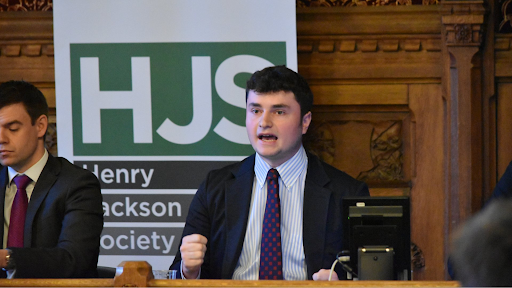
Featured image: Alexander Browder presenting the Cryptocurrency Money Laundering Report.
Credit: Henry Jackson Society via X.