

The Europe of Sovereign Nations (ESN) party, a far-right party within the European Parliament, faces a potential ban for alleged breaches of EU values, the European ombudsman said.
The ESN group was set up in 2024 after MEPs representing Germany’s Alternative for Deutschland (AfD) party were expelled from the right-wing Identity and Democracy Group due to allegations of sympathies with Nazism and Neo-Nazism.
AfD members proceeded to set up the ESN alongside members of France’s Reconquest party, Hungary’s Our Homeland Movement, Italy’s National Future, Poland’s New Hope party, Slovakia’s Republic Movement, Bulgaria’s Revival, and other far-right parties from across Europe.
The ESN exists as both a loose faction of MEPs and as a formal political party, registered with the Authority for European Political Parties and European Political Foundations (APPF) – for which it receives funding from the European Parliament. For 2026, funding is expected to be roughly €2 million.
Both its status as a registered party and the funding it receives is now under threat after APPF director Pascal Schonard wrote a report to the EU Council finding that the party failed to comply with EU core values. Notably, ESN was found to lack a “respect for human dignity, freedom, democracy, equality, the rule of law and human rights, including the rights of minorities.”
Why a ban?
“Banning a party would undoubtedly limit its ability to mobilize its own voter base,” Benjamin Höhne, professor for comparative European governance systems at Germany’s Chemnitz University, told EU Reports.
“Far-right parties fuel anti-democratic […] views in society. Political parties do not merely respond to an existing, static demand. Rather, the political supply creates the demand. In my view, this alone justifies banning an anti-democratic party,” he added.
Included in the 300-page Schonard letter against the ESN are court rulings and posts from social media in which members allegedly compare homosexuals to pedophiles, call for mass remigrations – an ethnonationalist term encompassing the mass, forcible deportation of immigrants and their decentants – and label Israel as “not just a criminal state,” but “a nation of criminals.”
Schonard also cited cooperation between Bulgaria’s Revival party and Vladimir Putin’s United Russia party, as well as findings from last year by German intelligence services concluding that the AfD should be classified as an extremist movement and a “threat to democracy.”
This came in the wake of a surge in support for the AfD across Germany, which had become the country’s main opposition party following its most recent national elections in early 2025.
The AfD has since continued to gain further successes in state elections earlier this year, and is now enjoying a record 29% of popular support, according to the latest polls – having effectively distanced themselves from the Trump administration and the MAGA movement after the unpopular conflict with Iran.
Read more: Europe holds the line: Centrists back in a week of high-stakes votes
The AfD has successfully contested in court the label of extremism that was applied against them, but this has not prevented many in Germany from arguing that the party should be banned due to it being ‘unconstitutional’.
The Bundestag had debated a ban on the AfD ahead of the 2025 national elections following proposals put forward by the centre-left Social Democratic Party (SPD).
The left-wing Die Linke party had also previously called for a complete ban on the AfD, whilst even German President Frank-Walter Steinmeier had indicated that such action might be warranted. “Never in the history of our reunited country have democracy and freedom been so attacked,” Steinmeier said at the time.
“Simply waiting for the storm to pass and taking cover in the meantime is not enough. If they attack our constitution, oppose it, want a different, non-free system, then the answer of our constitution is clear: a party that embarks on the path of aggressive hostility to the constitution must always reckon with the possibility of being banned.”
Meanwhile, local authorities in Bavaria had attempted to block prominent AfD politician Björn Höcke from speaking publicly earlier this year. Ultimately, however, the Bavarian Administrative Court ruled against this.
“The German understanding of democracy does not ban freedom of speech, but we have a concept of militant democracy, due to our history […] We want to defend our democracy against its opponents and its enemies, and therefore in the last resort we also have the instrument of a Party ban,” Antje von Ungern-Sternberg, a professor of constitutional law at Trier University, told DW News.
Wider implications
Some have warned against such kinds of legal action, arguing that attempts to impose outright bans on far-right parties would be counterproductive, as this can then be used to play into a narrative of victimhood and censorship by a hostile establishment.
Members of the ESN have already reacted with anger to the proposed ban on their party, labelling it as an attempt to silence nationalist and right-wing movements that are critical of liberalism and of mass migration.
Dóra Dúró, a member of Hungary’s Our Homeland Movement, has described the move as an attack on “sovereignists,” stating: “Attacks against national sovereignty are increased to a higher level. Our country stands by its party family and its representation of normality.”
“Of course, a potential ban would fuel the victim strategy of far-right parties,” Höhne argued.
“However, the portrayal of themselves as victims is already being used extensively. Enforcing a ban would certainly not be a walk in the park, but it is feasible. Those who fear this must act all the more quickly,” he concluded.
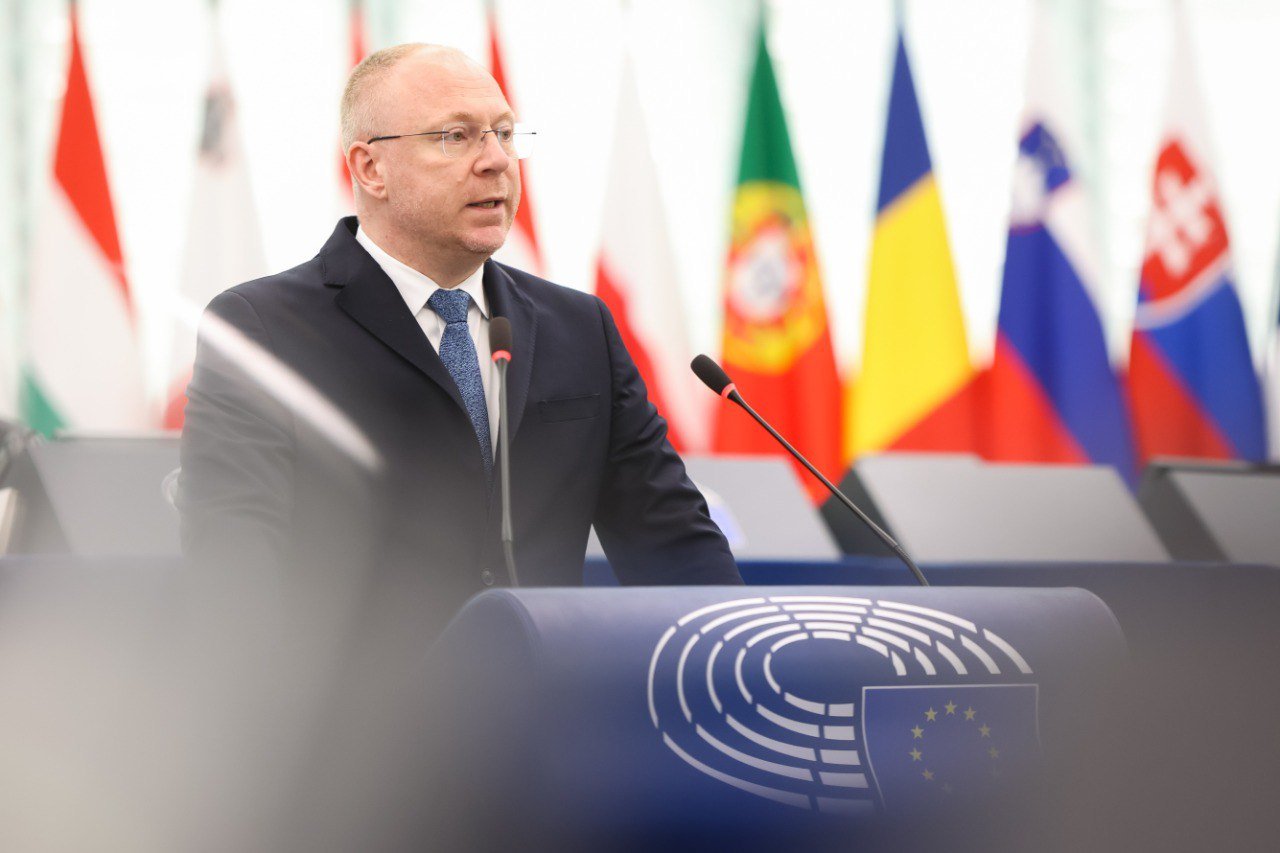
Featured image: ESN President Stanislav Stoyanov of Bulgaria’s Revival party at a May European Commission debate.
Source: ESN via X.