
Paris, France – On a rainy Friday morning, a classroom slowly fills with students at the Sorbonne-Nouvelle campus in Paris’ 5th arrondissement. Having no obligation to be there, nor any specific discipline or university in common, the students present are just eager to learn something, anything.
Today, they can choose from a lesson on cybersecurity, a seminar on the relationship between democracy and equality, a workshop on reading a state budget, and seminars on the repertoire of collective action in the current mobilisation of high school students. All hosted by the Université Populaire of Censier.
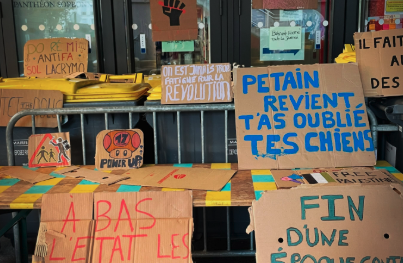
For almost one month, students of the Sorbonne-Nouvelle have blocked their campus’ entrance at Censier, thereby forcing the administration to close its services for the day. Like many other universities in Paris including École Normale Superieur and Paris-Nanterre, the aim is simple: to force the administration to recognize the grievances of high schoolers and put pressure on the government to reform certain policies.
As a way to remain engaged, informed and “emancipated” students taking part in the blockades decided to set up a temporary people’s university (Université Populaire) open to everyone and completely managed by the students. Everyday for three weeks, organizers come together in different working groups to plan the following day’s schedule, advertise on social media, reach out to professors for potential seminars and workshops and coordinate tutoring lessons for high schoolers.
The idea for a Université Populaire harks back to student protests of May 1968 when students of Paris-Nanterre occupied their university building and moved to the Sorbonne-Nouvelle. Amongst other grievances, they outcried the elitism and social reproduction of higher education. During the month-long occupation, students organized séances dedicated to the class struggle of students and workers, the international student movement, and hierarchy of university.
Thirty-four years later, students have once again taken control of the Sorbonne. The words “Censier en lutte” (Censier in struggle) are written outside Césure, the cultural centre attached to the university building that hosts the Université Populaire. Through it, students are telling their university administrations that the school year will not resume as normal until the high schoolers’ demands, along with their own demands for the university, have been met.
Three organisers from the Censier collective spoke with EU Reports about the main goals of their People’s University: solidarity with high school students, access to education, and safety.
“When it comes to our demands, we’re really aligned with all the high school students’ demands—the basic issues that have come up,” said Axelle, 21 year-old senior in political science at Sorbonne-Nouvelle.
“We’re no different from them. We’re fully part of the student and high school student movement. And so, our ‘people’s university’ is also bringing everything we wanted to do on the side to this space.”
While attending a packed day of seminars and workshops organised by the students, eating the free food offered and talking with various organisers, it appears clear that the solidarity through the Université Populaire has already responded to the main demands of high schoolers: an accessible and free institution for higher education.
Since 2018, French students looking to apply to university go through the Parcoursup platform. Among the grievances of students, they claim this system lacks transparency and is highly selective.
Due to the system’s algorithm as well as a ranking parameter of the candidate’s wishes, the platform strongly reduces acceptance rates. A parliamentary report published in April considers “pre-existing sociocultural inequalities that the Parcoursup system helps to perpetuate without correcting them—and may even exacerbate.”
At Censier, accessibility is guaranteed and selection eliminated. When asked about the target audience for Censier, Axelle explained, “at first, we figured we’d set everything up in the evening so we could go out and hand out flyers to workers and let them know there was something going on after work. In the end, given how many people we were reaching, we decided we’d do it during the day, too.”
“But the goal was really to reinvent the university. Because right now, it’s very selective, but we want it to be accessible to everyone, with no barriers to entry. The door is truly open—it’s symbolic. And that has changed the way we all think,” she continued.
This outreach isn’t just in academic terms. Rose, a 20-year-old senior in law and political sciences at Sorbonne-Nouvelle, said that the Censier is also a space for growing as an activist in a space safe.
“We’re also trying to show—especially to new activists—that everyone is affected by the Mouvement Lycéen. Even if you haven’t been following the news, if you aren’t already an activist, you can see on social media everyone getting tear-gassed and maybe wondering how to get involved.”
Organisers stress that their space is safe, since all activities take place in Césure, the recreational centre run by the association of the same name. This means they are protected from any police intervention the university administration might request, a point they highlight to attract more support.
Their Instagram bio, in fact, reads “Police-Free Space: Discussions, News, Alternative Workshops, Signs, Medical and Anti-Repression Training.”
“When you know you’re affected but don’t know how to act, and everything that’s happening right now is trying to dissuade you—having a small community, at least, to kickstart the process of politicisation and mobilisation is essential,” stressed Ivanne, 21 year-old student at Sorbonne-Nouvelle.
“It’s really about whether we can reach people—and we’ve reached quite a few, about 100. And we know that the more seasoned activists are already out blocking so these are probably people who are coming for the first time, and there are 100 people in the room, it’s incredible.”
The safety offered by the space chosen for seminars allows students to learn without distractions or fearing consequences. For Axelle, this means a greater opportunity for “emancipation” through learning.
“Education and developing critical thinking is the way to change your social trajectory, at least it is for me, so it’s important that we’re able to talk about that here,” she said.
“Today, with so much uncertainty in our futures, and the stress it’s causing us, it’s important to have a support system. And that’s this for us,” Rose added.
For the three organisers, they hope the movement continues and grows. Even if students decide to stop blocking the entrances and universities restart, they want to continue offering free seminars with the help of volunteering professors from political theory to practical skills such as learning how to pay taxes.
“The goal of the Université Populaire is a state of mind, not a place. We know that we have this space now, but we’re not dependent on it for the future,” Axelle explained. “We just need to get people together, whether that be in a park or a hallway or a public place.”
Featured image: Mathilde Larrere via Instagram