

Spanish Prime Minister Pedro Sánchez has accused various foreign actors, including Israel and Russia, as well as “the international far-right” of spreading disinformation relating to the ongoing migrant crisis in Ceuta, the autonomous Spanish community on the North African coast that has seen a massive influx of refugees from neighbouring Morocco since July 30th.
Read more: Humanitarian situation in Ceuta remains dire, aid workers say
According to Sánchez, while in conversation with Spanish radio Cadena Ser, these hostile actors have deliberately spread misinformation online about how Moroccan migrants will be treated, including the false claim that those who swim to Ceuta cannot then legally be deported.
This disinformation, he said, directly contributed to the huge numbers of people who have inundated the small coastal community and caused a massive crisis for Sánchez’s centre-left government.
The prime minister also directly accused both Russia and Israel of helping to actively spread such disinformation, as part of attempts to weaken Sánchez’s government.
“After July 30 and 31, there was a spread of rumours and disinformation from social networks linked to Russia and Israel, and the international far-right that always uses migration not only to attack Spain, but also to attack Europe and divide it,” he said, citing findings by the European External Action Service (EEAS).
Beyond Ceuta, however, Russia has frequently been accused of using online spaces and social media bots to spread disinformation and to interfere with or attack various European nations in the past – particularly following the war in Ukraine, on which Sánchez has been steadfast in his support for Ukraine.
Meanwhile, Israel has itself had an increasingly poor relationship with Spain in the nearly three years since the October 7 massacre, following the Sánchez government’s robust condemnation of Israel’s conduct in Gaza and the West Bank.
The Spanish government has consistently described the mass destruction inflicted on Gaza by Israel during the conflict, as well as the continued killings of Palestinians even following a supposed ceasefire, as war crimes and genocide.
Spain further imposed arms embargoes and additional boycotts on Israel, have boycotted cultural events such as Eurovision due to Israel’s involvement, withdrawn their ambassador to Israel following the war with Iran, and formally recognising the state of Palestine.
This comes a year ahead of Spain’s parliamentary elections, in which it is widely expected that the centre-right People’s Party (PP) is most likely to come out on top, but with gains also likely for the insurgent, far-right VOX party, who are being seen as potential kingmakers.
The wider reaction
Both Russia and Israel have strongly rejected Sánchez’s accusations that they have been seeking to inflame the crisis in Ceuta. Israeli Foreign Minister Gideon Saar described the claims as “brazen lies,” adding that “continuing to spread defamatory lies will not distract from Sánchez’s shameful failure in managing his country’s affairs.”
The same retort was also made by Israel’s Ambassador to the UN, Danny Danon, who added on X that “maybe before [Spain] continues lecturing us, it’s time it explained to the world why it still maintains colonial enclaves in Africa.”
There is little doubt that both the international right and foreign actors will be seeking to exploit the crisis in Ceuta, argued José Javier Olivas Osuna, an associate professor at the National University of Distance Education in Madrid and a research coordinator with the London School of Economics.
“This crisis is a golden opportunity for the far right to promote xenophobic attitudes,” Osuna told EU Reports.
“Loaded terms such as ‘invasion’ and ‘invaders’ have now been mainstreamed – even the centre-right Partido Popular [PP] is using them. Images of large, disorderly groups of people entering Spain have also helped reinforce ‘Great Replacement’ conspiracy theories.”
The professor added that the ongoing crisis “is set to be extremely damaging to Pedro Sánchez’s government,” describing it as “a point of no return.” He pointed to the protests that took place across Spain last week, which included both right-wing rallies, in which far-right groups were seen performing fascist salutes, and ostensibly non-partisan protests, which have attracted tens of thousands of people from across the country.
Right-wing parties used the protests to attack the Sánchez government and accused it of appeasement towards Morocco. The PP, for one, has argued that the government has not done enough to protect Spaniards in Ceuta.
“It did nothing to avoid the invasion on 30 July and it’s doing nothing to stop the public order crisis that’s getting worse every day,” explained PP leader, Alberto Núñez Feijóo.
Meanwhile, VOX leader Santiago Abascal similarly described the surge of migrants as “an invasion and an act of war promoted by Morocco and allowed by Sánchez, who is incapable of responding because he is subservient to Morocco.”
Deflecting blame?
Whilst Sánchez has blamed events in Ceuta on this online disinformation campaign, his critics have argued that it’s his government that must still bear the brunt of the blame for the ongoing crisis, alongside Morocco – which has been accused of deliberately allowing this flood of its own refugees into Ceuta, a claim Sánchez has consistently rebuffed.
“When people talk and speculate about the participation of Moroccan authorities, I deny this outright,” Sánchez told Cadena Ser.
Regardless, Osuna argued that most analysts see the accusations levelled at Russia, Israel, international far-right influencers and human-trafficking mafias “as a clumsy attempt to divert attention from the most likely cause of the problem: the Moroccan authorities.”
He also pointed to the Spanish government’s own “dreadful handling” of the crisis, stating that “the government not only misjudged the situation in the days before the crisis, disregarding intelligence reports and warnings from the local authorities in Ceuta, but also largely ignored the problem for almost a month afterwards.”
This point was further emphasized by Guillem Colom, associate professor of political science at Pablo de Olavide University, Seville.
“Politically, the far right is clearly trying to weaponise Ceuta by linking migration with loss of control, sovereignty and government weakness,” Colom told EU Reports. “The risk for Sánchez is that his emphasis on Russian, Israeli and far-right disinformation can be perceived as avoiding the more uncomfortable questions about Morocco and about the government’s own management of the crisis.”
Colom stressed the importance of the separation of the origin of the Ceuta crisis from its later informational exploitation. “At this moment, there is evidence that Russian-linked and pro-Israeli networks amplified the crisis afterwards, but this is not the same as saying that Russia or Israel caused it.”
Osuna, however, went further, arguing the Sánchez government has accused these actors without citing any known report to support the claim. “The only EU report it has referenced concerned Russian involvement alone, and even then, not in the crisis’s origin but as an amplifier of disinformation afterwards.”
“The far right and other international actors such as Russia and Israel have exploited the crisis for their own ends,” he added, “but they are not the ultimate culprits.” The Spanish and Moroccan governments, the scholar believes, bear the greatest responsibility for how events have unfolded.
Jorge Tamames, a fellow with the Spanish research centre and think tank Elcano Royal Institute, pointed out that there is difficulty in placing blame when it comes to online disinformation campaigns like this while in conversation with EU Reports.
“As both Spanish and EU authorities have pointed out, there is evidence of Russian attempts to influence the development of events in Ceuta. As far as we know, these initiatives were undertaken once the crisis was well underway.”
Tamames admitted some Israeli authorities expressed support for Moroccan revisionist claims in Ceuta and Melilla, but the fact remains that the head of mission at the Israeli Embassy in Spain rejected these positions.
“While these developments are concerning in their own right, they do not explain the full extent of the emergency that unfolded,” he added. “Hybrid attacks, by definition, are especially challenging when it comes to attributing authorship.”
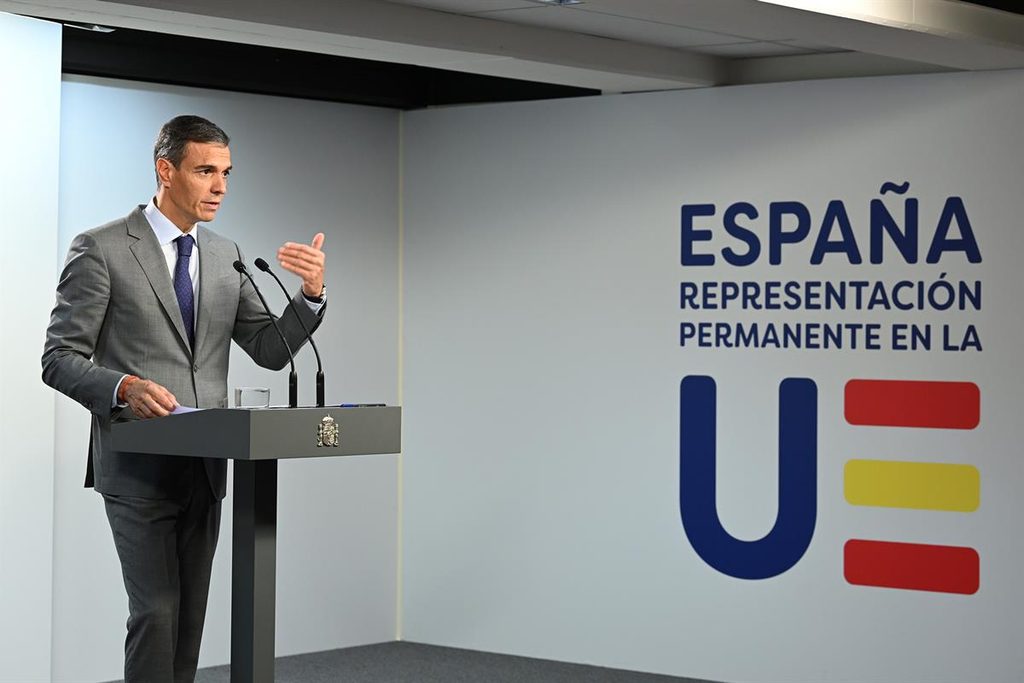
Featured image: El presidente del Gobierno durante una de sus intervenciones, junto al vicepresidente primero y ministro de Economía, Carlos Cuerpo.
Source: La Moncloa
Author: Pool Congreso. Congreso de los Diputados, Madrid – 9.9.2026