
Following last weekend’s elections in Russia, representatives from Russia’s Indigenous Peoples and the Russian opposition have released a statement condemning the results.
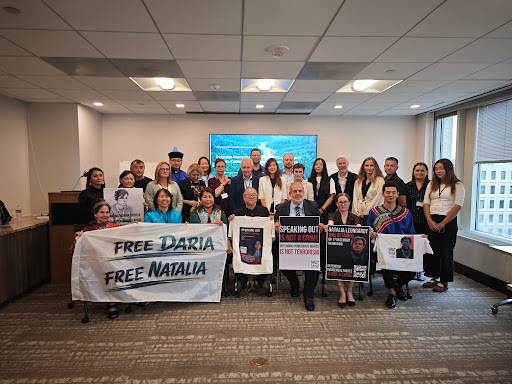
At a meeting in the Navajo Nation’s Washington DC Office, representatives adopted two resolutions.
The first resolution condemns the repression of Russia’s Indigenous and Small-Numbered Peoples, which has seen a dramatic increase since the invasion of Ukraine. The second resolution is a rejection of the State Duma elections.
Representatives were welcomed on Saturday, September 19, by DeWayne Crank, Deputy Executive Director of the Navajo Nation Washington, DC Office.
Participants also included Pavel Sulyandziga, representative of the Udege people and president of the Batani Foundation, Mariana Katzarova, first UN Special Rapporteur on the situation of human rights in the Russian Federation, and Vladimir Kara-Murza, a political activist and vice president of the Free Russia Foundation, among other representatives and activists.
Representatives from last weekend’s meeting also highlighted the cases of Daria Egereva and Natalia Leongardt, two activists who have been in pre-trial detention since December 2025.
Sulyandziga stated that the meeting was taking place at a “difficult time” for Russia’s Indigenous peoples, particularly those in the North, Siberia, and Far East.
“Right now, Daria Egereva and Natalia Leongardt are in custody, accused by Russian authorities of participating in a terrorist organization,” he stated in a press release. “The charges against them are fabricated and unlawful!”
Egereva, a member of the Selkup nation, is a climate and Indigenous rights activist. Prior to her arrest, she was the co-chair of the International Indigenous Peoples Forum on Climate Change, and was a key Indigenous voice during COP28 in Dubai, COP26 in Baku, and COP30 in Belem. She was arrested just weeks after her return from Brazil.
Leongardt is a human rights advocate who specialises in the protection of Russia’s Indigenous population, and has worked with Indigenous rights groups from across the country.
In June 2024, Russia’s Supreme Court designated the non-existent Anti-Russia Separatist Movement an extremist organisation, which targeted 55 Indigenous and minority organisations. Later that year, another 172 Indigenous organisations were labeled terrorist organisations.
Among the now 830 organisations which the Russian government has listed as “terrorists or extremists” was Aborigen, which acted as a network of Indigenous leaders across Siberia, North and Far-East Russia. The network has since been disbanded.
Indigenous peoples have also suffered heavy losses fighting in Russia’s invasion of Ukraine. During the 2022 mobilisation, it was reported that Indigenous nations were drafted at higher rates than areas with larger ethnic Russian populations. By the end of 2023, regions with higher ethnic minority populations had some of the highest mortality rates amongst conscripted soldiers.
This trend has continued, with the highest number of losses suffered in the Republics of Bashkortostan and Tatarstan, two of the largest Turkic republics in the country, located in the western Volga-Ural region.
The resolution to reject the outcome of the State Duma elections comes as President Vladimir Putin’s party, United Russia, won another landslide victory in a system allegedly rigged in the party’s favour.
Russia’s elections have long faced criticism for failing to adhere to democratic standards. Political opponents have been jailed or killed, and opposition is tightly managed.
Just last month, the only party in opposition to Russia’s war in Ukraine, Yabloko, was banned from running in the election. Although some of the party’s candidates managed to run in individual constituency elections, many were barred. Some are currently in jail.
Editor’s note: More information about Daria Egereva and Natalia Leongardt’s cases can be found here.
Featured image: Russian Indigenous and opposition leaders gathered in Navajo Nation’s Washington, D.C. office.
Courtesy of Batani Foundation