
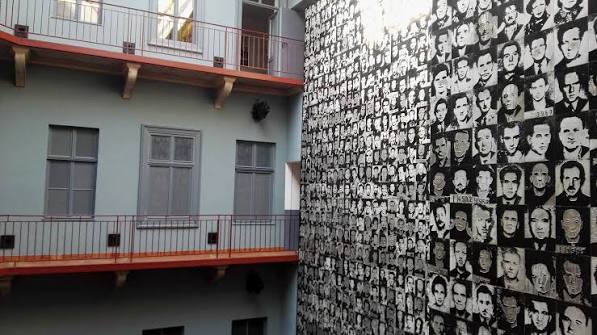
The Terror Háza (House of Terror), a well-known museum in Hungary dedicated to highlighting the country’s experience of totalitarianism, is set to reopen following backlash against its closure by Prime Minister Péter Magyar’s centre-right Tisza government.
Located at Budapest’s Andrássy Avenue 60 in, the museum occupies a building that served first as headquarters for the Arrow Cross, the fascist, pro-Nazi party which governed Hungary on the Nazis’ behalf from 1944 to 1945, and later as headquarters for the communist secret police under the Soviet-backed regime that governed the country from 1945 to 1990.
Opening in 2002, under right-wing populist Viktor Orbán’s first government, the museum was set up to commemorate what has been referred to as Hungary’s “Double Occupation” by both the Nazis and the Soviets, as well as acting as a memorial to their victims and to the Hungarian Revolution of 1956. Such a revolution against the Communist regime was brutally crushed by the Soviet Red Army.
In the 24 years since it opened, the museum has gone on to gain international recognition, attracting thousands of tourists each year both from Hungary and around the world.
Why the closure?
Having been financed by the Orbán government, critics have claimed that the Terror Háza downplays Hungarians’ own complicity in the two regimes, as well as placing far greater emphasis on Hungary’s communist regime than it does its fascist one.
This has, it’s been argued, helped to reinforce narratives peddled by the Orbán regime, as well as to tarnish opponents of Orbán and to bolster the image of him and his fiercely anti-communist Fidesz party.
Read more: Orbán vows to “never give up” as Fidesz reelects him leader
Following the win for Péter Magyar’s Tisza Party at this year’s April 12 election, the new Hungarian government has been pushing for a complete dismantling of the Orbán regime, including the nationalising of the foundation network that runs the museum.
On Tuesday, September 15, Minister of Social Relations and Culture Zoltán Tarr, announced via Facebook that the museum’s director, Mária Schmidt, had been dismissed, and that the Terror Háza would also be closing.
“The Terror House Museum is temporarily closed until the exhibition’s content lighting is completed, and the rights are clarified,” he stated.
The museum’s founding director, Mária Schmidt, stated that she had been informed of the government’s decision through Tarr’s Facebook post, and that she had not been given “any explanation or justification.”
“I only hope that the justification for the closure is not related to my well-known oppositional political sympathies,” she added on Facebook.
Members of the Tisza government had welcomed the news, with State Secretary for Public Collections and Monument Preservation Zsolt Sári stating that the Terror Háza had become overly politicised in recent years.
“I am convinced that a museum – especially one of such weight, a memorial institution – must function transparently, on solid professional foundations and without political interference. Its operation must now be placed within historically authentic, professionally grounded frameworks,” he noted.
Erasing history?
Members of Fidesz, however, along with other opposition politicians, were quick to claim that the government was seeking to erase or rewrite Hungary’s history.
Balázs Orbán, Viktor Orbán’s former political director, has called the museum “one of the country’s most important memorials to the victims of communism,” including his own grandmother, and has argued that the museum had been under attack “from post-Communist and progressive circles”.
“These are the new communists,” he argued on X, referring to Magyar’s Tisza party.
“Péter Magyar, Zoltán Tarr, and the Tisza party do not respect anything,” added János Bóka, leader of the Fidesz group within Hungary’s National Assembly and former minister for European Union affairs.
“On the 70th anniversary of the 1956 revolution and the war of independence, the Tisza party wants to erase the most important memory point of 1956. This is a shame and disgrace, one that the participants in the erasure will bear for the rest of their lives.”
Fidesz called for the immediate reopening of the Terror Háza and the reinstatement of Mária Schmidt. Figures linked to Fidesz had already organised protests outside the museum that were scheduled for this weekend and in the next month.
“We have a past,” organizers stated. “We have thoughts about our future, we have a homeland and a nation, we have our faith and we preserve all of our important identities. That is precisely why the House of Terror is ours!”
The government then backtracked, with Tarr confirming Terror Háza will be reopened from next week, as opposed to the indefinite timespan he originally suggested. “The primary mission of the institution – which presents the crimes of oppressive dictatorships – is to provide a professionally authentic portrayal of the darkest eras of our modern history that befits the Hungarian nation.”
“We have also initiated a professional review of the exhibition, conducted by staff from the Institute of Historical Studies ELTE and independent experts,” he added. “Until the review is concluded, the House of Terror exhibition remains open to visitors in its current state.”
Featured image: Terézváros. Andrássy útca House of Terror is a museum which contains exhibits related to the fascist and communist regimes in 20th-century Hungary and is also a memorial to the victims of these regimes, including those detained, interrogated, tortured or killed in the building. The building was used by the Arrow Cross Party and AVH.
Author: Budapest – Terror Háza Múzeum
Source: Wikimedia Commons
Creative Commons Licenses