
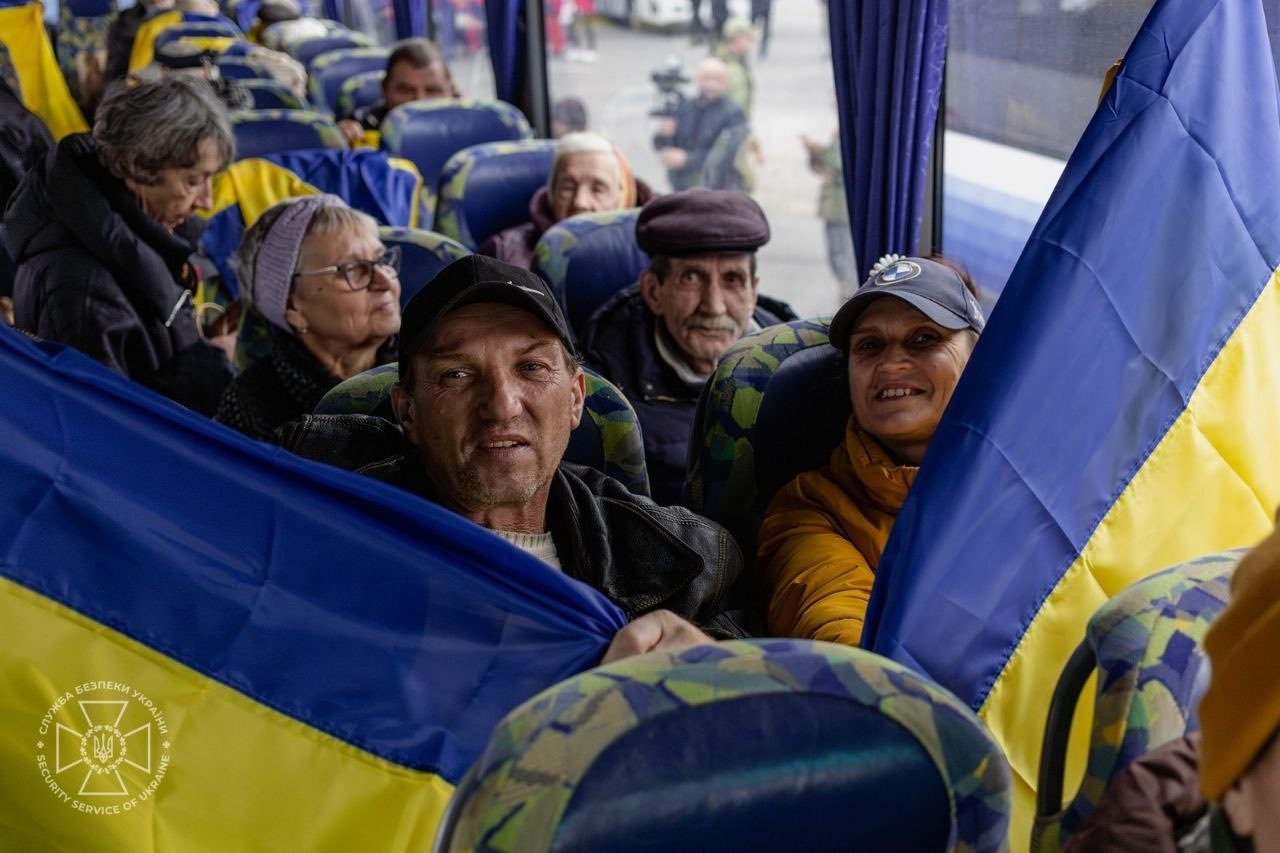
Starving residents of a Russia-occupied town in the southern Kherson region crossed the Ukrainian border in the Chernihiv region for the first time in four years, thanks to a humanitarian truce.
The six-day ceasefire, brokered by Melania Trump with the Pope’s involvement, came into force on October 29 with the intention of evacuating civilians from the town, which has been occupied by Russian forces since 2022.
The humanitarian convoy successfully returned nearly 800 people, many of them elderly residents, marking a rare moment of respite in an increasingly attritional war.
“The situation in Oleshky is dire. Oleshky is a front-line war city on the brink of disaster,” said First Lady Melania Trump in a White House statement announcing the ceasefire agreement on October 23.
Oleshky, a city in southern Ukraine, has been occupied by Russia since its full scale invasion on February 24, 2022. Since then, the city’s population has declined significantly, with only 2000 estimated to remain there. Most of them are elderly individuals and people with disabilities who are unable to leave.
“Oleshky’s remaining population is comprised primarily of elderly residents who urgently need medical attention, medicine, food, and clean water,” said Melania Trump.
To define the terms of the local ceasefire, the First Lady reportedly worked directly with Russian and Ukrainian leadership.
Announcing the ceasefire, the White House said those who wish to evacuate would receive coordinated support and transportation to their preferred destination, whether it be Russia or Ukraine.
Ukrainian President Volodymyr Zelenskyy expressed his gratitude to the U.S. and Melania Trump for their mediation.
“And thank you to everyone around the world – to all journalists, political and civic leaders, and all caring people who brought global attention to the situation in Oleshky,” added Zelenskyy.
The journey to Ukraine
According to Reuters, to reach the Ukrainian border, residents of Russia-occupied Oleshky had to take a long and complicated route, first travelling by bus via Crimea to the Russian town of Anapa before taking a flight to Belarus, and finally continuing to Ukraine.
In the video shared by the Ukrainian Parliament Commissioner for Human Rights, Dmytro Lubinets, dozens of mostly elderly people are shown travelling by bus with their pets and only a few bags packed.
At the Ukrainian border, returnees were reunited with family members and large military tents and aid ambulances were erected to provide hot meals and first aid.
“We have come a complicated way: from negotiations and agreeing on a ceasefire to delivering humanitarian aid directly to Oleshky and organising the evacuation of civilians,” said Lubinets upon the returnees coming back home.
Later, he added that the next step will be establishing a special centre for returnees within the Ukrainian Ombudsman’s office, bringing together government agencies, humanitarian groups, and human rights organizations to provide ongoing support.
Following the successful humanitarian operation in Oleshky, Ukraine accused Russia of taking advantage of the ceasefire to strengthen its military positions in the Kherson region, Reuters reported this Monday.
In the Monday statement, Kyiv’s General Staff claimed that Russia used the ceasefire to rotate troops, boost defences and improve military logistics.
“Under the ceasefire introduced for the humanitarian operation in Oleshky, units of the Defence Forces of Ukraine ensured that the ceasefire was observed and acted exclusively within the framework of the agreements reached,” said Kyiv’s General Staff on their official Facebook page.
It added that the enemy, by contrast, used the humanitarian pause to improve its positions.
Kremlin spokesman Dmitry Peskov claimed he does not have any specific information on the Russian army movements, yet he added that adjusting positions during the ceasefire would be a normal practice for both sides.
Featured image description: Residents of Oleshky returned safely to Ukraine.
Featured image credit: @andrii_sybiha via X.