
Bulgaria held the second round of its presidential election on November 1, which saw Iliana Iotova defeat opposition candidate Andrey Gyurov to become Bulgaria’s first female elected president.
Although the result gives Iotova an electoral mandate, the historically low turnout of 27% with fewer than three in ten eligible voters participating raises questions about the strength of her public support.
While low participation does not invalidate an election in Bulgaria, it can undermine perceptions of democratic legitimacy, particularly in a country already struggling with deep-seated distrust of its political elite.
The election followed years of unstable governments, mass protests over corruption, a substantial parliamentary realignment in April 2026, and growing tensions over Russia’s war in Ukraine.
More recently, Bulgaria was faced with deadly drone attacks on commercial vessels near its Black Sea Coast, amplifying existing security concerns.
Bulgaria is a member of both NATO and the EU, but it also has longstanding cultural, historical and political connections to Russia, and Prime Minister Rumen Radev has cultivated diplomatic relations with Moscow.
Iotova previously served alongside Radev as vice president and has been Bulgaria’s acting president since he resigned in January.
As of November 2, the election results have been officially announced, concretising Iotova’s position of power in Bulgaria’s politics.
Iotova won by approximately 18 percentage points, taking 57.6% of the votes as opposed to Gyurov’s 39.5%, in a much larger margin than in the first round on October 25.
A key tension in their presidential runoff was the future of Bulgaria’s relations with Russia; whilst Gyurov is explicitly pro-Western, Iotova’s position is more ambiguous and several Bulgarians shared concerns with EU Reports about the impact of her victory on Bulgaria’s sovereignty.
In 2023, Iotova explicitly condemned Russia’s invasion and called for Russian troops to withdraw from Ukrainian territory. However, she opposes sending Bulgarian military assistance to Ukraine and has criticised EU sanctions against Russia as counterproductive, advocating instead for restoring diplomatic dialogue with Moscow and negotiating an end to the war. Her close association with Radev has also provoked suspicion.
Blagovest Stoyanov, a 25-year-old real estate entrepreneur from Sofia, told EU Reports “the biggest worry is that we are going to be a Russian satellite”, and expressed concerns that “we have chosen a mockery of a president, who will serve only Radev and not the people”.
However, it is not only the outcome of the presidential runoff that has raised concerns. Multiple Bulgarians also described political polarisation, generational divides, and a public mood of helplessness where voting is concerned.
“I’m worried because this election has exposed generational and geographic divisions that I haven’t seen before. Political disagreements have always existed, but in my experience they used to feel more like debates among people of all generations,” said Danail Alekov, 35.
“Now, the gap has become particularly visible, and people seem increasingly aggressive in defending their views. That’s what concerns me about Bulgaria’s future: differences becoming personal, with people increasingly unable to listen to one another.”
Alekov added that in Bulgaria, concerns about corruption make it difficult to vote purely according to ideology, and compared the elections to those in Brazil, where “there is also a strong geographic divide between the poor Northeast and the rich South.”
Sofia, the country’s main economic centre, voted predominantly for Guyrov, while smaller regional cities and towns mostly voted for Iotova, according to Central Election Commission (CEC) data.
Hristo Dyulgerov, a Bulgarian political science student in the U.S., said the result was expected. “Bulgaria is very much a polarised country and has been growing more and more polarised for a while. A common sentiment is the disdain towards politicians in general.”
He added that Bulgaria has been experiencing low voter turnouts “since basically forever” and “many people say common phrases such as ‘a single vote doesn’t matter’, ‘the system will never change’, ‘I’m tired of listening to the same promises of new and better futures’.”
“In some countries such a turnout [27%] is considered illegitimate, and I personally would agree. So, whoever the candidates are, the vote should be illegitimate in my opinion.”
Some of Bulgaria’s contemporary distrust of politicians and voting may have historical roots in its recent past. The country’s transition to democracy following the collapse of communist rule in 1989 was accompanied by significant political and economic upheaval.
The turbulent 1990s saw financial instability, organised crime and the emergence of powerful networks connecting business and politics. Although Bulgaria joined the European Union in 2007, concerns over corruption, judicial independence and political accountability have continued to shape public debate.
More recently, parliamentary elections and difficulties forming stable governments have reinforced perceptions of a political system unable to deliver lasting change.
“For the majority of the 2010s, the ruling party was a clientelist one,” Dyulgerov noted, “prior to that in the 2000s and especially 90s corruption was even more rampant than now as was organised crime. People grow accustomed to living in such an environment. Even those who may have believed reformist parties, such as the ones supporting candidate Gyurov—they don’t anymore because they have felt they were wronged on multiple occasions.”
For Stoyanov, the issues date back even further. “In theory, communism fell in 1989 but, unlike in other countries behind the Iron Curtain, they didn’t face any real repercussions. In fact, some of them rebranded themselves as socialists. Others went as far as saying they are democrats.”
A conviction that Bulgaria is characterised by impunity for the powerful and apathy among the people seemed consistent among all of EU Reports’ interviewees.
A 22-year-old finance student from a Muslim Turkish family in Bulgaria, speaking under anonymity, said they “don’t lose faith in democracy” but feel none of the candidates represent them.
He also raised concerns over Iotova’s track record during her time as vice president, alluding to her pardoning of Ognyan Atanasov—nicknamed Petrich Escobar for his drug-related criminal offences—and convicted drug dealer Dinko Gospodinov.
The April parliamentary elections were also “frustrating” for him because of Radev’s opacity. Radev had resigned the presidency to run and went on to win a majority. “The way he won with a majority is that no one knew who he really represented. Was he pro-Russian or pro-European? Was he anti-Muslim, or more liberal towards them?”
Some Bulgarians, however, strongly support Iotova precisely because they believe she is best-positioned to bolster stability in Bulgaria after decades of divisions in the country.
Ivaylo Venchev, 33, reasoned that Iotova “served as an MP in the European Parliament since Bulgaria joined the EU in 2007 until she became Bulgaria’s vice president in 2017, so she is a very institutionalised candidate”.
While Venchev acknowledged “she is critical of the European Commission when she feels it’s needed,” he believes “she is generally pro-EU, and in her years as an MP she has proven exactly that.”
By contrast, Venchev described Gyurov as being looked upon “by many people as Ursula von der Leyen’s puppy” because “the parties that have elected him as a candidate never criticise the EU commission, and here most of the people are pro-EU, but they don’t like the EU management very much now.”
Speaking about the political situation in Bulgaria, he told EU Reports that, since 2020, the country has had parliamentary elections almost every year because “the institutions weren’t working correctly and there were problems with the budget almost every year.”
Consequently, “most of the people felt it but especially the most vulnerable groups who rely on welfare and pensions and businesses that work with the government.”
For some Bulgarians, Iotova’s election represents the prospect of greater political stability after years of institutional uncertainty. For others, it raises fears of an erosion of Bulgaria’s sovereignty and a consolidation of pro-Russian sympathy in the country’s parliament.
With just 27% of the electorate having participated in Iotova’s victory, Bulgaria’s first female president faces a challenge extending beyond relations with either Brussels or Moscow: restoring public confidence in a political system that many appear to have stopped believing can represent them at all.
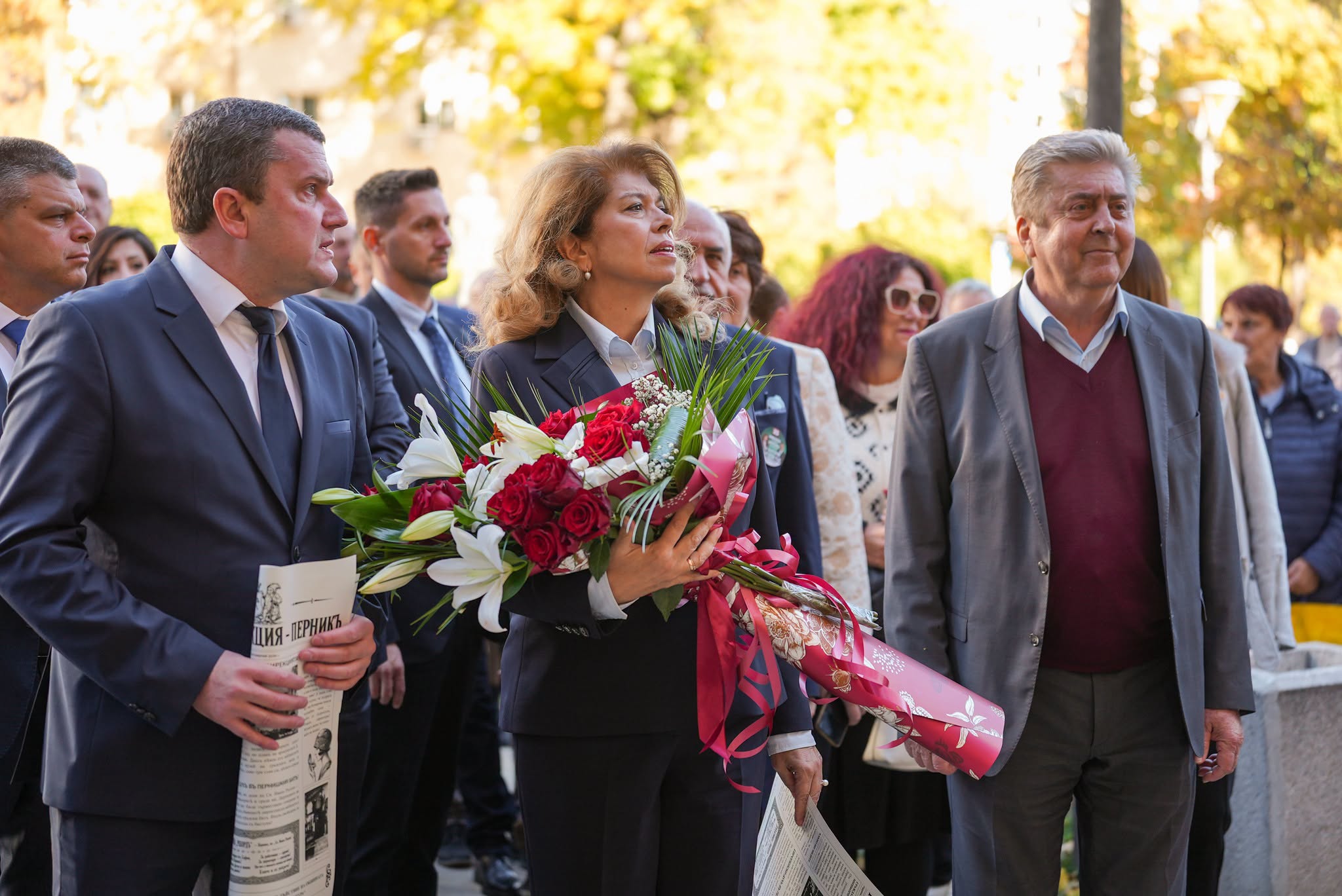
Featured image: Iliana Iotova via Facebook