

Dublin, Ireland – U.S. President Donald Trump’s visit to Ireland sparked public criticism and widespread protests across the country, including from different humanitarian and student organizations that defend the Palestinian cause.
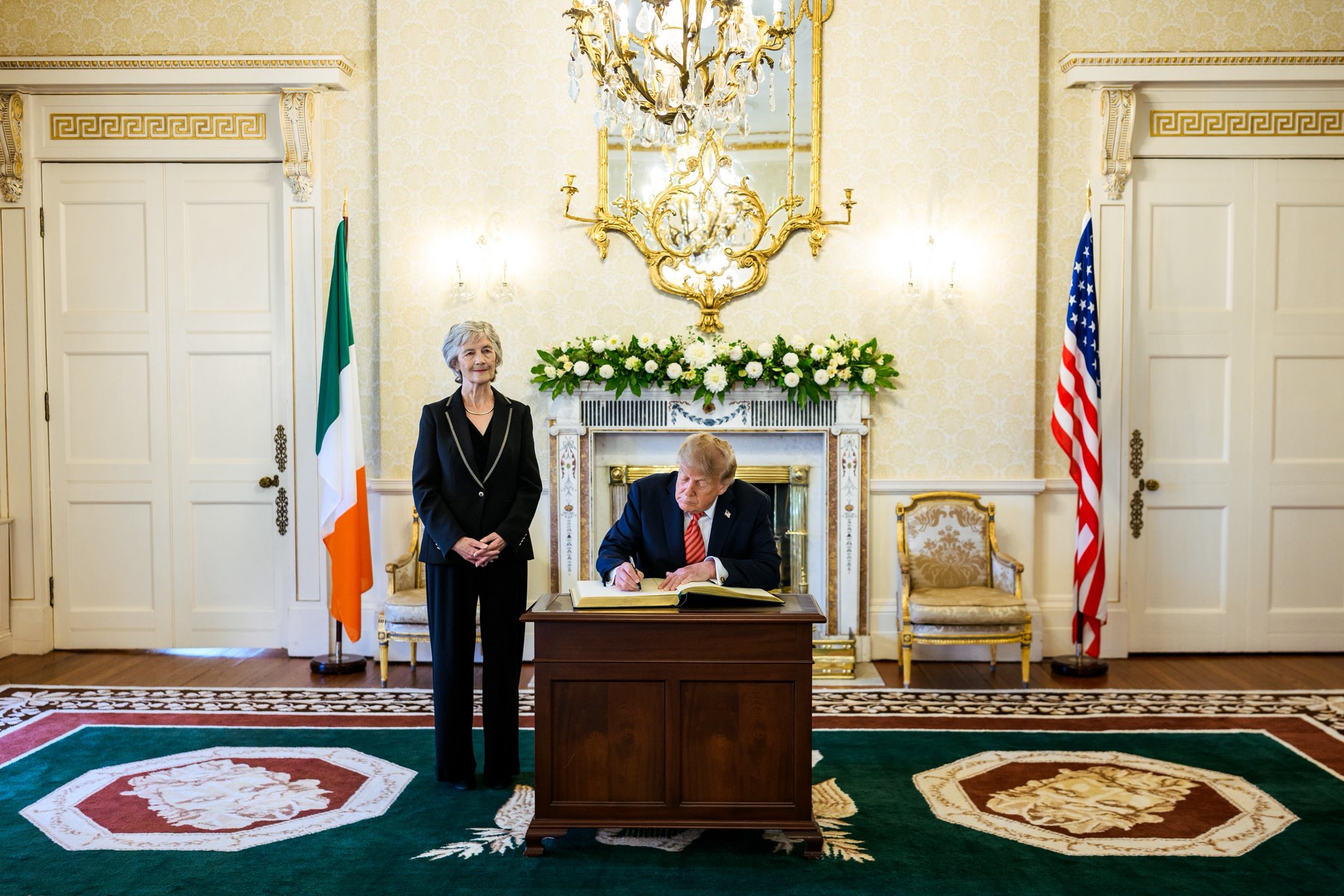
The president arrived in Dublin on September 12, 2026, where he held political meetings with government figures, including left-wing President Catherine Connolly and center-right Taoiseach Micheál Martin.
Trump’s high-level meetings took place in Phoenix Park, one of Dublin’s most visited tourist sites, which remained closed all weekend as part of several security measures.
This included a guard of honor at Áras an Uachtaráin, the official residence of the president of Ireland, on Saturday morning, followed by a formal bilateral meeting with Micheál Martin at Farmleigh House, the state’s official guest house, and an address to industry leaders in the U.S. Ambassador’s Deerfield Residence.
President Connolly shook hands with the U.S. President at Áras an Uachtaráin and presented him with traditional and symbolic gifts: a St. Brigid’s cross, a book on the voyage of St. Brendan, and a collection of poems by Belfast writer Michael Longley.
According to local media, this last detail, a nod to the poem Ceasefire, one of Ireland’s most celebrated works which carries a message of forgiveness, peace, and the end of armed conflict, served as a subtle nod on Trump’s relationship with Israeli Prime Minister Minister Benjamin Netanyahu and the war in Gaza.
Renewed Ireland-U.S. relations?
Connolly’s diplomatic reaction has drawn criticism given her history as a public opponent of Trump’s policies and her participation in protests against his previous visit in June 2019.
“The people want justice. The government wants optics,” said Seán Radcliffe, chair of student movement Trinity BDS, while in conversation with EU Reports. Trinity BDS’s action made Trinity College Dublin the first university in the West to cut all ties with Israel on June 6, 2025.
Multilateral relations between the two countries have been strong for decades and marked by visits from U.S. former presidents, including Bill Clinton, Barack Obama, and Joe Biden, which were widely celebrated.
Yet, Trump’s presence stands in stark contrast, marked instead by sharp political divisions
“Donald Trump is not welcome here. This is a U.S. President who has eroded democratic norms worldwide, who has ripped up climate agreements, who has started illegal wars, who has presided over a genocide in Gaza, who’s been responsible for creeping fascism across the United States,” stated Ivana Bacik, leader of the Labour Party, on social media. “We should not be rolling out a red carpet for him.”
Days before, the Sunday Independent and Ireland Thinks revealed a poll result where 69% of Irish citizens weren’t supporting Trump’s visit to the country.
However, the president’s visit was not driven only by diplomatic affairs, but by one of his most recognized passions: golf. The Amgen Irish Open, a worldwide competition, took place at his resort in Ireland’s Doonbeg, County Clare, on Sunday, September 13.
The U.S. president announced he would drop all tariffs on Irish whiskey, which faced the standard 15% tariff while the UK and Northern Ireland did not, after awarding the trophy to the tournament winner, Shane Lowry, as a closing of his two-day trip.
Public backlash took to the streets
During the weekend of Trump’s Irish visit, different organizations and political parties expressed their rejection in the streets.
“There are several reasons why the organization ‘Sobremesa in Disidencia’ was out in the streets to show Trump he’s not welcome,” stated one of the members of this organization to EU Reports.
“As a collective mostly made up of migrants from Latin America, we want to highlight the brutality and cruelty of his regime, which continues the tradition of victimizing and terrorising our people and our countries,” he added. “For example, ICE disproportionately inflicts violence towards people with our backgrounds.”
Motivations amongst protesters varied, however. While some protested against the conflict in Gaza, others rallied against hard-right policies targeting LGBTQ+ minorities, and many denounced Trump’s history of presumed misconduct against women.
“We refuse to normalise a man who has facilitated genocide, who has launched illegal wars, and who is now being welcomed to Ireland like a visiting monarch,” Radcliffe stressed.
Reporters also asked Trump about the demonstration, to which he replied: “I didn’t know there was a protest. It can’t be a very big one because we’ve been all over Ireland today already … I haven’t seen any.”
The collective outcry was also marked by a political background, with some rejecting that public funds be deployed for a visit that, while formally diplomatic, was fundamentally driven by private motivations:
“We can find the resources to police Trump’s golf trip. We cannot find the resources to grant visas to scholars. That is Ireland. That is what we have become,” Radcliffe concluded.
Featured image: White House via X