

The UK has officially announced sanctions against Israeli settlements in the occupied West Bank, which have been described by the International Court of Justice (ICJ) as illegal for over two years.
The sanctions include a ban on trade in goods with illegal settlements in Palestine, a sanction on individuals and companies that continue to profit from these settlements, alongside recognition of the unlawful nature of the settlements in the West Bank, as per UK Prime Minister Andy Burnham.
“In a difficult and dangerous world, a decade on from Brexit, there is a risk that Britain loses the confidence to lead and stand up for its values. I’m not prepared to let that happen. It is more important than ever that Britain stands for something,” the prime minister said on X.
UK Foreign Secretary Ed Miliband further described the measures as signalling the “beginning of a new approach” to the Israeli Palestinian conflict, while he used the UN’s definition of ethnic cleansing to state.
“The British government agrees that there is ethnic cleansing of Palestinians in areas of the West Bank,” he said.
This strong turn in foreign policy came alongside similar action from France and Canada, which announced that the UK’s move “marks a further turning point in our approach to protecting the two-state solution,” in a joint address with the UK on September 8, 2026.
This was followed by a joint statement from the UK, France, Canada, and nine other countries: Denmark, Finland, Iceland, Ireland, Norway, Poland, Portugal, Spain, and Sweden.
“The Government of Israel’s actions in the West Bank are undermining the possibility of a two-State solution,” the statement read, with all 12 countries planning to introduce national and/or support European restrictions on trade in goods with settlements which are illegal under international law.
This coalescence of European opinion on Israeli settlement in the West Bank has come in large part due to the advancement of the E1 Israeli settlement project in the West Bank. While plans for the E1 settlement had arisen as early as 1991, advancement of such plans in 2025 led to widespread condemnation from Israel’s European former allies.
Israeli Finance Minister Bezalel Smotrich said the approval of the E1 settlement plans “buries the idea of a Palestinian state”, while Prime Minister Benjamin Netanyahu echoed this sentiment: “We are going to fulfil our promise that there will be no Palestinian State.”
With these implications attached to the potential settlement, and the rise in settler terrorism across the West Bank, European nations have finally been pushed towards concrete action.
The reaction from Jerusalem has been predictably ferocious, with Israel planning to shut down the UK consulate in response and figures from across Israeli politics such as Foreign Minister Gideon Sa’ar accusing the UK of election interference and hostility to Israel. Israel has also retaliated by banning 12 British nationals from Israel, 11 of them MPs, in a move that will not entirely displease those targeted.
An official response has yet to be expressed by those in Washington, but Secretary of State Marco Rubio gave a markedly ambiguous answer. “We share the goal of stability. We don’t want to see some uptick in violence or an uptick in conflict or tensions in the West Bank at a very tenuous time. In the region, there’s always tenuous times,” he stressed, adding that Washington will not be joining the sanctions.
With U.S. President Donald Trump expected to respond in the coming days, Westminster braces for Washington’s reaction. Given the current U.S. administration’s traditionally unwavering support for Israel, a backlash against the measures would hardly come as a surprise.
European nations, led by the UK, have now made their stance clear. What remains inconclusive is the effect these sanctions will have, if any, on the Israeli government’s attitude towards illegal settlements in the West Bank.
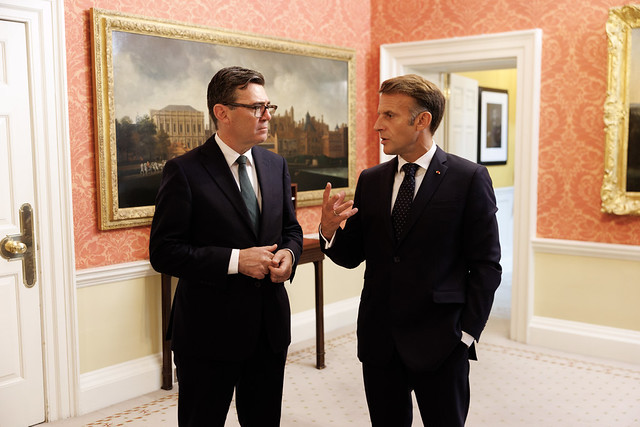
Featured image: Minister Andy Burnham and his wife Marie-France van Heel meet Emmanuel Macron, President of France and Brigitte Macron, First Lady of France at 10 Downing Street.
Author: Simon Dawson / No 10 Downing Street
Source: Number 10 via Flickr