

Norway has expanded its Finnmark Brigade with a new artillery battalion, combat air defence battery and communications company, the Norwegian Armed Forces announced on August 20, as NATO’s northernmost member deepens its military footprint along the Russian border.
The new units were formally stood up during a ceremony at Porsangmoen, the brigade’s garrison in Norway’s northernmost county, roughly 180 kilometers from the Russian border.
“This is a completely different level of firepower than what has been used before,” Brigadier John Olav Fuglem, the brigade’s commander, told Reuters in a phone interview from Porsangmoen.
The expansion gives the brigade the ability to strike land targets 40 kilometers away and to coordinate fire with aircraft and ships from both Norwegian and NATO forces, representing a sharp step up from its previous role of surveilling patrolling Norway’s 198-kilometer frontier with Russia.
It also comes as Nordic states continue raising defence spending, with Norway’s budget now on track to hit 3.17% of GDP this year, up from 1.5% in 2014.
New howitzers arrive ahead of schedule
The artillery battalion has started receiving K9 VIDAR self-propelled howitzers, Norway’s variant of South Korea’s K9 Thunder system.
The first four systems and their support vehicles have already reached Porsangmoen, out of 24 units Norway has funded to fully equip the battalion; the remainder are due for delivery in 2028.
The K9 VIDAR can currently strike targets more than 40 kilometres away, a range the army says could extend past 120 kilometers once ramjet-powered ammunition enters service. Officials say the battalion’s build-up is running ahead of schedule, with its core capabilities expected to be in place by 2028.
Defence Minister Tore O. Sandvik cast the move as part of a broader effort to turn higher military budgets into real capacity. “Now we are building up the Armed Forces and strengthening Norway’s defence capability,” Sandvik said at the ceremony.
“This is a milestone, and illustrates how the defence sector is now converting increased budgets into defence capability. This is important for securing the country in unsettled times,” he added.
A frontline posture in the High North
Russia maintains significant military infrastructure across the border from Finnmark, including assets tied to its Northern Fleet.
Fuglem said the brigade’s new capabilities are meant to send an unambiguous signal north. “We will answer every threat and attack on Norway and NATO,” he said.
The Finnmark Brigade is Norway’s second brigade and the first the country has stood up since the end of the Cold War. Established in 2025 with about 280 permanent personnel, it is expected to reach roughly 350 by autumn 2026 and between 700 and 800 by 2033, when it is due to reach full operational capability with a total force of around 4,000 career soldiers, conscripts and reservists.
Norwegian Army chief Major General Lars Lervik has linked that growth to years of infrastructure investment in the region.
“We have approximately doubled our presence in Finnmark from 2017 to 2025, and the growth will continue in the years to come,” he said when the brigade was first established.
Expansion continues through 2033
Further expansion will require new barracks, housing, offices and training areas in Finnmark, along with stronger border fencing, additional surveillance systems and drones along the frontier with Russia.
Together, officials say, the measures are meant to widen Norway’s military footprint in the Arctic while reinforcing NATO’s broader northern defence posture.
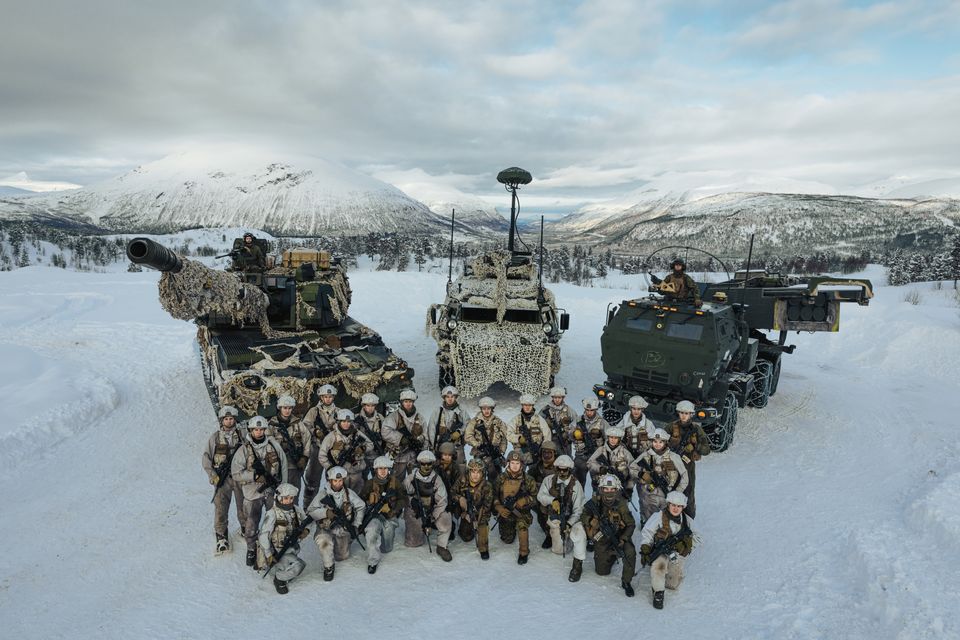
Featured image: Norwegian and American soldiers in front of Norwegian K9 VIDAR from the Artillery Battalion in Brigade Nord, electronic warfare vehicle from the Intelligence Regiment and American HIMARS rocket artillery, at exercise Thunder Bolt in 2026.
Source: Kommunikasjon
Author: Sondre Mosdal / Forsvaret