
Clacton-On-Sea, United Kingdom – As voters head to the polls in the parliamentary by-election in the south-eastern constituency of Clacton in Essex, a record number of candidates are making their final pitch to locals.
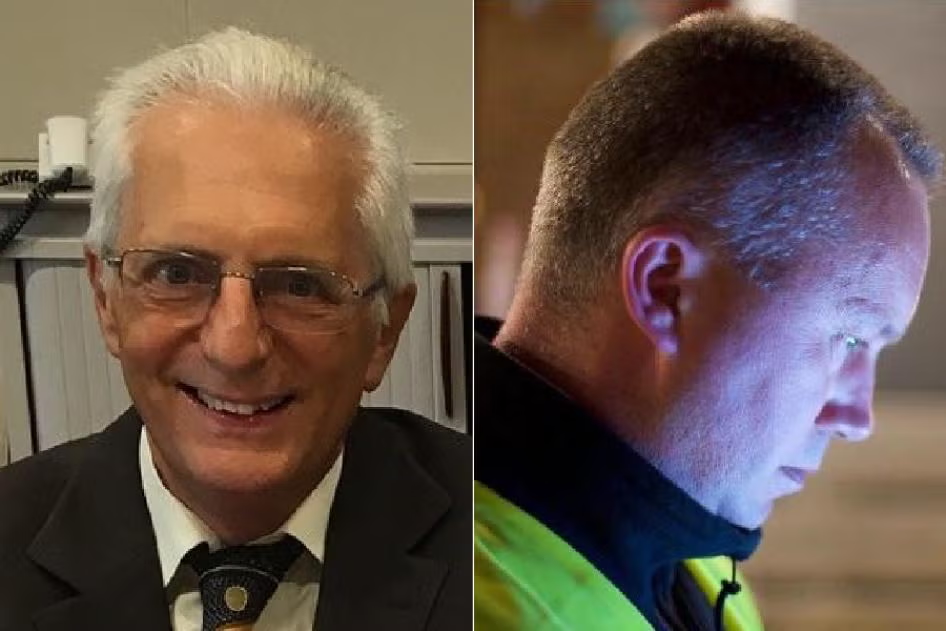
The two most high-profile candidates in the election are Reform UK leader Nigel Farage and British political satirist Jon Harvey, who is running under the moniker of Count Binface.
Constituency polls suggest that the two candidates could get up to 93% of the vote share between them.
But Binface and Farage are up against 32 other candidates, making this the most-contested by-election in British political history.
However, many of the candidates spoke to EU Reports about the difficulty of getting their message across to voters because of the high-profile nature of their opponents’ campaigns, which are getting most of the national and local media’s attention.
Below is a brief summary of some of these candidates, their ideologies and their criticisms of their mainstream opponents.
The candidates pushing for localism over party politics
Marc Wilkinson is standing as an independent in the election, but has a bold plan to create a network of over 100 local community parties all around the UK.
Wilkinson is the current leader of Edinburgh & East Lothian people, and he has applied to register Aberdeenshire People, Greater Manchester People and Essex People as political parties. These groups would be the first members of the proposed 100+ party network.
Wilkinson said that his goal was to create a local community party “for every area of the country with zero external influence, thereby cutting out the ability of the corporate lobbyists and billionaires to have influence over the parties.”
Wilkinson cited both Lord Sainsbury’s donations to Labour and Christopher Harborne’s funding of Farage as examples of the external influence that his movement would seek to get rid of.
Martyn OBrien, an independent from London who has family in Clacton, said that he too is completely “community focused” in his political mission.
“I like advocating for people that need advocating for. [Running as an MP] is an extension of that for me.”
OBrien, who has a background in disability and elderly care, also spoke about the need for MPs to commit more to representing their constituency and less to adhering to the orthodoxies of national political parties.
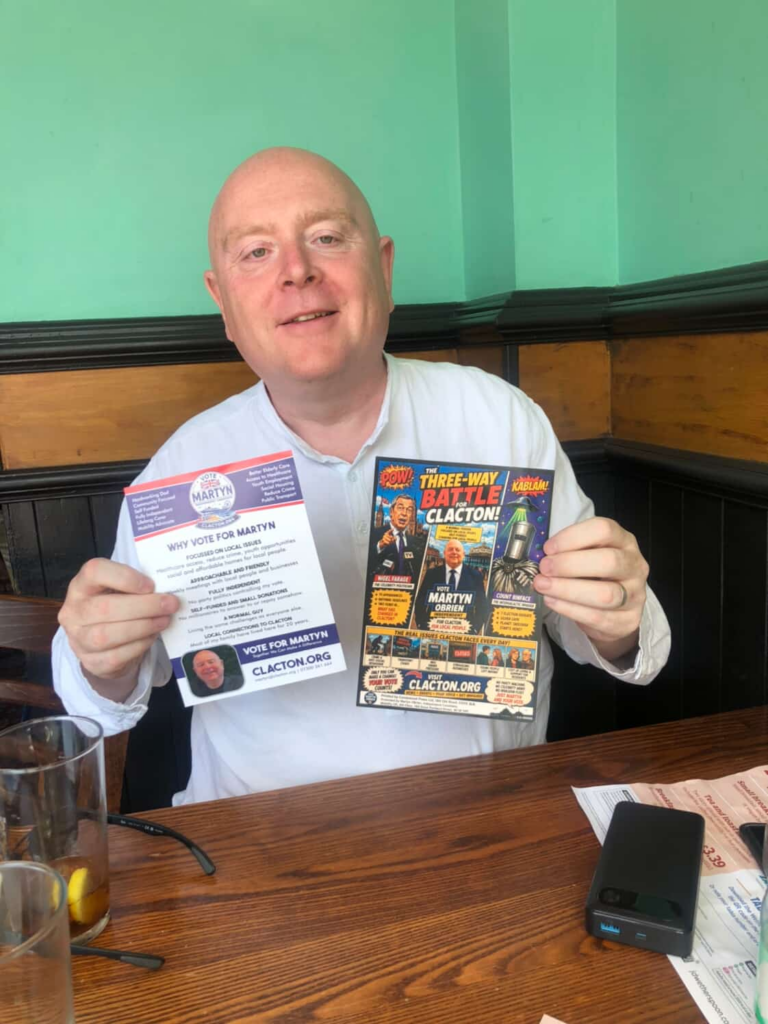
Image Source: Raphael McMahon (own image)
“Local people helping local people is the way forward. We need local politics. We need to get rid of helicoptering in the next favourite person from a party […] If I get my way, I will set the rule that an MP must live in the area or have a provable genuine connection of 5 years [to that area].”
“That way you get a local politician, at the moment we just get someone with 16 jobs using the title of MP to open doors,” he added.
Farage has been criticized for making large amounts of money off his second job as a promoter of physical gold dealer Direct Bullion.
The issue-based candidates
Although all the candidates that EU Reports spoke to stressed the need to heighten Clacton’s profile and tackle local issues, some also explained how they were using their candidacy to increase popular awareness about specific issues.
Robin Green, an independent, is particularly concerned about the advance of unregulated AI. “My top issue is AI because the major AI labs like Open AI and Anthropic are racing to build superintelligence.” Technology giant Meta, for one, has poured billions into its AI division, Superintelligence Labs, in attempts to keep pace with Open AI and Anthropic.
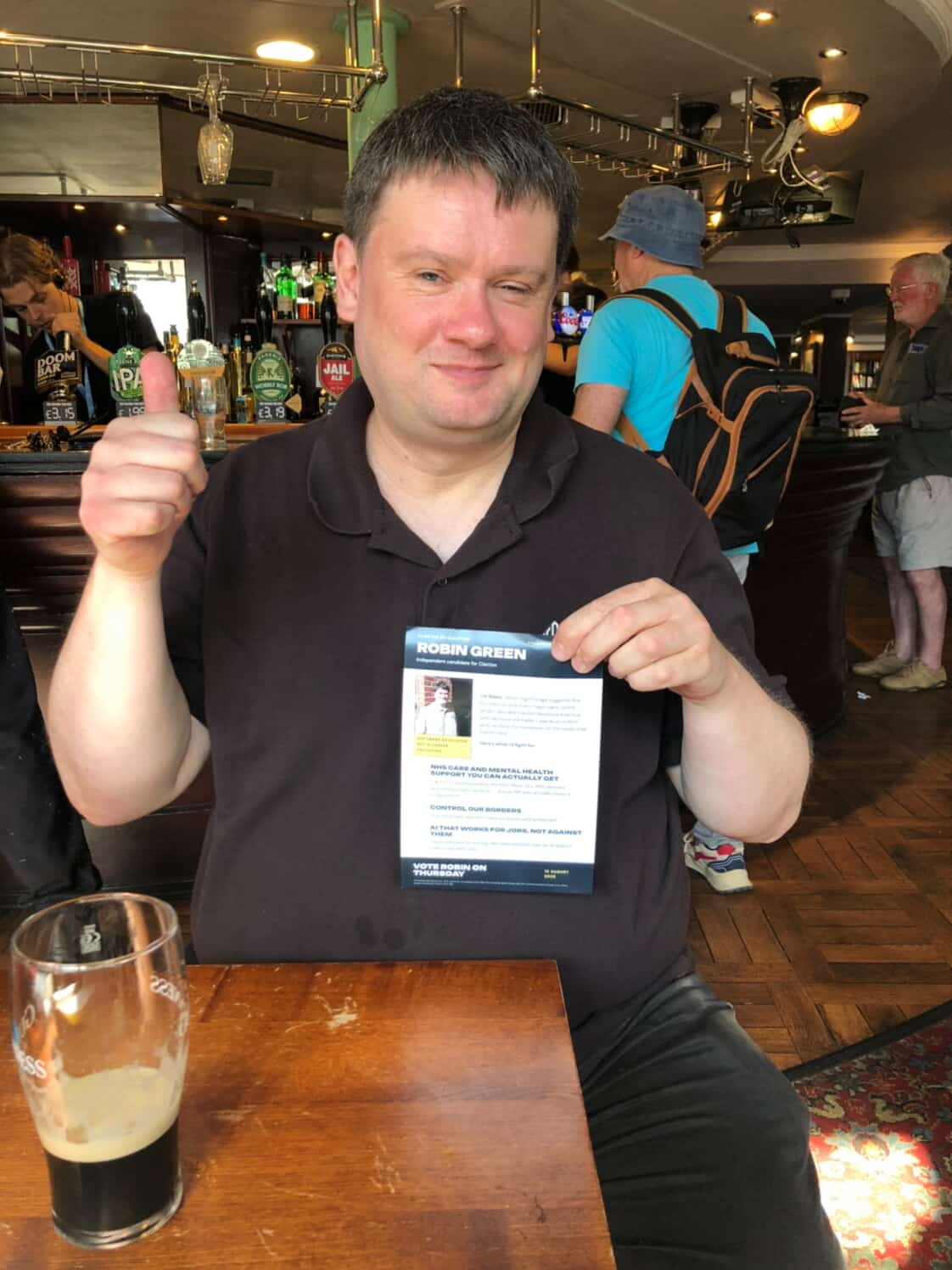
Image Source: Raphael McMahon (own image)
“If we thought that the current AI technology, which is taking jobs from translators, graphic designers and so on, was bad, superintelligence, where the AI will be as intelligent as humans in every domain of work, that is going to lead to massive job losses,” Green continued.
Although Green clarified that AI is an inevitable feature of the future, he advocates for more stringent regulation and control in order to safeguard employment.
John Stevens, the candidate for the europhile Rejoin EU party and a former Conservative Member for the European Parliament, said that his intention in this by-election is effectively to make the vote a referendum on Brexit.
The mainstream parties’ absence “gives an opportunity for a very clean vote on Brexit, because there is no clutter from other issues,” he stressed. “Although this is one of the heartlands of Brexit, I thought that if we could demonstrate that there is a significant anti-Brexit vote here of all places, that would mean that we could easily have another referendum and win it.”
The Rejoin EU party candidate added that, if voters don’t like Nigel Farage and think Brexit was a mistake, they should vote accordingly: “from the heartland of Brexit, that sends a national message.”
Clacton has had a profoundly eurosceptic recent political history: 70% of those who voted in the 2016 referendum backed the leave campaign, and the constituency has been represented in parliament by both UKIP and Reform UK, parties which are characterized by their aversion to the EU that Farage currently leads or has previously led.
Gerry Smith, an independent candidate originally from Scotland, also told EU Reports that she is running because the mainstream parties “are not putting candidates forward”, a decision she described as “appalling”.
Her wider motivation for entering into politics, however, is her commitment to raise awareness about and reform the British foster care system, which she believes has failed in its duty to protect vulnerable children.
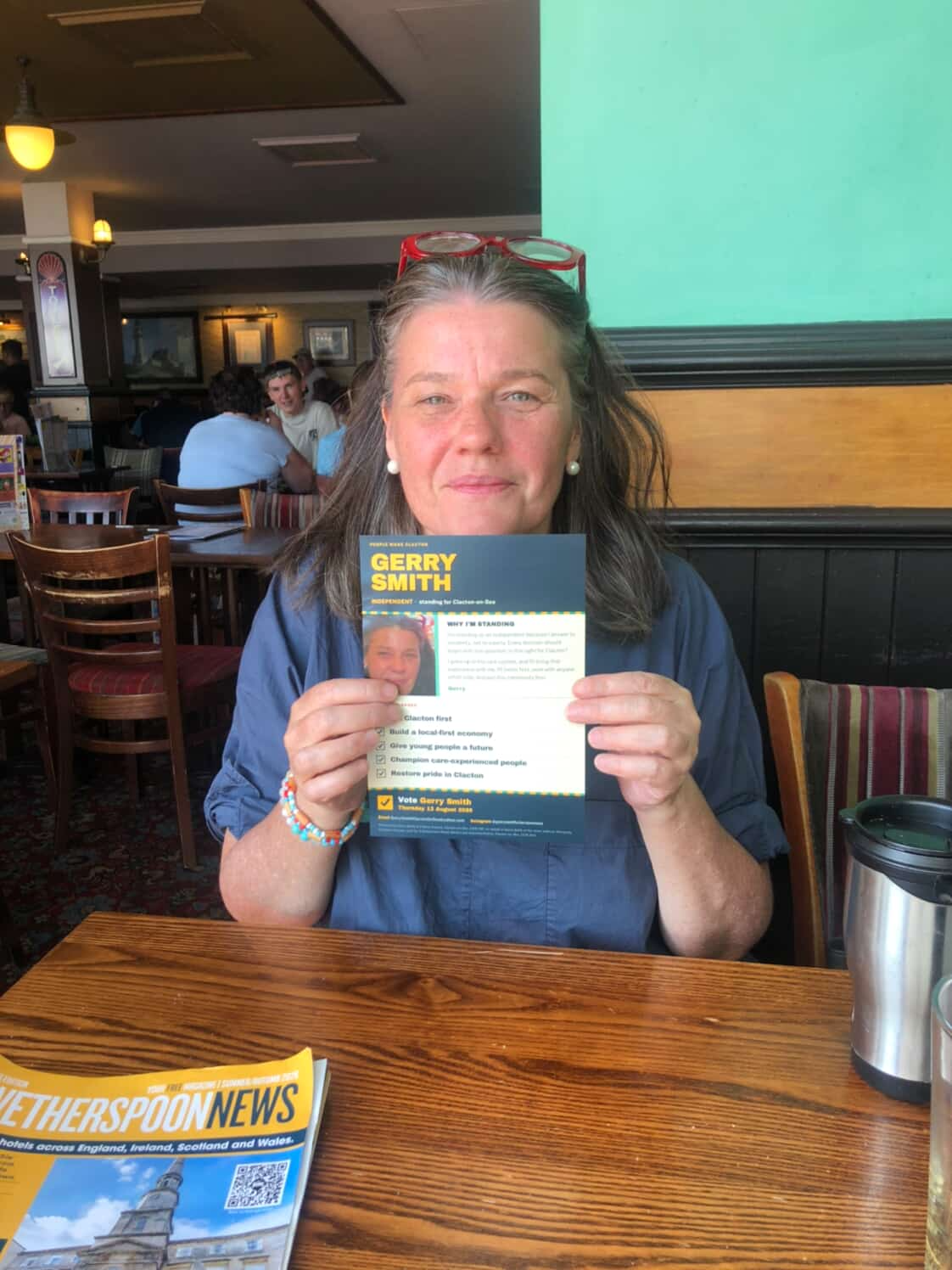
Image Source: Raphael McMahon (own image)
“One of the reasons that a lot of people are standing is because they have one particular issue that has been the catalyst to push them forward into this by-election. My catalyst is homegrown refugees […] kids that grow up in the care system.”
Smith stressed that the UK has privatized all children’s homes, and that costs for housing a child in the care system have reached around £4,000 a week. “But that £4000 is not spent on the child. It would be cheaper to send these children to Eton, Harrow and Rugby [elite UK private schools].”
“Private equity companies are investing in private children’s homes so kids from care have become nothing more than an economic commodity,” she concluded.
Concerns have indeed been raised about the growing capture of the juvenile care system by profit-driven private equity companies. Sources from some homes told The Guardian in late June 2026 that the system treats “children like cattle.”
Farage criticized, Binface’s motives questioned
Other candidates also spoke to EU Reports about their main qualms with Farage and Binface, the two frontrunners.
Mathew Carr, an Australian-born independent running under the moniker Woke Trump Carrzee, said that his campaign is designed to “mock and eradicate the political culture that is represented by President Donald Trump and Nigel Farage, who seem to represent very selfish politics.”

Image Source: Raphael McMahon (own image)
Carr is on a mission to, in his own words, “claim back [the term] ‘woke’ for the people.” Woke is a political and social term which was initially used to describe a person alert to social injustice, but in some political circles, it is now used disparagingly to describe exaggerated political correctness and aversion to offense.
Carr’s criticisms were not limited to Farage. Although he acknowledged the amusing nature of Count Binface’s campaign, he stressed that Binface distracts attention from potentially more serious candidates.
“What I have found is an electorate that is propagandized along the lines of Reform to a large extent, but also they are not realizing that there are high-quality alternatives other than Binface and Farage.”
“Binface and Farage seem to get all of the attention from the broadcasters. I’ve complained to Ofcom [the UK’s broadcasting regulator] about that.”
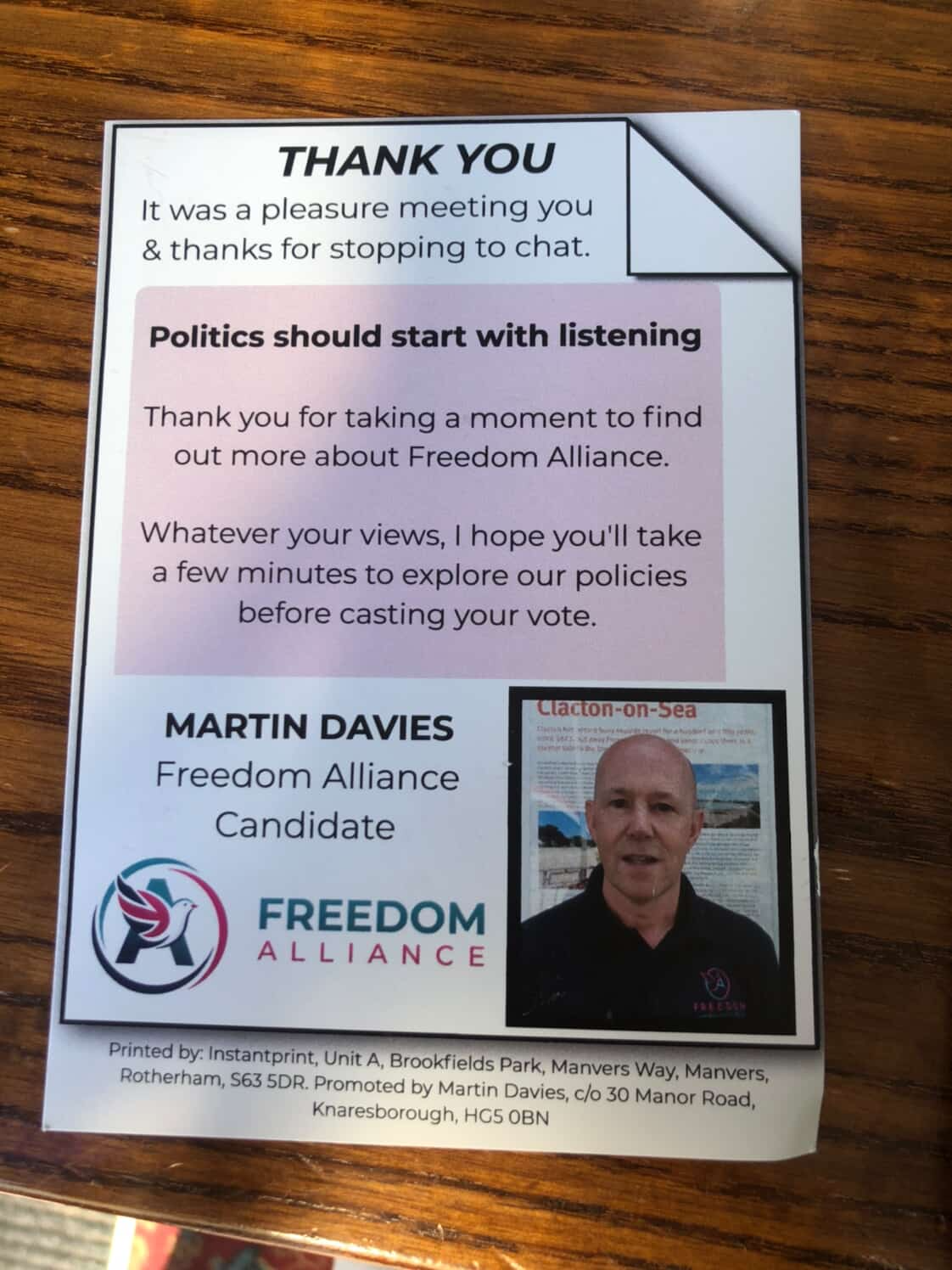
Image Source: Raphael McMahon (own image)
Martin Davies, leader of libertarian party Freedom Alliance, was similarly critical of Binface’s candidacy.
Davies said that a Binface victory “would make Britain a laughing stock around the world … there is such a paucity of understanding of the political environment and choices in the political environment that, against what some people think will be a future Prime Minister, a bin would win.”
Alan “Howling Laud” Hope, the leader of the satirical British Monster Raving Loony Party who is also running in Clacton, went further, calling Binface “a poor man’s loony”.
Binface has stood as a candidate on several occasions, and has been widely touted as Farage’s primary challenger. Many of his policies are satirical, including pledges to construct at least one affordable house, the conscription of people who use speakerphones on public transport, and a referendum on the planetary status of Pluto.
However, the comedian has also promised to spend more time in Clacton than Washington DC, ban MPs who resign mid-parliament from standing in the consequent by-election and not accept financial gifts from crypto billionaires.
All of these pledges are aimed at Farage, who resigned and called the by-election mid-parliament amidst scandals relating to his funding by crypto billionaire Christopher Harborne. He has also come under fire for missing a large number of parliamentary votes and making numerous trips to the U.S. to visit President Trump, his political friend and ally.
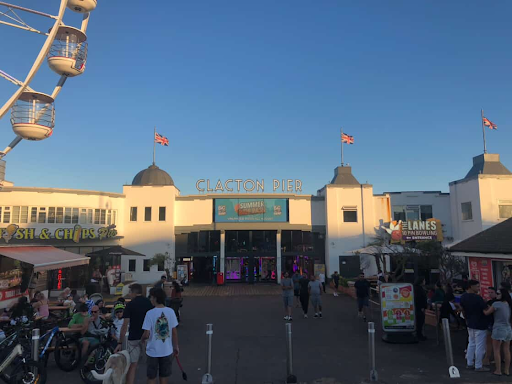
Featured Image Description: The iconic Clacton pier
Image Credit: Raphael McMahon (own picture)