
On Sunday October 25, 2026, Serbian President Aleksandar Vučić conceded defeat after his Serbian Progressive Party (SNS) lost Serbia’s parliamentary election to the student-backed movement Student List.
With nearly 99% of the vote counted, Student List had approximately 52.7% of the vote, compared with 39.2% for Vučić’s alliance. With a parliamentary majority, Student List is in a position to form a new government, marking the end of a Vučić-ruled Serbia.
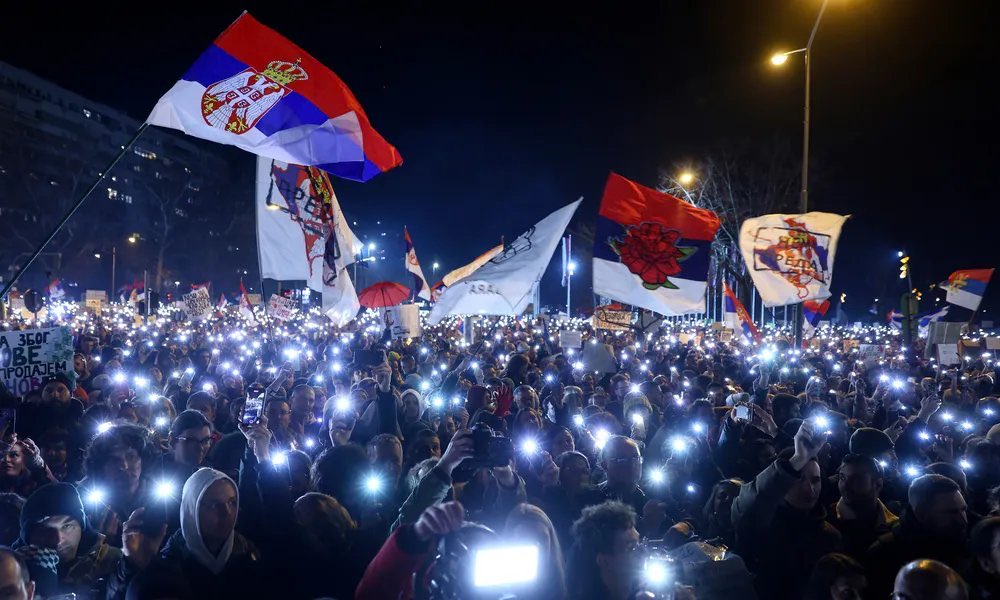
Tens of thousands of Serbians gathered in Belgrade and other Serbian cities to celebrate the election outcome and multiple Serbians told EU Reports that this election was about much more to them than the number of votes
The movement began in 2024, when a railway station canopy collapsed in Novi Sad and killed 16 people. The tragedy sparked massive student protests over alleged corruption, government accountability and democratic freedoms.
Read more: ‘Serbia, Wake Up’: Anti-government protests escalate as citizens demand elections and accountability
Protesters’ most serious allegations were that state officials had been negligent in their oversight of the project and pocketed the money for themselves in collaboration with foreign companies.
These protests continued for almost two years and eventually became a nationwide political movement capable of defeating the ruling party, which Vučić had led and which had dominated Serbian politics since 2014.
Read more: Serbia’s protest movement turns one: what’s happened so far, and what comes next?
Vuk Radišić Višnjić, a 26-year-old Master’s student of Political Science and a volunteer for the Green-Left Front left-wing party and its youth organisation, said the Novi Sad tragedy played “a huge role” in bringing about this election outcome.
“People have been dissatisfied with the ruling party for a while but there was no unifying factor powerful enough to bring everybody together for long enough,” she said.
The party she is part of grew from these protests, beginning as the Don’t Let Belgrade D(r)own grassroots movement. There had also been protests over the corruption and ecological harm of several regime-backed projects such as Belgrade Waterfront and lithium mining, “but the Novi Sad disaster was the last drop”.
She told EU Reports that “people mourned in public by standing silently and some protests arose right after the first of November, and people demanded an investigation and arrests of those responsible. The government lied, kept changing their story, and refused to allow any real investigation.”
A turning point, she added, was when “people who were mourning, particularly from the Faculty of Dramatic Arts, were attacked by regime sympathisers and […] that really ticked off people.”
“The more the regime tried to suppress these demands by the people and these acts of mourning, the more we wanted to show them,” she said. “It created a domino effect in which the government (in)action would bolster the movement.”
The movement also garnered significant support from Serbians living abroad.
Dr. Tatjana Brightside, a 37-year-old forensic psychologist from Belgrade’s Zemun municipality, now based in Dallas, Texas, told EU Reports that “when the protests started two years ago I even flew to Serbia for a week just to go to the streets and join the movement.”
“This student movement has been such a breath of fresh air in the world, not just in Serbia. They united the whole country. People you could never imagine marching alongside each other,” she noted.
Voting from abroad was a complicated process for Brightside. She was meant to vote in Houston, but she said Serbian authorities refused to open a polling station there despite a sufficient number of registered voters. She bought tickets to Chicago, then ended up flying to Los Angeles to cast her ballot instead.
“They made us vote according to Serbian voting times, which meant in the middle of the night.”
However, she marvelled that “despite the crazy long and slow line, not a single person was in a bad mood or complaining! Everyone was stoked to see how many people showed up! The energy was amazing.”
“I couldn’t not vote,” she said. “Honestly, ever since the protests started I’ve been itching to move back. It was just as clear as day to me that they would succeed… It feels like the most monumental day in my life.”
Rados Radević, a 40-year-old political scientist based in Belgrade, said that the dominant impression within his social circle is “the feeling that we finally got our country back, and that this is a starting point for building a new Serbia: a Serbia that reflects who we really are, in which every single citizen will be free.”
Younger Serbians also expressed their optimism. Jana Savić, a 28-year-old economics student with a professional background in marketing and digital communications, said the result is “about much more than the number of seats won or lost”.
She credited students who spent months “standing up for accountability, justice and institutions that serve citizens rather than protect those in power,” along with ordinary people who took personal risks and refused to accept corruption as part of everyday life.
“What makes this movement particularly meaningful is that it has given people hope that change can come from citizens themselves,” she said.
Savić said her hopes for Serbia’s future centre on the choices young people are forced to make.
“So many of us have considered leaving, not necessarily because we do not love our country, but because we want a future where we can build careers and live with dignity, without needing political connections, comp[romising our values, or constantly questioning whether the system will protect us.”
She wants a Serbia where people can criticise those in power without fear, where the law applies equally to everyone, and where young people do not see leaving as their only realistic option.
“I do not expect change to happen overnight,” she acknowledged, “and I know the road ahead will be difficult. But after everything people have invested in this struggle, I believe there is a real opportunity to build a more democratic, fair, and accountable Serbia.”
“Hope, for me, is not the belief that everything will suddenly be fine. It is the belief that we no longer have to accept that things can never be different.”
Featured image: Mohamad Safa via X