


European businesses are expanding their use of artificial intelligence, but integrating the technology into everyday operations remains a challenge. According to Eurostat, 20% of EU enterprises with at least 10 employees used AI technologies in 2025, up from 13.5% in 2024. As adoption grows, attention is shifting toward how companies can apply AI to specific business processes and turn its outputs into operational results.
That challenge is particularly relevant to retail execution, where consumer goods companies must translate marketing strategies into activities across physical stores. AI can analyze shelf conditions, identify misplaced products and flag promotional inconsistencies, but those insights have limited operational value if field teams cannot act on them and verify the results.
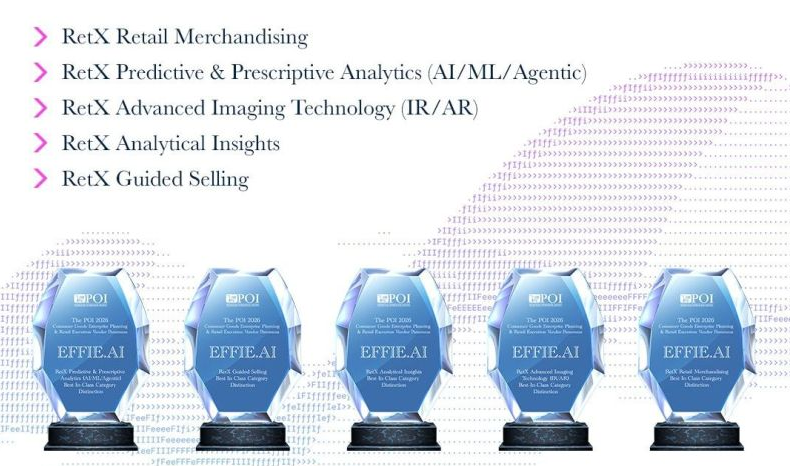
Against that backdrop, Effie AI, a retail execution platform serving consumer packaged goods (CPG) brands, has received five Best-in-Class Category Distinctions in the Promotion Optimization Institute’s (POI) 2026 Consumer Goods Enterprise Planning & Retail Execution Vendor Panorama. The recognition highlights its approach to agentic AI, which is designed to coordinate retail workflows and help verify actions rather than stop at generating recommendations.
The company has a European presence with an office in Kyiv, Ukraine and is also expanding in the United States. In May 2026, Effie AI announced the opening of an office in Deerfield, Illinois, near Chicago, describing the move as a way to work more closely with clients and support the adoption of agentic retail execution.
POI described effie.ai’s approach as “Operationalized Agentic Retail Execution,” positioning the technology around the execution of store-level tasks and the collection of verified information from the field.
How effie.ai connects AI insights with store-level action
Retail execution systems traditionally help companies monitor product availability, placement and promotional compliance. However, identifying a problem is only one step in the process. A representative still needs to interpret the finding, determine the appropriate response, carry out the task and confirm that the issue has been resolved.
Effie AI’s platform is designed to connect these stages. Its agents can plan store visits, guide field representatives, initiate corrective actions and verify outcomes. The system follows a cycle of detecting an issue, deciding how to respond, taking action, verifying the result and learning from the outcome.
Human workers remain responsible for physical tasks and interactions with store personnel, while AI supports analysis, decision-making and coordination. This division places agentic AI within frontline workflows rather than limiting it to back-office analysis.
POI recognized effie.ai across five categories: RetX Retail Merchandising; RetX Predictive & Prescriptive Analytics (AI/ML/Agentic); RetX Analytical Insights; RetX Advanced Imaging Technology (IR/AR); and RetX Guided Selling.
According to the company’s announcement, the assessment also highlighted its proprietary image recognition technology, which supports cloud-based, on-device and hybrid deployments. The platform is designed to accommodate conventional retail workflows as well as more agentic forms of execution.
The system also emphasizes the quality of the data collected during store visits. effie.ai says it verifies execution data at the source and structures it in real time, giving headquarters visibility into activity at the store, merchandiser and stock-keeping unit (SKU) levels.
The company describes this foundation as a “live digital twin” of retail execution. The data can then support operational analytics and enterprise AI applications, although its usefulness depends on the accuracy of field observations and how effectively companies integrate the information into their decision-making processes.
For European businesses, the broader question is how to move from AI adoption to measurable operational value. Eurostat’s figures show that adoption is growing, but the share of enterprises using AI does not by itself establish how extensively the technology has been integrated into core workflows.
For retail technology providers, connecting recommendations with verified execution is therefore an important part of the value proposition. A system that identifies a merchandising problem is not necessarily equivalent to one that helps resolve it and records the outcome.
Effie.ai’s five POI distinctions recognize capabilities spanning merchandising, predictive analytics, imaging and guided selling. The broader challenge for the sector will be demonstrating whether agentic systems can consistently improve execution across complex retail networks while producing reliable data and measurable business outcomes.
As European companies continue to expand their use of AI, the technology’s role may increasingly be judged not only by what it can identify, but also by what it helps businesses accomplish.

Disclosure: This article mentions a client of an Espacio portfolio company.