

A knife-edge election saw Sweden’s Prime Minister Ulf Kristersson resign after his government failed to achieve a parliamentary majority on September 13.
Magdalena Andersson, who previously served as prime minister from 2021 to 2022, is faced with uniting four parties with significant conflicts – if she is to step into Kristersson’s place.
On September 19, the Swedish Election Authority formally certified the parliamentary result of Sweden’s latest Riksdag election, in which opposition parties, led by Andersson, won 176 seats in Sweden’s 349-seat Riksdag, whilst parties supporting Kristersson won 173.
Under Sweden’s system of negative parliamentarism, a prime minister can take office unless a parliamentary majority votes against them. That threshold is 175 votes. Now, with opposition parties holding 176, Kristersson conceded defeat and resigned on September 17.
After the vote count was formalised, Speaker Andreas Norlén gave Andersson the task of exploring the possibility of forming a government on September 18. Her party, the Social Democrats, took the lion’s share of the vote for her bloc, with 99 seats in the Riksdag, though she must now assemble a government the remaining three parties can support.
Her greatest challenge is that the Left Party and the Centre Party show no inclination to collaborate with each other. Though both could enable an Andersson government, they sit far apart on economic policy, and have issued her incompatible demands.
Kingmakers who won’t sit together
The Left Party took 30 seats in the Riksdag, is socialist and economically interventionist, and is led by Nooshi Dadgostar. It demanded substantially more redistribution – including a billionaire tax – and stronger restrictions on private profits in welfare and schools.
Meanwhile, the Centre Party, led by Elisabeth Thand Ringqvist, took 25 seats. A market-liberal party with roots as Sweden’s agrarian party, it favours lower taxes and private enterprise, opposes banning profits in privately-run schools, and seeks a government with policies anchored in the political centre.
The fourth party in Andersson’s potential bloc is the Green Party, led jointly by Amanda Lind and Daniel Helldén. It took 22 seats in the Riksdag, and the Centre Party has said it could govern with the Social Democrats and the Greens, offering a potential three-party coalition option.
However, the Centre Party has said it will not sit in a government with the Left Party, with Thand Ringqvist stressing she currently sees no possibility of governing alongside the Left Party on the party’s principle of a centre government.
Dadgostar says the Left Party will only vote for a government that it will be a part of. She argues that the Left Party’s voters shouldn’t help put Andersson in office only for their own party to be excluded from governmental power.
Although the Left and Centre Parties disagree on economic policies, they are united in their opposition to the Sweden Democrats, the far-right party which gained 62 seats and is led by Jimmie Åkesson.
The Centre Party’s emphasis on individual liberty and international cooperation makes it distrustful of the Sweden Democrats, saying its values are incompatible with Sweden Democrats’ nationalism and approach to immigration and identity.
The Left Party likewise has major disagreements with the Sweden Democrats over its political aims.
Ahead of the September 13 elections, the rightist party proposed to keep asylum immigration as low as possible, tighten work permit requirements, and revoke permanent resident permits.
In April, Dadgostar publicly repudiated the prospect of the Sweden Democrats entering a future government with the Moderates, calling it “disgusting”.
“Now there is a lot at stake and now we know that we can have rightwing extremist ministers in the government. Now we have to come together to offer a different path for Sweden,” she told Swedish newspaper Dagens Nyheter.
The Sweden Democrats party itself suffered an important setback in the election, falling by three percentage points, which has interrupted its pattern of electoral growth. This decline in vote share is its first in a Riksdag election since it entered parliament in 2010.
Since both the Centre Party and Left Party strongly oppose the Sweden Democrats getting into government, an escape-hatch to the Centre-Left deadlock could be the Centre and Left either compromising on their demands or abstaining from the vote altogether.
In this case, an abstention can produce the same practical result as a vote in favour of the proposed government, since it won’t contribute to the 175 opposition votes needed to vote it down.
Minority rule or coalition?
There is a chance the Social Democrats could form a minority government if the Centre, Left, and potentially Moderate Parties choose not to vote Andersson’s government down.
However, she may need to form a coalition to formally take up the prime ministership. If she forms one with the Green Party, the Centre Party would join or tolerate this government, though the Left Party would not vote for a government it isn’t part of.
Andersson must pick sides between the Centre and Left parties.
Under Sweden’s constitution, the Speaker has up to four attempts to secure parliamentary approval for a prime minister. If all four propositions are voted down, an extraordinary election must be held within three months, with a caretaker government running the country in the interim.
Regardless, even this selected government would only be in power until the next scheduled ordinary election in September in 2030.
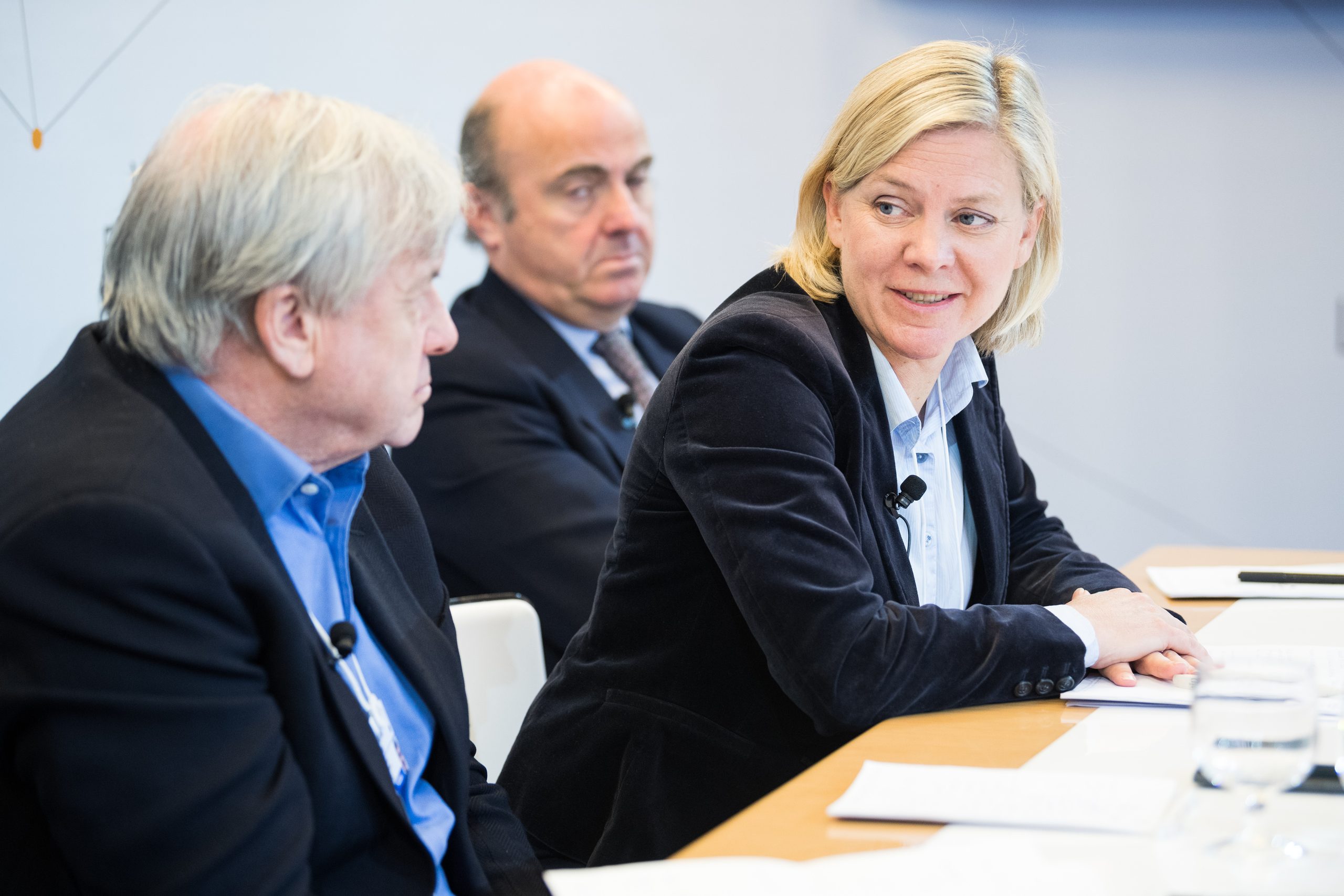
Featured image: Magdalena Andersson, Minister of Finance of Sweden speaking at the Annual Meeting 2017 of the World Economic Forum in Davos, January 18, 2017
Source: World Economic Forum / Boris Baldinger via Flickr
Creative Commons Licenses