
Nine years after journalist Daphne Caruana Galizia was murdered, the suspected mastermind’s recent acquittal has triggered a wave of mass protests in Malta’s capital.
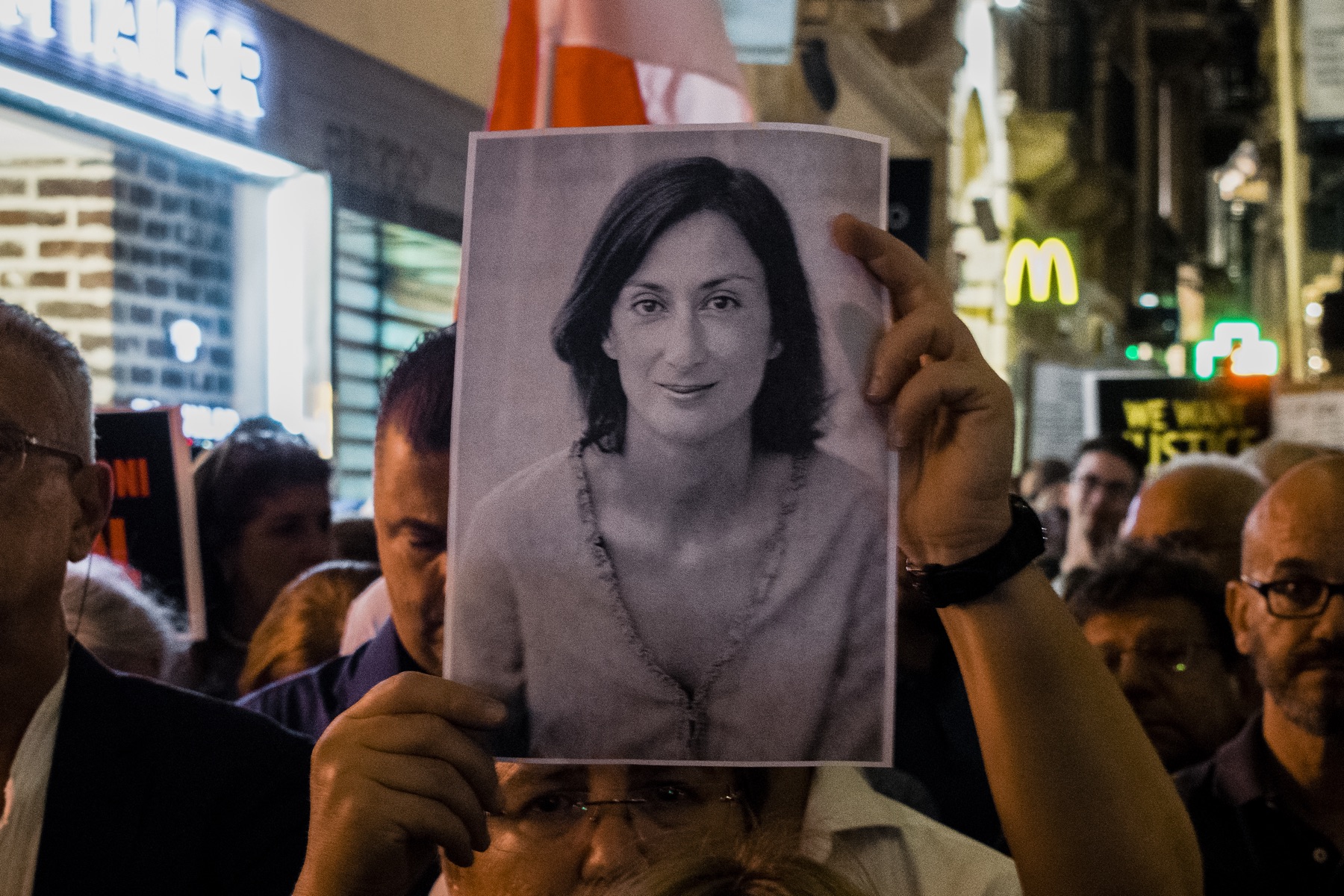
On Wednesday, September 16, a crowd marched through Valletta to express their outrage at the acquittal of Yorgen Fenech, a businessman whose property empire spans casinos and hotels, for suspected complicity in murder and criminal association after a two-month trial.
Fenech was acquitted 8-1 on September 2, and, despite expectations that Malta’s attorney general will launch an appeal, the legal threshold for an appeal is high: Article 500(3) of Malta’s Criminal Code allows the appeal court to intervene only in the case of a “grave irregularity” in the proceedings, reducing the likelihood that an appeal could meaningfully challenge the acquittal.
Five men are serving lengthy prison sentences for their roles in carrying out the assassination, yet the powerful figure suspected of orchestrating it is now likely to walk free.
Caruana Galizia was a writer, journalist, blogger and anti-corruption activist, known for her investigation of the Panama Papers. She was assassinated on October 16, 2017, when a bomb was placed under the seat of her car, and was remotely detonated.
With three decades of journalistic experience preceding her death, Caruana Galizia had become one of Malta’s most prominent–and polemic–journalists.
Via her platform, Running Commentary: Daphne Caruana Galizia’s Notebook, her penultimate and final posts were about Adrian Delia, then-leader of Malta’s Nationalist Party (PN) and Keith Schembri, a Maltese businessman serving as chief of staff to then-Prime Minister Joseph Muscat. These entries were published just minutes before her assassination.
The acquittal of businessman Yorgen Fenech
By September 4, 2026, independent Maltese civil society organisation Repubblika and Occupy Justice, an all-women pressure group, had called for a protest in place of a vigil at Great Siege Square in Valletta, scheduled September 16, and in solidarity with Caruana Galizia’s family.
Since the late journalist’s assassination, a vigil has occurred on the 16th of every month.
Last week’s protest saw the laying of flowers and candles before portraits of Caruana Galizia, and protesters were also seen carrying placards saying We will not look the other way and Mafia, Mafia, demanding accountability for her murder.
Internationally, the reaction was swift. The Brussels-based anti-corruption organisation Transparency EU called the verdict a setback for journalist protection and urged the European Commission to strengthen protections for journalists investigating corruption and organised crime.
Transparency EU director Nick Aiossa argued that the jury’s failure to convict Fenech sent “a chilling message to every journalist who dares to hold power accountable”. Meanwhile, Reporters Without Borders said it was “beyond outraged” by the outcome.
The Panama Papers
Both Delia and Schembri were named in The Panama Papers, the 2016 leak of 11.5 million documents from the Panama-based law firm Mossack Fonseca, investigated by the International Consortium of Investigative Journalists (ICIJ) and partner newsrooms. The scandal showed how politicians, celebrities and wealthy individuals globally used offshore shell companies to hide assets, avoid taxes, and, in some cases, launder money.
Many of the public figures, businesses, and HNWI named in the Panama Papers had legitimate reasons for wanting their assets in offshore accounts. As the Organized Crime and Corruption Reporting Project (OCCRP) notes, offshore accounts can protect companies from asset seizure in countries with corrupt legal systems, and help individuals in places where kidnapping for ransom is common keep a low profile at home.
But the same secrecy makes it hard to question where funds come from. Politicians, for example, have been accused of using offshore accounts to store public funds they have embezzled.
The Financial Action Task Force (FATF) has also documented the use of shell companies to disguise fraudulent financial activities by fabricating bogus loans, fictitious consultancy fees, and false invoices.
One such suspicious company was 17 Black, a secretive Dubai company that became the focus of corruption and money-laundering concerns in Malta. The firm was owned by Fenech, while he also served as director and investor in Electrogas, the consortium awarded the €450 million Maltese power-station project.
Leaked documents showed that Panama companies owned by Keith Schembri (Tillgate) and Konrad Mizzi (Hearnville), the minister closely associated with the energy project, listed 17 Black as a “main target client”. Their accountants also said the companies expected up to $2 million in payments from 17 Black and another firm for unspecified services.
What the documents could not establish, however, was whether that payment was ever wired and, if so, for what reason.
Schembri, Mizzi, and Fenech have all denied wrongdoing where 17 Black is concerned.
Caruana Galizia had already reported on 17 Black in February in 2017, although it was only after her death that Reuters publicly named Fenech as 17 Black’s suspected owner in 2018.
The global fallout
The Panama Papers exposed cases of corruption in an investigation considered extraordinary both for its scale and the profiles of the public figures it examined, who faced subsequent calls to step down from public office.
The leak revealed, for example, that former Icelandic Prime Minister Sigmundur Davíð Gunnlaugsson’s wife Anna Sigurlaug Pálsdóttir owned an offshore company that held claims against Icelandic banks, generating controversy due to the undisclosed conflict of interest this exposed. After a wave of protests in Reykjavik, Gunnlaugsson resigned within days of the first Panama Paper stories in April 2016.
In the UK, there were protests after Samantha Cameron, wife of former Prime Minister David Cameron, was found to have owned shares in an offshore investment fund established by her husband’s late father.
Pakistan’s prime minister Nawaz Sharif was removed from office after details about his family’s overseas properties were revealed.
“Atmosphere of impunity” in Malta
Within Malta, however, the public figures connected to the Panama Papers maintained their positions in government and business circles. Muscat kept both Schembri and Mizzi in his administration, for instance, despite multiple massive protests across the country.
Meanwhile, Caruana Galizia, whose reporting had uncovered both Schembri and Mizzi’s ties to offshore accounts in advance of the Panama Papers’ release, was facing increasing scrutiny and pressure from those in power.
Being an investigative journalist in the smallest country in the EU had made Caruana Galizia a household name and a visible target, and her blog averaged hundreds of thousands of views a day in a country whose population was below half a million.
At the time of her assassination, she was facing 47 libel suits and, following her assasination, the EU amped up efforts to combat Strategic Lawsuits Against Public Participation (SLAPP), recognizing that the pressures she faced could have been classified as systemic intimidation of a journalist.
The intimidation she faced extended beyond SLAPP to threats to her life and harm to her household. She was vilified online as a “witch” and subjected to arson attacks. Per her son, Paul, three of her family’s dogs were deliberately killed.
Calls for a public inquiry into Caruana Galizia’s death began within days of her murder, but the Maltese government held off until the Council of Europe formally urged it to set up an independent inquiry within three months. Malta announced the inquiry just before the deadline.
In July 2021 the inquiry concluded that the Maltese state bore responsibility for creating the “atmosphere of impunity” in which her assassination became possible, and had failed to adequately recognise and respond to the risks to her life.
Fenech’s acquittal this month has thrust the case back into the spotlight in Malta and beyond. For 107 months, her family, and now the crowds who gathered on September 16, have been making the same demand of the Maltese government: accountability.
Current Prime Minister Robert Abela issued a statement on September 2. “At this sensitive moment, the government appeals for prudence in public comments that could do more harm than good,” he said, in reaction to the acquittal.
Featured image: via the Daphne Caruana Galizia Foundation.