

Last Monday, the Tbilisi Court of Appeals overturned a previous acquittal of a Georgian police officer for stalking and harassing a minor.
It reversed a previous court ruling which found that the actions were “immoral”, rather than criminal, ordering the officer’s release.
The decision marks a rare victory for victims of cases of gender-based violence (GBV) in Georgia, with rights organizations saying the country’s justice system fails to protect women.
The police officer has now been convicted of stalking and sentenced to two years in prison.
The suspect allegedly knew that the victim was underage yet maintained contact with her both online and in-person, repeatedly touching her without consent, according to women’s rights group Sapari.
According to a 2022 survey conducted by Geostat and the United Nations Women’s Organisation, half of women aged 15-69 would experience at least one of seven forms of GBV in their lifetime in Georgia. In the same year, the country’s emergency domestic abuse hotline received an average of over 50 calls a day.
But victims of GBV often face significant difficulty when seeking justice in Georgia. According to research by the Georgian Young Lawyers’ Association, an independent human rights organization, the country’s laws on GBV consistently fail to provide victims with justice nor meet expectations under international law.
The law
Georgia is one of 36 signatories to the Council of Europe’s ‘Convention on preventing and combating violence against women and domestic violence’, otherwise known as the Istanbul Convention. The Convention was first opened for signature in 2011, with Georgia ratifying it in 2017.
The first Article of the Convention states that its purpose is to “prevent, prosecute and eliminate violence against women and domestic violence.” To assist countries in doing so, it provides a framework of definitions of acts of GBV, and how countries can support initiatives to combat root causes.
In 2024, the Georgian Young Lawyers’ Association (GYLA) published an in-depth report which exposed inconsistencies between Georgian law and the Convention, highlighting where legislation falls significantly short of meeting the Convention’s standards.
The first key issue which the report identifies is that definitions of GBV acts are frequently much stricter in Georgian law than what is stated in the Istanbul Convention. For example, in the Criminal Code of Georgia, rape is defined by violence being used as a part of forced sexual penetration, rather than what the Convention defines as rape, which is a lack of consent on the victim’s behalf.
There is a separate article for forced sexual penetration without physical violence, although this, too, does not acknowledge the victim’s lack of consent.
The definition of harassment and stalking is also unconventionally narrow. According to the Criminal Code of Georgia, victims must prove that stalking has caused them mental suffering, as well as necessitated a significant change in lifestyle. What constitutes ‘mental suffering’ or ‘significant change in lifestyle’ is open to interpretation, which causes significant issues for victims seeking justice. The Istanbul Convention merely requires that the act must cause fear of safety, setting Georgia’s minimum standards much higher than expected.
Rights group Sapari, which appealed the initial acquittal of the officer, argued that the officer’s actions caused the victim, who began avoiding places where she knew she may encounter her abuser, “severe psychological suffering”. Under Georgian law, this just meets the bare minimum of what victims have to prove in court.
Tackling the problem
The GYLA report identifies another key issue – Georgia’s lack of sufficient data and analysis on GBV. Article 11 of the Istanbul Convention requires parties to collect, analyse, and publish data on GBV as well as to support research of root causes, effects, and efficacy of interventions into tackling GBV.
However, GYLA’s report accuses Georgia’s key institutions of failing to analyze the available data. Analysis is carried out at the discretion of each individual institution involved in reporting and publishing of data, but has not been a requirement. This makes identifying and tackling root causes of GBV much more challenging.
Additionally, the current Georgian government has been targeting NGOs, such as Sapari, since the pro-EU protests in 2024. In turn, this limits the effectiveness of organisations in tackling GBV – another violation of the Istanbul Convention, which states that Parties should encourage, support and cooperate with these organizations.
Last year, Sapari was accused of using its funds to “organize violent acts or to procure equipment” and had its bank accounts frozen by order of the Prosecutor’s Office of Georgia.
Sapari, however, defended their right as a civil society organisation to purchase protective equipment for their staff who were monitoring human rights violations, particularly against women, during the mass pro-EU protests in 2024.
The organization stated that this was “another example of the increasing use of Russian-style repressions against Georgian civil society organizations”, and that it would continue to voluntarily assist victims of GBV for as long as possible.
A culture of normalization
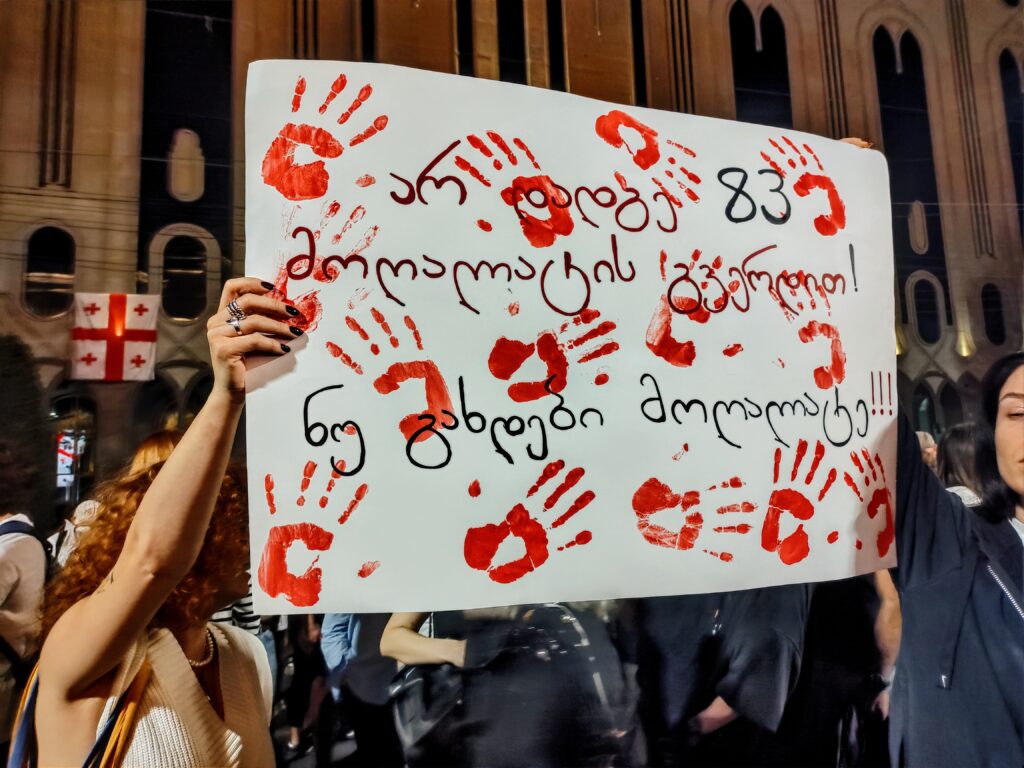
Human rights groups and independent news outlets have reported that officers at protests in Georgia frequently harass women. Independent Georgian news outlet OC Media reports that at least four cases of police using sexual violence against female protestors have been reported since the start of the protests in 2024. Many women have also posted about their experiences online, claiming that police officers frequently threaten to rape and sexually assault them at protests.
Amnesty International published a report in May 2025, which found that officers were using strip-searches against female protestors, despite full undressing during searches being prohibited under Georgian law, and that sexist abuse was being used to intimidate protestors. They claim that this behaviour forms “a broader pattern of abuse by and impunity for Georgia’s law enforcement agencies”.
According to UN Women, Georgia does not provide training to the police to support victims of GBV.
There has been little discussion or implementation of the findings of the GYLA report, and the law continues to fall significantly short of aiding victims in seeking justice. Groups which aim to support victims of GBV when the law cannot are facing an uncertain future in Georgia, with a political environment which is increasingly hostile to their mission.
Last week’s case epitomises the struggles of Georgian women in their fight for justice – from a culture of misogyny within the police, to a legal system which is not fit for purpose.