
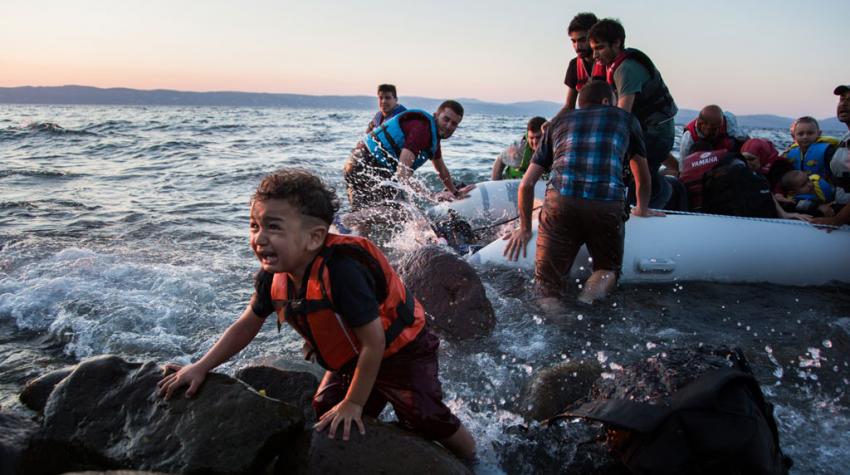

Irregular migrant arrivals in Europe fell 26% last year, the lowest levels since 2021, according to the report by Frontex, the European Border Agency.
Frontex’s figures show that irregular arrivals to the EU have fallen again at the end of 2025, dropping to 178,000. The figure reinforces a downward trend that has persisted over four consecutive years, as the EU continues to tighten its migration policies.
The Canary Islands route saw the steepest decline – down 63% – driven by a sharp fall in departures from Morocco, Mauritania, and Senegal. The western Mediterranean was the only route to record an increase, rising 14%, largely due to a surge in Algerian departures.
The European Agency celebrates these figures as a “significant development” achieved by strengthening border controls.
Such strengthening has been achieved primarily through cooperation between the EU and key partner countries outside the EU, alongside joint operations with national authorities and improvement in surveillance technology.
Tighter border controls have had devastating consequences for migrants, forcing many to take increasingly dangerous routes into the EU. According to UNHCR, at least 1,953 people died or went missing while trying to cross the Mediterranean in 2025 alone.
“It’s more accurate to say that migration pressure hasn’t gone away – it changed shape. When one route becomes harder to use, smugglers adapt and look for alternatives”, Chris Browski, communications specialist at Frontex, explained to EU Reports.
Red Cross research shows that these alternatives are often more treacherous and potentially deadly for migrants.
Although far-right populist politicians in the region frequently warn of a migration crisis, the latest figures suggest a more stable picture across European borders. Nevertheless, the data has failed to counter this narrative, with far-right parties continuing to grow in popularity across the continent, now polling at around 25%.
Cooperation with transit countries
A crucial development in 2025 contributing to the decline in irregular migration was the EU’s expanded cooperation with transit countries. Through migration agreements and partnerships with countries such as Türkiye, Tunisia, Egypt, and Mauritania, the EU provided financial support in return for stronger border controls, measures against migrant smuggling, and readmission cooperation.
“Closer cooperation between the EU and key partner countries has reduced departures on some routes, especially in West Africa and parts of the Eastern Mediterranean”, Browski outlined.
Also speaking to EU Reports, Peter Varga, Legal Director of International Refugee Assistance Project (IRAP) Europe, an organization which provides legal aid and advocacy for displaced people, shared his perspective on the partnership agreements with transit countries:
“[The agreements are] a misleading label for policies whose primary goal is to keep people out of Europe, despite credible and persistent reports of grave human rights abuses and extreme forms of modern slavery in several partner countries,” Varga said.
IRAP focuses on working with refugees in Europe who are trying to reunite with family members left behind.
Varga’s work with both long-term residents in Europe and their families seeking reunification gives him insight into how current policies affect people on both sides. He said the arrangements are designed as “informal soft law instruments, limiting democratic scrutiny and effective judicial review”.
Migrants and human rights groups report that Mauritian authorities intensified crackdowns on migrants from March last year, following a 2024 pact with the EU aimed at curbing irregular migration.
Data from the Red Cross, based on interviews with arrivals, indicates that departures from Mauritania fell by 89% to 23 between April 1 and December 31, 2025, compared to 216 in the same period of 2024.
This externalization of borders – shifting enforcement to partner countries – has reduced the number of boats reaching the EU. However, the Red Cross found that following the crackdown in Mauritania, smuggling networks from West Africa to Spain’s Canary Islands adapted towards more distant and potentially deadlier routes.
“The most lethal crossing [to Europe] is sadly yet to become more lethal still,” Hassan Ould Moctar, a lecturer in the anthropology of migration at SOAS University of London, told Reuters, referring to the Canary Islands route.
Browski believes the EU policy changes most affecting Frontex operations mark a shift away from solely reacting at the border.
“The focus now is on earlier action: working more closely with partner countries, sharing information faster, and targeting the smuggling networks that organize these journeys,” Browski explained.
Varga explained the shift in focus as, “away from life-saving responses, such as those prioritized under earlier search and rescue efforts, toward pushbacks and other forms of deterrence”.
He added that this change has coincided with serious legal and humanitarian concerns, as allegations of illegal pushbacks involving Frontex grow, while organizations working to save lives face criminal prosecution.
Technological advancements
The EU has stepped up investment in surveillance technology and patrols along key maritime routes to strengthen border control.
Satellite and airborne-based Earth Observation (EO) technologies now support national authorities in managing the EU’s external borders. Frontex deploys drones and coordinates patrols to detect vessels earlier, intercept more boats, and deter departures.
A Frontex report highlighted six cases demonstrating the effective use of EO technologies for maritime surveillance, vessel detection, pre-frontier monitoring, and well tracking cross-border crime and irregular migration.
“Planes and satellites have become essential tools for how we patrol Europe’s borders… at the same time, they are critical for saving lives, by helping us locate small boats in distress across vast areas”, Browski explained.
Anti-immigration rhetoric
Irregular migration in the EU has now almost halved since 2023. In December 2025, European Commission President Ursula von der Leyen acknowledged this sharp drop, saying, “the figures speak for themselves” during the Conference of the Global Alliance to Counter Migrant Smuggling in Brussels.
Despite evidence to the contrary, far-right populist anti-immigration sentiments, rooted in exaggerated stats, persist.
Jordan Bardella, president of French far-right National Rally party, told the BBC in December that “France will no longer be the target of mass immigration”, promising to “take back control of our borders.”
A policy brief by the Paris School of Economics found that anti-immigration rhetoric generates a “repulsive effect” that discourages potential migrants – especially those who are highly educated and skilled – resulting in an “adverse selection of immigrants.”
The brief also noted that these sentiments influence the implementation of restrictive government policies. The electoral success of far-right parties has pushed centrist and left-leaning parties to adopt tougher lines on immigration to appeal to public anxiety, “leading to an overall hardening of policy”.
This shift has translated into concrete measures, including stricter asylum laws, fewer legal migration pathways, stronger border controls, and reduced entitlements for new arrivals.
French President Emmanuel Macron’s administration adopted a “shield” strategy amid growing anti-immigration sentiment and pressure from the far-right National Rally. Macron framed the policy as necessary to manage borders and “calm the tensions” in France.
Looking ahead
Europe’s borders are set to tighten further as the EU’s Migration and Asylum Pact, the most far-reaching reform yet, comes into force in June 2026, alongside planned implementations of Entry/Exit Systems (EES) and the European Travel Information and Authorization Systems (ETIAS).
Varga told EU Reports that the Pact is a “direct result” of how European officials have responded to rising anti-immigration rhetoric.
In the future, Europe risks effectively abandoning the 1951 Refugee Convention in favor of a system built on externalization.
Varga warned that, as the saying goes, “history does not repeat itself, but it rhymes”, arguing that fearmongering and political failure are repeating old patterns.
The director also insisted that European populations demand better leadership and “refuse to let them chip away at our institutions and the human rights system that previous generations fought so hard to build.”
Featured image: via the United Nations