
Glasgow, Scotland — In 2022, Nika Kovač was studying at Columbia University in New York when both American society and her life would be changed forever. After witnessing the fall of Roe v. Wade, she would devote the next three years of her life advocating to protect European women from a similar fate.
“I saw first hand how rights can be taken away overnight,” she told EU Reports. “I didn’t want what happened in the U.S. to happen to Europe.”
Although her home country of Slovenia has abortion rights enshrined in the constitution, many other EU countries do not have such protection. The World Health Organization estimates that around 483,000 unsafe abortions happen each year across Europe.
After Poland’s near-total abortion ban in 2020, a UN report found that at least six women had died after being unable to access an abortion, while many others experienced physical and mental suffering.
In Malta, where abortion is also illegal, pro-choice organization Doctors for Choice Malta estimates that at least 100 people travel abroad for abortions each year. Even in countries where abortion is legal, many still allow doctors to conscientiously object to performing the procedure.
Therefore, Kovač and her team realised that the fight for access to abortion could not remain a national fight, but should be escalated to the European Union level.
This desire for protection at the EU level led to My Voice, My Choice, an initiative calling for the EU to create a financial mechanism where member states could opt-in to fund travel costs for people travelling to their countries to receive abortion care.
Three years later, with the support of 1.2 million EU citizens behind them, My Voice, My Choice brought their proposal first to the EU Parliament, then the EU Commission. This led to one of the most significant decisions on abortion in the history of the EU.
Navigating EU institutions
“Because we believe in change through democratic mobilization, we decided to use the only formal democratic tool available to EU citizens, the European Citizens’ Initiative,” said Kovač.
The European Citizens Initiative allows proposals for legislation receiving at least one million signatures across seven EU countries to be considered by the EU Commission. Over the course of a year, My Voice, My Choice collected 1.2 million signatures backing their initiative.
“This moment is not only about reproductive rights,” said Kovač. “It is about whether European democracy functions as promised; whether citizens can use the tools they are given and see a real institutional response and change.”
As grassroots organizers, navigating EU bureaucracy was new terrain for the group.
“We didn’t enter European institutions with a lot of hope, but we believed in our idea,” said Jerca Freilh, content creation lead, in a press conference following the decision. “We did everything we could—we moved to Brussels, we met with politicians who gave us hope and were so supportive, and today we are so, so, proud.”
These efforts paid off in December 2025, when they presented their initiative to the EU Parliament. The Parliament supported the proposal, voting to ask the EU Commission to create a new fund to support people travelling for abortion care.
In late February, the Commission gave them an answer in recognizing the danger associated with unsafe abortions in Europe, but decided that “it is not necessary to propose a new legal instrument.” Instead, they invited member states to seek funding to improve abortion services, including subsidizing travel for those using these services, through the existing European Social Fund Plus.
Although disappointed that no new funding stream would be created, Kovač called this decision “a victory for women in Europe [and] a good day for European democracy.”
In her view, this decision shows that there are pathways within the EU for member states to support people travelling for abortion. With the EU Commission giving explicit permission to use funds for this purpose, countries may now be encouraged to do so.
My Voice, My Choice has many high profile supporters, including the leaders of France, Spain, and Slovenia. The initiative was also endorsed by the International Confederation of Midwives (ICM), who represent the voices of midwives globally.
Daniela Drandić, Head of Advocacy and Communications at ICM, told EU Reports that the My Voice, My Choice campaign is significant because it frames women’s reproductive health as a political and human rights issue.
“With this ‘yes’ from the European Union, they firmly said that it’s a right and that it transcends member state politics,” said Drandić. “I think that’s putting us on a really interesting trajectory that’s absolutely necessary given the pushback on women’s health and rights that’s happening globally.”
The importance of the movement
For Kovač, this campaign has proven the importance of a strong grassroots movement to hold governmental institutions accountable and into change.
“The institution itself will not take care of things. The movement is needed,” she said, following the Commission’s decision.
Local chapters of My Voice, My Choice were set up to gather signatures in several EU countries, but the group also reached many supporters through their strong online presence.
“Our online community was our strongest ally and biggest weapon,” said Veronika Povž, who coordinated the digital campaign alongside Freilh. “For us it’s super important that people are not just followers, they are [an] active part of the campaign.”
My Voice, My Choice used social media not just to gather signatures for their own campaign, but also to raise awareness about feminist issues across the globe, from ICE’s violence in the United States, to the Epstein files, and Israel’s genocide in Palestine. They are also supporting other Citizens’ Initiatives, such as Against Conversion Therapy’s campaign to ban LGBTQ+ conversion therapy in the EU.
Unfortunately, they’ve also been subject to relentless online abuse, including death threats and deepfake porn images of Kovač.
Drandić argued that My Voice, My Choice’s campaign showed the important role civil society and women’s groups can play to bring people together in movements.
“People are actually coming together, and they’re creating a movement to show policymakers that this is something that’s important and this is something that we want policymakers to pay attention to,” she said.
Improving abortion access beyond finances
“What we know globally, is that in countries where women don’t have access to timely, safe, comprehensive abortion services, we see maternal mortality numbers go up,” said Drandić, emphasizing the consequences of inaccessible abortion care.
My Voice, My Choice seeks to address the financial obstacles that prevent people from accessing safe abortion, but these are not the only barriers present.
“The reality is that every single country in the EU restricts abortion access in some way,” said Camille Kumar, Managing Director of the Abortion Support Network, an organization supporting people travelling for abortion.
In particular, she points to countries with term limits where abortion care is only provided up to a certain stage of the pregnancy. Many of the people ASN supports come from countries where abortion is legal, such as France and Ireland, but are no longer eligible for care in their home country.
Nevertheless, she welcomed My Voice, My Choice’s push for the EU to intervene where they have the power to do so.
For Drandić, abortion, as well as contraception, should be available as part of primary care.
“Having midwives and having comprehensive sexual and reproductive health services in communities actually is really important,” she said.
Without these services, “[people] have to go into this grey area for seeking information, which is not always accurate and is not always providing them with all the options that they actually have,” she added.
The ICM is currently campaigning for governments to invest in addressing the shortage of midwives around the world, as they believe that more trained midwives will help to improve women’s reproductive health. It’s equally important that those midwives are enabled to do their work without political restrictions.
“In Europe, we’re facing a lot of issues when it comes to midwifery, and one of them is a lack of professional autonomy and a lack of scope of practice in many countries,” said Drandić.
Ultimately, she hopes that My Voice, My Choice has proven that midwives associations, civil society, and the health sector must collaborate and build connections to fight for better, more accessible services.
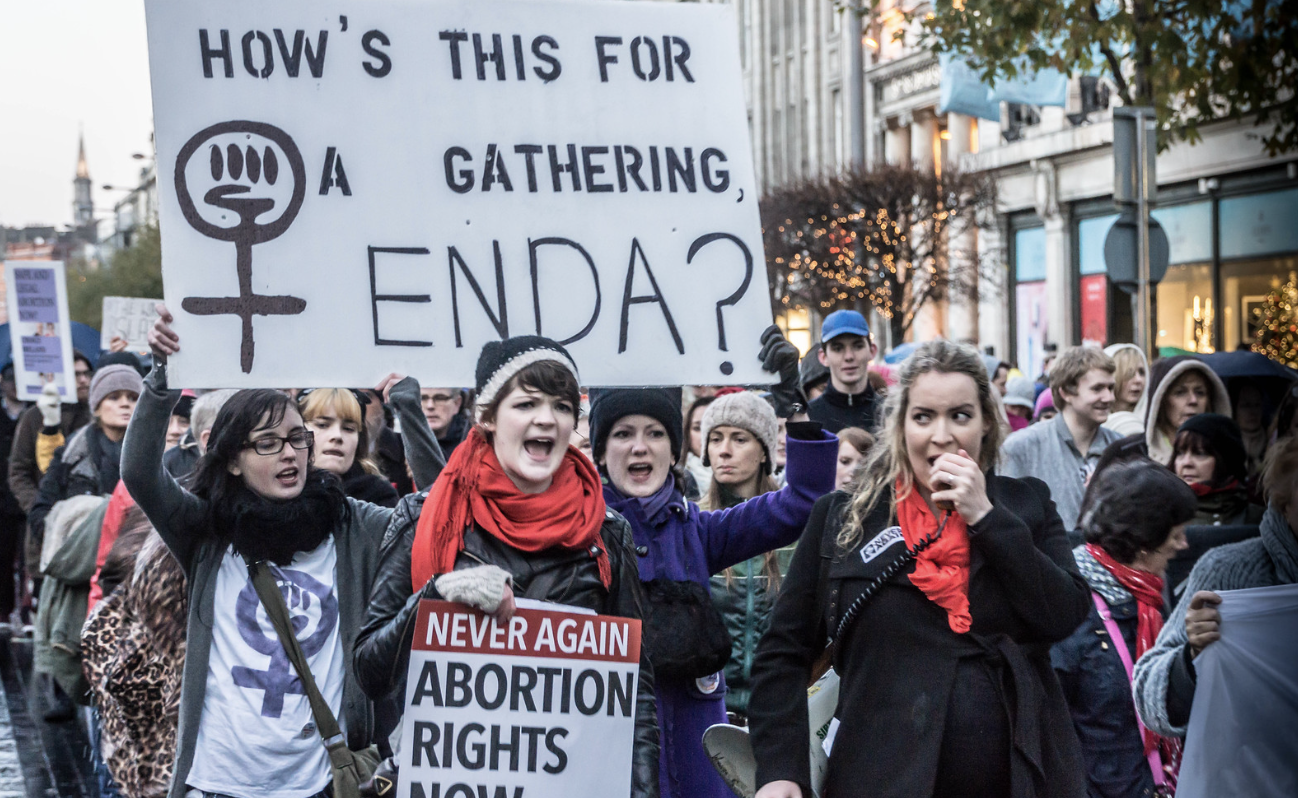
Featured image: About Ten Thousand People Attended A Rally In Dublin In Memory Of Savita Halappanavar
Source: William Murphy via Flickr
Author: William Murphy
Creative Commons Licenses