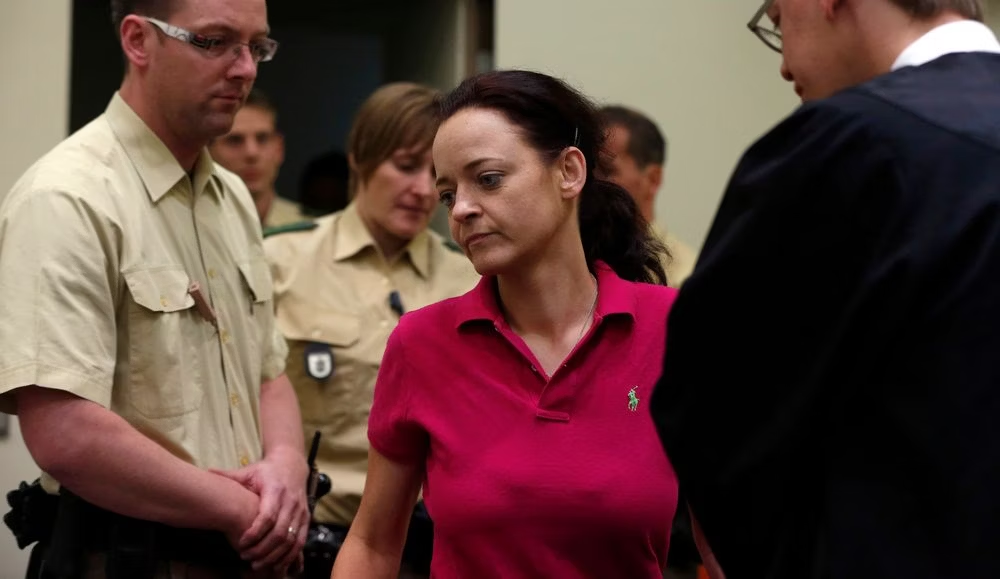



Glasgow, Scotland – Members of the Filton 24 – a group of Palestine Action activists arrested following their breaking into a UK-based Israeli arms factory – have announced that they will soon pursue legal action against their former prisons for what they consider “medical neglect” while on hunger strike.
In a press conference on March 25, former prisoners Kamran Ahmad, Teuta Hoxha, Heba Muraisi, Madeleine Norman, and Qesser Zuhrah detailed abuse, harassment, and neglect that they allegedly experienced while being held on remand.
Lisa Minerva Luxx, a member of the Filton 24 Defence Committee, told the press conference that more details on the planned legal action would be announced in the coming weeks.
Why were the Filton 24 imprisoned?
Starting in August 2024, 24 people were arrested under suspicion that they were connected to a break-in at an Elbit Systems factory in Filton, near Bristol.
Following their arrest, the UK government invoked anti-terrorism powers to deny the Filton 24 bail, even though no member of the group has been charged with terrorism offences to date. This meant that some members of the group were incarcerated for as long as 18 months without trial.
Read more: UK hunger striker begins thirst strike: “They will be held to account”
While in prison waiting for their trial, the Filton 24 members reported facing prejudicial treatment, physical abuse, and restrictions of their ability to express themselves and associate with other prisoners.
“Prisoners were warned not to associate with us because we were deemed to be terrorists,” said Hoxha. After the proscription, she said that prison treatment got harsher, and “included removal from recreational activities and jobs, ban on books, and mail censorship.”
Muraisi and Zuhrah both described physical assault by guards and being forced into solitary confinement.
“I hated having to pick up the phone to tell my loved ones what happened because I would start crying,” Zuhrah said to the press.
The first six members of the Filton 24 began their trial in late 2025. When not convicted of any offence, all were released except Samuel Corner, who is still facing charges of grievous bodily harm.
In February, prosecutors dropped charges of aggravated burglary against the other 18 defendants, allowing them to successfully apply for conditional bail.
Palestine Action was proscribed as a terrorist organisation in July 2025, but the UK High Court ruled the decision unlawful in February.
Hunger strikes and hospitalisation
On November 2, 2025 – the anniversary of the Balfour declaration, by which the British government supported the establishment of a Jewish state in Palestine – Zuhrah and Amu Gib, who were incarcerated in association with a break-in at RAF Brize Norton, began a hunger strike.
Their demands called for better prison treatment, right to a fair trial, de-proscription of Palestine Action, and closure of Elbit Systems’ operations in the UK.
“We felt every avenue was exhausted, legally and socially, to challenge the biases of our case and our treatment, and also to stop the genocide going on abroad,” said Ahmad, who also began his hunger strike in November 2025.
During their respective hunger strikes, Zuhrah, Muraisi, Hoxha, and Ahmad all described experiencing medical neglect from the prisons. They alleged that they were not provided with sufficient electrolytes, their medical concerns often dismissed, and they were not given proper care once they ended their strikes.
Zuhrah recalled that she was left paralysed on the floor of her cell for 22 hours before receiving medical care. It was only after a crowd gathered outside the prison, including MP Zarah Sultana, that the prison called an ambulance.
“The guards took turns staring at me, watching and waiting for either my soul to leave my body, or my dignity to collapse and for me to end my hunger strike,” said Zuhrah. “This was one of the scariest and hardest moments of my life.”
The mistreatment allegedly continued when the hunger strikers were taken to hospital. Muraisi said she was chained to a male guard, and asked to change clothes in his presence.
“Due to their treatment of me in hospital, I was forced to stop my refeeding early and return to the prison against medical advice,” she said.
Ahmad was similarly cuffed to a guard, and claimed that the marks from the cuffs are still visible today. He also said that he still suffers from chest pain and shortness of breath as a result of the hunger strike.
Other strikers report experiencing long-term effects such as brain fog, which Hoxha told the press conference makes it hard for her to articulate herself.
In particular, Ahmad drew attention to the condition of Umer Khalid, another hunger striker associated with the action at Brize Norton, who has currently lost the use of his legs. Khalid is still incarcerated, and suffers from Limb-Girdle Muscular Dystrophy.
During the hunger strike, the Ministry of Justice denied claims that hospital care was being refused.
Featured image: via Worker’s Weekly Internet Edition.