
As the conflict in Iran continues, Portugal’s far-right Chega (Enough) party intends to put forward a proposal banning the entry of any migrants from countries affected by the conflict.
In a press conference in early March, Chega party leader and Assembly of the Republic Deputy André Claro Amaral Ventura announced the party would be proposing the total “suspension of the entry of asylum applications into Europe from the Middle East,” to avoid a new migration crisis in the wake of U.S. attacks on Iran and Iranian counter-attacks on Israel, the Gulf states, and other nations throughout the Middle East.
“It was precisely these countries that caused the migration crisis of 2014 and 2015, which is still being paid for to a large extent because there was no control,” Ventura stated. “Europe will not withstand another wave of refugees of this type without systemic political movements.”
Whilst he has conceded that there may be some exceptions for “absolutely inescapable cases of humanitarian situations,” the deputy has called for a ban of at least six months, with the possibility for this to be extended “as long as necessary while the area is destabilised.”
The Chega party intends to present this proposal to the Assembly – Portugal’s parliament – whilst also leveraging their role as a member party of the right-wing European Parliament Patriots of the Republic group – which includes Hungary’s governing Fidesz party, Spain’s VOX and France’s National Rally – to push for similar policies to be implemented at a regional level.
What is Chega?
Whilst the Chega party do not currently hold a majority in the Portuguese Assembly, theirs has been a fast-growing party that has gone from a fringe movement to the main opposition force in the space of just seven years.
Prior to this, Portugal had been seen as largely avoiding the tide of right-wing populism that has spread across Europe over the past decade. Founded in 2019 by Ventura, Chega had initially won just 1.3% of the vote in the elections of that year.
However, by the time of the parliamentary elections held in 2025, Chega’s share of the vote had rocketed up to 22.76%, overturning decades of bipartisanism after it gained a greater number of seats than the Socialist Party (PS), and coming in second place behind the centre-right Democratic Alliance (AD).
In the presidential elections held over January and February 2026, Chega again came in second place, with moderate Socialist candidate António José Martins Seguro being seen as winning only after moderate Conservatives voted for him in order to prevent a Ventura win.
With its strict anti-migrant policies, and campaigns based around slogans such as “This isn’t Bangladesh”; the Chega Party has drawn widespread accusations of racism – particularly against Muslims and communities like the Roma people.
With his background as a sports commentator, Ventura has effectively portrayed himself as a man of the people, whilst also harkening back to the days of Portugal’s authoritarian past, when the country was governed by right-wing dictator António de Oliveira Salazar from 1932 to 1968.
Alongside their calls for a ban on migration from the Middle East, the Chega party has over the past year also successfully pushed through the Assembly a ban on burqas and other face veils. They are now also calling for a ban on the flying of Pride flags on or outside public buildings.
“The State cannot transform public buildings into propaganda panels,” stated Chega MP Francisco Gomes, who maintains that public buildings should not be “ideological showcases or extensions of private agendas.”
In response, however, a number of Portuguese MPs have called for a ban on the Chega Party itself, which is to be discussed at the Assembly.
Could Chega be banned?
A petition calling for the Chega party to be outlawed was initially put forward in January 2026, on the basis that the party does not comply with the Constitution, as it espouses fascist ideology – which is prohibited of associations or organisations under Portuguese law.
A further petition calling for Chega’s dissolution was put forward in late February. And, whilst a debate on this in Parliament is not mandatory since it received less than the 2,500 signatures necessary, the Assembly’s Constitutional Affairs Committee has accepted it for consideration.
The admissibility report, authored by PS MP Isabel Moreira, received votes in favour from the PS and the separate left-wing Livre party, whilst the Social Democrats (PSD) and Liberals (IL) largely abstained, with Chega opposing.
The petition was accepted on February 18, and is to be debated in the Portuguese Assembly.
Moreira emphasized that only the Constitutional Court can declare a party illegal, with the Assembly only having the power to debate or request this. She also stressed the importance of freedom of expression, stating: “It is part of the democratic rule of law, and therefore of a democratic constitution, to take the risk of welcoming the intolerant.”
The Chega party reacted with anger to the admittance of this petition by the Committee. “The persecution of Chega subverts democracy, attacks democratic plurality, freedom and the principle of separation of powers.” said Chega MP Vanessa Barata.
Critics have also suggested that such a move will only give further credit to Chega’s arguments.
“The idea of banning Chega is a political project that, given its growth, its parliamentary representation, and its impact on the political landscape, simply makes no sense,” noted Dr. João Ferreira Dias, a researcher in populism studies at the University Institute of Lisbon.
“It would be like trying to put the snake back in the egg,” he told EU Reports. “On top of that, it’s counterproductive, as it fuels a narrative of victimhood, persecution, and censorship; something that plays right into the hands of charismatic, populist, and messianic parties like this.”
“It’s a very poor way for the left to show it’s still relevant, and it risks undermining the Constitutional Court,” the scholar concluded.
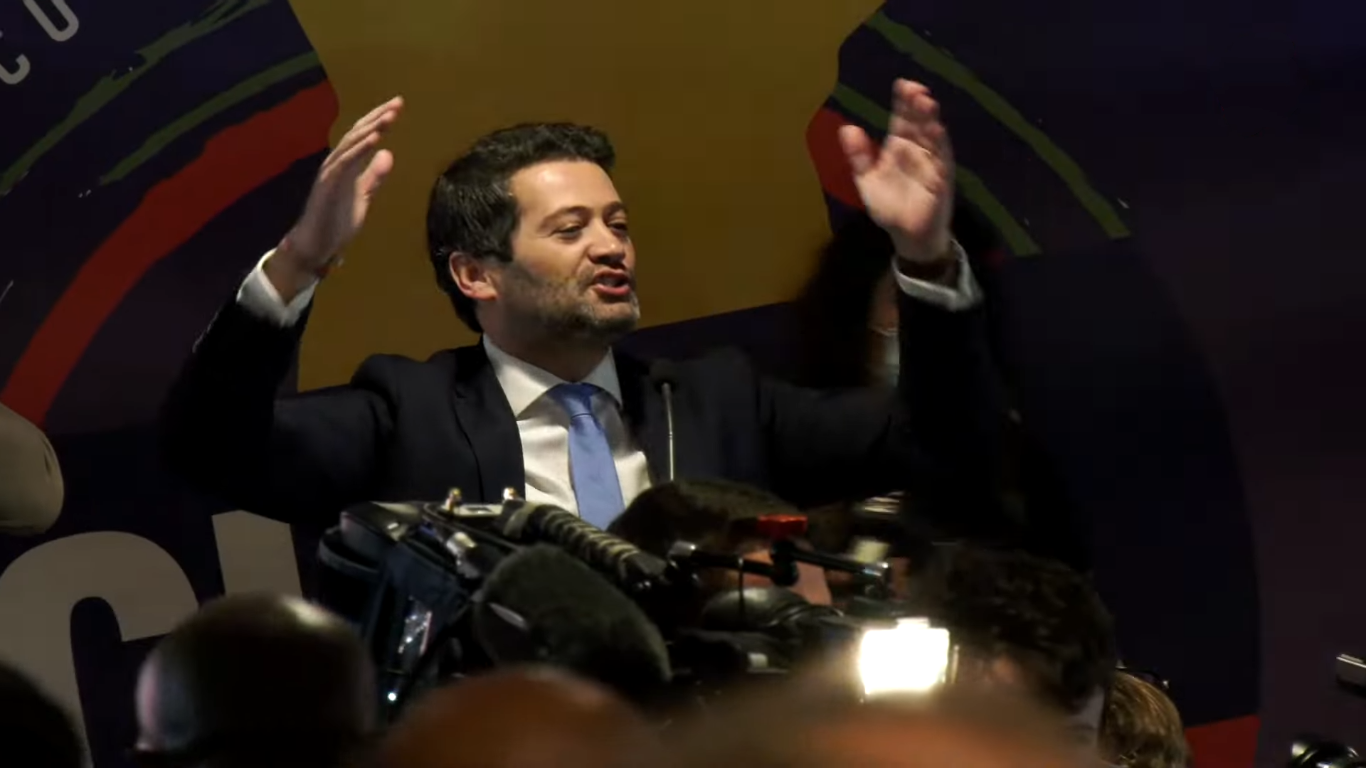
Featured image: André Ventura discursa na noite eleitoral das Legislativas 2022
Author: Agẽncia Lusa
Source: Wikimedia Commons
Creative Commons Licenses