

London, UK – Armenia is ranked among the top five countries targeted by Russian efforts to spread disinformation, alongside Moldova, Latvia, Estonia and Serbia.
Following a study undertaken by the Center for Information, Democracy and Citizenship at the American University in Bulgaria, which analysed more than 640,000 publications released by Russia between December 2024 and March 2025, scholars concluded that most targeted nations host critical energy infrastructure connecting European markets with Russian supplies – which is of strategic interest to President Vladimir Putin.
Russia now frequently interferes in elections in countries which were formerly under USSR influence or considered an essential “buffer”, such as the Balkans, as per Euronews.
President Putin is motivated to muffle pro-European discourses in these regions via electoral interference, and was almost successful in the 2024 Moldova presidential elections when a comprehensive disruption campaign – including the buying of votes, cyberattacks, and espionage – led to the very narrow reelection of President Maia Sandu.
Sandy is not favoured in Russia due to her role in securing candidate status for Moldova to join the European Union in June 2022.
An even greater degree of Russian interference was experienced during Romania’s presidential elections in November 2024, when Calin Georgescu, a largely unknown ultra nationalist pro-Russian extremist, came a surprise first in the first round, winning 20% of votes.
Georgescu’s rise to popularity was deemed too good to be true, and on December 6, 2024, Romania’s highest court annulled the election which was rescheduled for May 2025, after which the politician was charged for attempting to stage a coup.
Armenia faces an altogether different geopolitical context in the lead up to its June 2026 parliamentary elections: unlike other nations targeted by Russia’s disinformation campaigns, Armenia goes one step further against her former ally Russia by becoming more closely aligned with both Europe and the U.S.
Armenian Prime Minister Nikol Pashinyan’s distance from Russia comes following his dismay at Putin’s betrayal of the Collective Security Treaty Organisation (CSTO) during the Nagorno-Karabakh War (2023-24), which obliges members to defend one another if under attack.
The CSTO took no action when sovereign territory of the Republic of Armenia was occupied by Azerbaijan in 2021; CSTO member Belarus actively aided Azerbaijani forces between 2018 and 2022 while tensions peaked with Armenia; and Russia abdicated its mandate under the Trilateral Peace Treaty of November 2020 to keep the humanitarian corridor from the Republic of Armenia open during Azerbaijan’s blockade of the Armenian population in the war.
Eduard Arakelyan, a military analyst at Yerevan’s Regional Center for Democracy and Security, confirmed to Politico that these events are a “complete breach of the CSTO alliance.”
“We’ve always known the bloc was more supportive of Azerbaijan,” he said. Such a conclusion has informed Armenian domestic and foreign policy ever since.
Armenia-U.S. relations warm:
The first sign of a new-and-improved U.S.-Armenia alliance came when President Donald Trump’s administration advanced the Trump Route for International Peace and Prosperity (TRIPP), a proposed transit corridor through Armenia aimed at connecting Azerbaijan’s Nakhichivan exclave to the mainland.
“TRIPP is expected to generate reciprocal benefits for international and intra-state connectivity for the Republic of Armenia,” a U.S. government statement said.
The new TRIPP Implementation Framework also hopes to further “American commerce by expanding regional trade and connectivity… [and] create new transit opportunities linking Central Asia and the Caspian to Europe,” – a clear threat to Russian trade and commercial influence in the region.
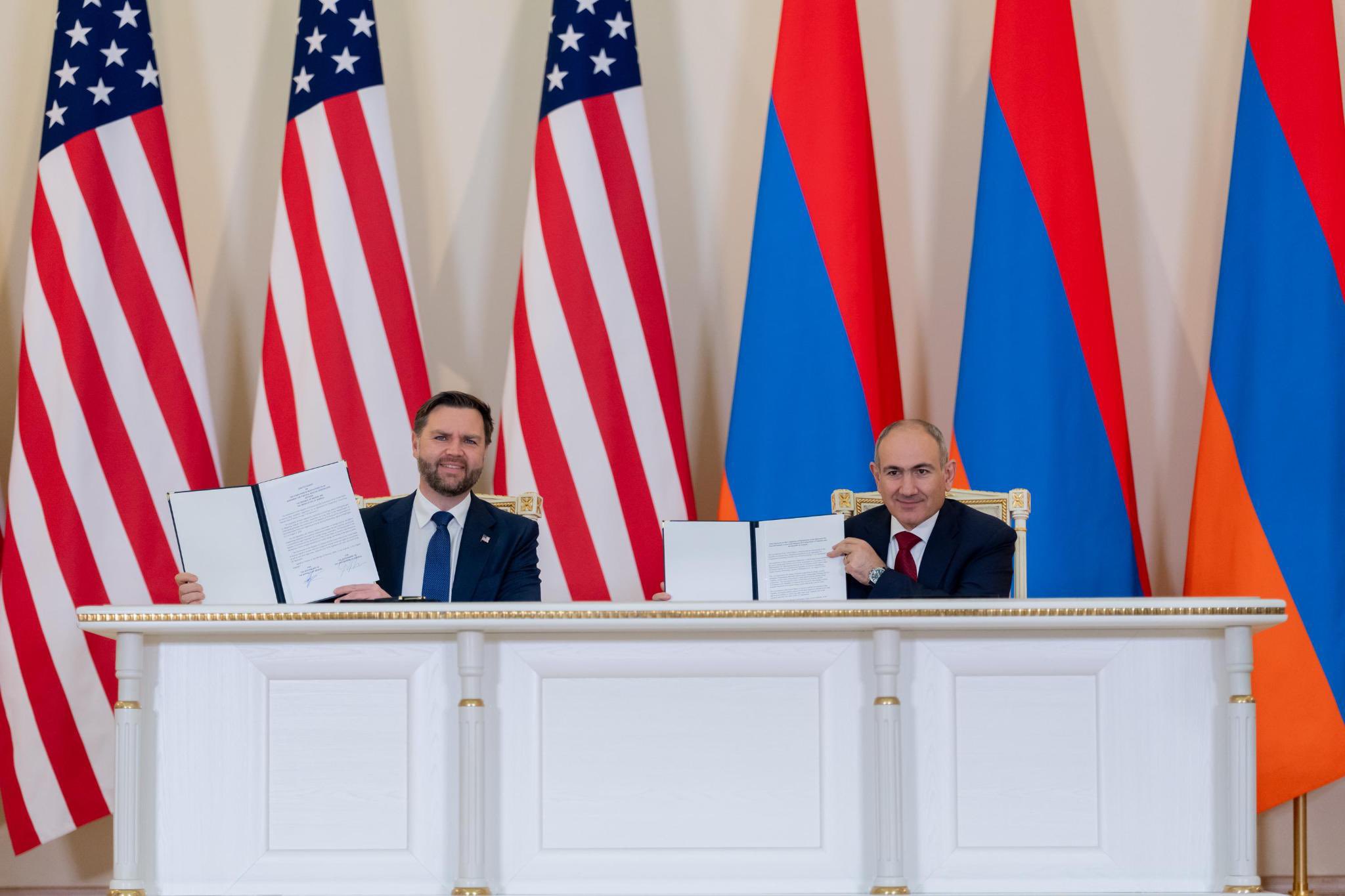
Besides this, U.S. Vice President JD Vance made a historic trip to Armenia this week, marking the highest-level visit by an American leader since Armenia gained independence from the USSR in 1991.
Read more: U.S. Vice President visits Armenia and Azerbaijan to promote Trump-backed trade route
The Vance-Pashinyan talks deepened cooperation in nuclear energy, cemented news of Armenia’s first ever purchase of U.S. military technology and outlined deals in chip production in Armenia, according to OC Media.
Vance outlined that the countries have agreed to cooperate in the civil nuclear sector, which is to contribute to the diversification of Armenia’s energy resources by involving safe and innovative technologies, according to Armenian Prime Minister Pashinyan.
During the meeting, Pashinyan and Vance announced the completion of negotiations on an intergovernmental agreement, whereby the nations will cooperate in the peaceful use of nuclear energy. Russia, meanwhile, had offered the construction of new nuclear power units in Armenia days before Vance’s visit.
Lacking in fossil fuels, Armenia clings to a decrepit Soviet-era nuclear plant which is past its original design life, lacks the secondary containment for modern plants and lies 12 km away from a tectonic faultline. Despite Armenia continuing to rely on Russian uranium supplies, it is increasingly turning its eye to the U.S. for its nuclear future.
U.S.-Armenia AI chip deal:
Vance emphasized the nature of the “incredible tech-deal” the U.S. and Armenia struck, unlike Trump’s predecessor President Joe Biden – who had curbed exports of Nvidia AI chip deals to the country under the AI diffusion rule.
Trump’s second administration ensured that the AI startup Firebird was given U.S. regulatory approval for the sale and delivery of an additional 41,000 NVIDIA GB300 graphics processing units (GPUs) to Armenia in the second phase of the so-called Armenia AI Megaproject.
Vance highlighted that the U.S. would issue a “number of export licenses for the sale of high-powered Nvidia chips”.
“These chips…simply do not exist in most countries in the world… [but] they are now going to be developed and the data centres using those chips are going to be built and, in fact, are already being built in Armenia thanks to the Prime Minister’s leadership.”
Armenia continues its legacy as the Silicon Valley of the Soviet Union; formerly responsible for the telecommunications, computing and electronics industries under the USSR, the country now aims to strengthen its technology sector and position itself as a regional hub.
Analysts predict that the sector will only continue to grow due to investment and the influx of Russian tech experts émigrés. Given Armenia’s lack of natural resources and limited geostrategic importance, the growth of the IT sector could be pivotal in making Armenia attractive to Europe and beyond.
Within the context of U.S.-Armenia cooperation being consolidated, alongside European Union-Armenia approximations, Pashinyan’s foreign policy decisions over the last year will leave him vulnerable to Russian interference in the upcoming months before the June 2026 elections.
Until then, Russia’s so-called “clone sites” – designed to resemble reputable Western publications – will surely continue to publish spurious information about the increasingly EU and Western-aligned Armenian prime minister.
We can expect to see more virulent attacks than those against Moldova or Romania as Armenia undermines Russia twice-over, while Pashinyan’s government pursues a new multilateral foreign policy – including alliances with Europe and the U.S. in Putin’s backyard.
Featured image: JD Vance via X.