
Edinburgh, Scotland – As Brussels accelerates efforts to reduce its reliance on China, a revived free trade agreement with India is being framed as both a geopolitical necessity and an economic opportunity.
The EU-India trade agreement sheds light on a strategic shift in European economic policy towards Asia, diversifying partnerships as an attempt at the bloc’s ‘de-risking’ approach to China-centric supply chains. The agreement also underpins the EU’s quick response to U.S. pressure.
American President Donald Trump’s aggressive trade policy – including a 50% tariff threat on Indian goods and a warning of punitive charges against the EU over Greenland defence commitments – has added urgency to Brussels’ diversification agenda.
Europe’s reassessment of China began in 2019, when the European Commission described Beijing as a “systemic rival”. Such a shift was reinforced by China’s punitive trade measures against Lithuania, export controls on critical raw materials, and its political alignment with Russia following its invasion of Ukraine in 2022.
Together, these developments highlighted Europe’s supply-chain vulnerabilities, prompting Brussels to prioritise strategic autonomy above pure cost efficiency.
This recalibration gave renewed momentum to the long-stalled EU-India free trade negotiations, which collapsed in 2013 before being reopened in 2022.
Officials from both sides have adopted triumphalist rhetoric, but underneath those statements lies a deal that could harm workers in both continents, even as proponents argue it offers numerous opportunities for both economies.
What the deal contains
The EU-India free trade agreement comprises three interconnected components: investment protection, trade, and geographical indications.
It aims to eliminate tariffs on 96% of bilateral trade, saving EU exporters an approximate €4 billion annually.
EU–India bilateral trade is currently estimated at €120 billion, with services trade alone accounting for €59.7 billion in 2024. European foreign direct investment to India is €132 billion, highlighting the deal’s importance for capital-intensive sectors.
While Europe sees the deal as opening India’s market to chemicals, pharmaceuticals, automobiles, machinery and wines, India hopes the agreement will improve its access to gems, textiles, jewelry, leather and professional mobility services – a key priority that Indian negotiators have pushed for decades.
In the services sector, EU firms would have access to 144 service subsectors, including engineering, IT, and business services.
European Commission President Ursula von der Leyen called it the “mother of all deals,” while Indian Prime Minister Narendra Modi celebrated it as “historic.” These claims, however, mask the embedded asymmetries reflecting domestic political constraints and unequal bargaining power.
As economist Marta Bengoa states, “trade agreements redistribute activity rather than create it, producing winners and losers within both economies.”
An agriculture-for-cars bargain
Sensitive agricultural produce such as beef, sugar, rice, and dairy remains excluded from the agreement, so as to protect EU farmers.
Meanwhile, India’s pharmaceutical and automobile sectors encounter steep tariff reductions; automobile duties will drop from 110% to 10% and will be completely abolished for car parts in five to ten years.
The EU estimates that exports to India will double by 2032, prompting concern among Indian unions. The Communist Party of India also echoed these concerns:
“The EU itself projects its exports to India to grow by 107.6 per cent within a few years. It will adversely affect employment as the imports in automobile, electrical machinery etc., will have an impact.”
“The reduced cost of cars and wines will only benefit the affluent, while the tariff cuts will wreck the livelihoods of workers, farmers, and common people,” the Party added. European exporters, however, see ample opportunity.
Belgian Green MEP Saskia Bricmont referred to the agreement as an “agriculture-for-cars logic,” while speaking to Brussels Signal. She characterised the deal as something that is meant to protect EU agricultural interest while opening Indian markets for European cars, warning that this could risk becoming an “Ukraine-for-cars” trade-off, given India’s continued entanglement with Moscow.
India also stands to benefit, however, as European investment could modernise manufacturing and create export jobs in sectors with comparative advantages and limited market access – including leather, textiles, marine products like shrimp, and jewelry.
Doctor Wilfried Swenden, Professor of South Asian and Comparative Politics at the University of Edinburgh, also sees potential benefits:
“I wouldn’t necessarily write off Indian businesses. There are perhaps even manufactured goods that do not require the kind of complex inputs that may be produced much more cheaply in India than in Europe. And if they are given access to the European market, could benefit from this agreement,” he told EU Reports.
Through the trade agreement, Indian textile and leather exporters especially benefit, as they can finally compete with Bangladesh and Vietnam, which have received preferential access for years.
The service provisions also represent rare EU concessions on labour mobility: for European industries facing skilled labour shortages – including IT and software development, engineering and the healthcare sector – easier access to Indian professionals fulfills a genuine economic need.
The pharmaceutical paradox
The agreement marks a fundamental dilemma: how to encourage drug development while ensuring medicines remain affordable.
India supplies over 20% of generic medicines and 55-60% of vaccines worldwide. The EU’s push to extend pharmaceutical patent protections could sharply raise drug prices, potentially by as much as fiftyfold, according to Dutch advocacy group ARISA.
Concerns also go beyond the two signatories, as various developing nations are dependent on affordable Indian generics.
Pharmaceutical industries in the country, however, are divided. While small manufacturers fear being squeezed out by the competition, larger research-focused firms see opportunities in European collaboration, namely through joint R&D venture initiatives for complex generics and biosimilars, technology transfer for advanced therapies, and development of new molecules.
Meanwhile, Indian smallholder farmers will face pressures from new patent rules, expected to increase costs for fertilisers and seeds, raising food security doubts for millions.
De-risking or diversification?
Brussels positions its desired proximity to India as “de-risking, not decoupling,” yet EU-China bilateral trade exceeded €730 billion in 2024. India’s continued dependence on Chinese goods restrains its ability to become a full alternative.
“India is a very good example of a country with the necessary market size to facilitate de-risking from China through diversification,” wrote Alicia García-Herrero, chief economist for Asia-Pacific at Natixis, in Bruegel. However, she also noted that a complete substitution of China continues to be challenging due to India’s current market size and manufacturing capacity.
Professor Swenden is similarly cautious of the notion that India is replacing China as a trade partner.
“It may eventually, in time if all of this is implemented and some of the commitments to collaborate more on certain issues in the future – including areas and security and so forth – it can potentially provide an alternative. But there is a very long way to go before that is actually being reached.”
Yet, partial diversification carries strategic weight. By deepening ties with India, Europe gains leverage against China while aiding a democratic partner. The EU-India Trade and Technology Council could also gradually reduce dependencies, although sustained political will is required.
Regardless, the geopolitical logic is littered with contradictions: Indian ties with Russia remain substantial; 38% of Russia’s crude oil exports were purchased by India in 2025.
“It is incomprehensible to conclude a partnership with a state that does business with Putin’s Russia, while we legitimately support Ukraine,” Bricmont stressed.
Animal welfare groups have also criticised the deal for allowing imports from production systems banned in the EU:
“Allowing cruel imports creates a race to the bottom that undermines our values and our farmers,” noted Mandy Carter of the Animal Policy International NGO.
A complex bargain
The EU-India trade agreement anchors Europe’s trade strategy in managing geopolitical risk. European pharmaceutical companies, automakers, and wine producers stand to benefit, alongside Indian IT professionals, textile exporters, and consumers accessing cheaper European goods.
The gains are real: European manufacturers access a rapidly growing consumer base, while Indian exporters receive secured preferential treatment in well-to-do European markets.
However, the costs fall on Indian small-scale farmers, automobile workers, and pharmaceutical manufacturers – who are already facing intensified competition – along with patients globally who may lose access to affordable medicines.
And, in Europe, the deal safeguards agricultural lobbies while potentially undermining animal welfare standards.
Whether the agreement constitutes a balanced bargain depends on its implementation. Will labor mobility translate into genuine opportunities? Will sustainability provisions be enforced? Can India leverage European investment to build competitive industries?
The European Parliament and India’s Cabinet will ultimately determine whether this agreement delivers shared prosperity or disproportionately shifts burdens onto vulnerable populations.
The mother of all deals?
In an era of geopolitical fragmentation, trade deals inevitably involve trade-offs. The question is whether democratic institutions have sufficient power to hold negotiators accountable.
The “mother of all deals” promises historic significance; whether that history will provide benefits to ordinary workers or primarily serve elite interests depends on democratic vigilance by both sides in the coming years.
The agreement is still far from implementation. After the conclusion of negotiations on January 27, 2026, it will undergo a process of legal vetting and translation that is estimated to take up to six months.
Formal signing would be the next stage, after which the agreement will go through numerous ratifications by the European Parliament and India’s Union Cabinet. If ratification proceeds smoothly, the agreement could enter into action by early 2027.
Once fully enacted, tariff reductions will be steadily phased in over several years. Automobile duties and other sensitive sectors will face extended transitional periods. This staged implementation shall offer both risks and opportunities as it provides time for industries to adapt, but prolongs uncertainty for workers whose livelihoods are at stake.
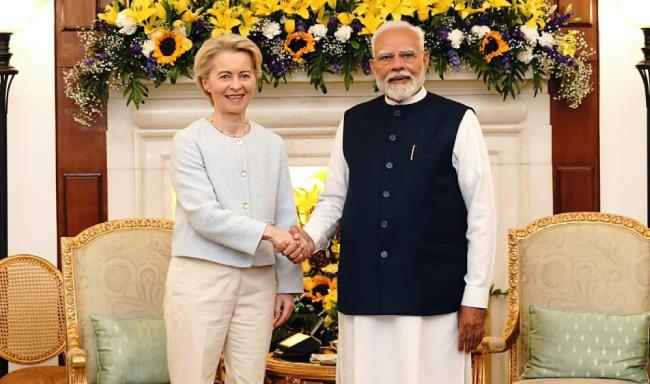
Featured image: Prime Minister Shri Narendra Modi met H.E. Ms. Ursula Von Der Leyen, President of the European Commission at Hyderabad House
Source: India Ministry of External Affairs