

Tbilisi, Georgia – The UK, Germany and Canada are among 24 Organization for Security and Co-operation in Europe (OSCE) member states to initiate a mission to examine deteriorating human rights conditions in Georgia.
Western leaders have expressed numerous warnings about the ruling party Georgia Dream’s increasingly authoritarian mode of governance in recent years.
The country, long seen as one of the most democratic post-Soviet states, has received warnings about serious backsliding from the EU and in November 2025, was declared a candidate country “in name only”.
In a joint statement released on the British government’s website, OSCE members highlighted restrictions on freedom of expression and assembly. They also pointed to politically motivated arrests and prosecutions, and a bid to ban opposition parties.
Read more: Rights groups warn of democratic backsliding as Georgia toughens protest legislation
Dozens of protesters who took part in mass demonstrations after the decision to suspend EU membership talks in late 2024 are currently serving prison sentences.
Prominent politicians have also been jailed. Cases were recently brought against eight opposition leaders, several of whom are already in prison. The charges, ranging from sabotage and to aiding foreign powers, carry potential sentences of up to 15 years.
The 24 states launched the probe by invoking the Moscow Mechanism, a procedure which allows OSCE member states to send an expert mission to investigate human rights violations in another participating country.
The mechanism has been activated sixteen times since its creation in 1991. It was initially rare, largely to investigate attacks on civilians during the Yugoslav wars, but it has been invoked more frequently since Russia’s 2022 invasion of Ukraine, particularly to investigate alleged abuses by Russia and Belarus.
OSCE members previously invoked the Vienna Mechanism, a less hardline tool allowing monitoring of implementation of rights commitments, following police brutality against protesters in December 2024.
Read more: 365 days of defiance: Georgia protesters mark resistance movement’s anniversary
Georgia now has time to respond to the OSCE’s request. If it accepts the request to send a mission, it will have the right to choose three rights experts from a pre-established selection. But, if it declines, states can instead appoint a group of independent rapporteurs to visit Georgia and produce a report.
The OSCE’s announcement came shortly after Georgian Dream unveiled a package of legislative amendments tightening restrictions on organisations that rely on foreign-funding like NGOs, civil society groups and independent media outlets.

Source: Zlad! via Wikimedia Commons
Creative Commons Licenses
The proposals strengthen existing requirements for recipients of foreign funding to register, comply with onerous reporting obligations, and obtain government approval for any foreign grants.
Under the amendment, failure to obtain permission for foreign funding could result in fines, community service or up to six years in prison. Employees of foreign-funded bodies will also be barred from political party membership for eight years.
Several NGOs have already suspended their work, and many more have had to reduce their activities. Some prominent rights groups and civil society organisations have also come under investigation by the state’s anti-corruption bureau, resulting in the freezing of their bank accounts.
Irakli Kirtshkalia, chair of Georgian Dream’s parliamentary faction, said that the measures were designed to “ensure that in the future no one can find alternative ways to finance unrest and violence in Georgia from outside the country.”
Georgian Dream has repeatedly justified repressive measures by claiming they are necessary to prevent foreign influence and attempts to disrupt constitutional order. Government critics dispute this, claiming the measures are instead politically motivated moves designed to suppress dissent and weaken civil society.
Editor’s note: The reporter’s name has been withheld due to security concerns.
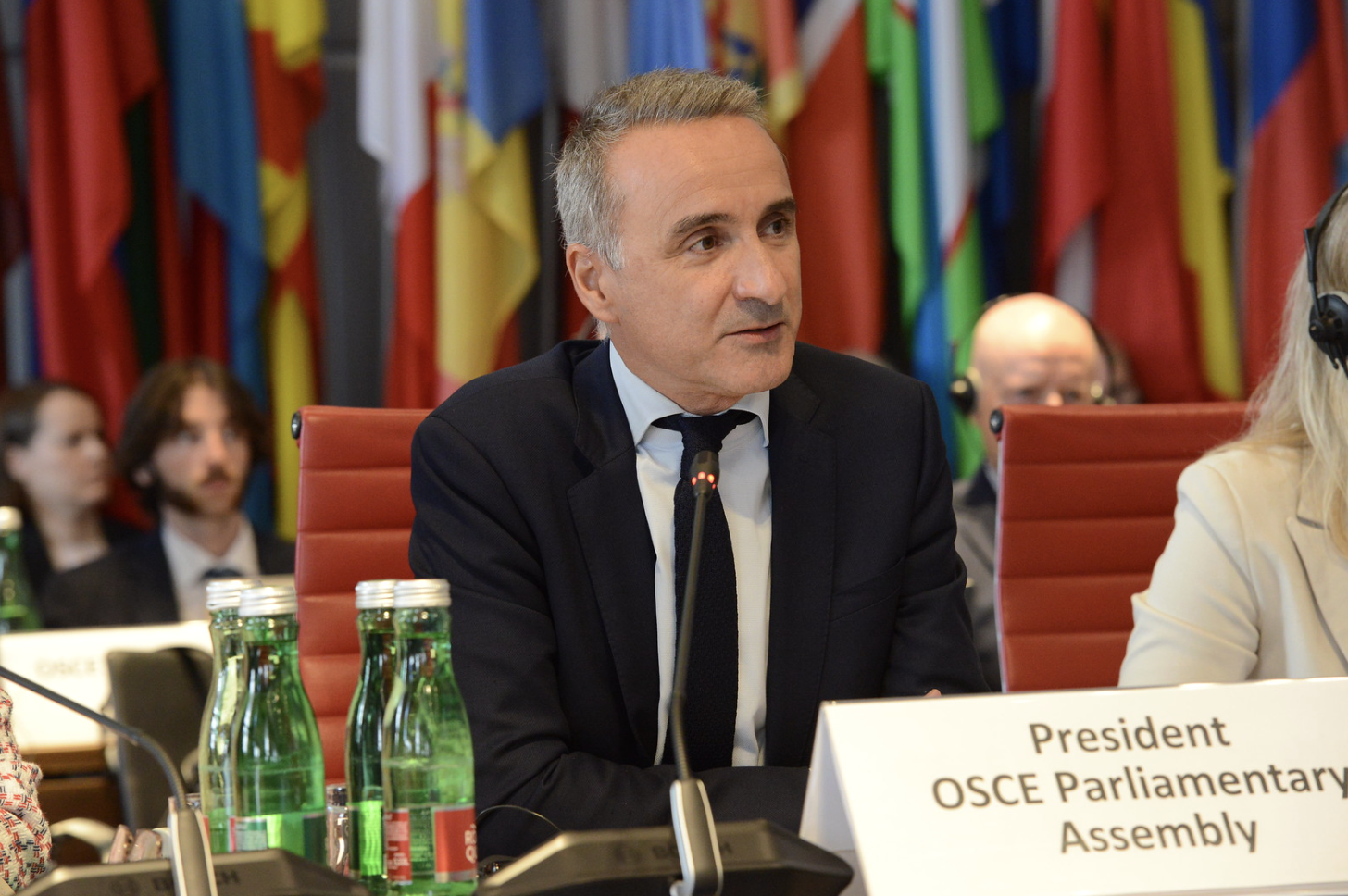
Featured image: President Pere Joan Pons addresses the OSCE Permanent Council in Vienna, 11 Sept. 2025.
Source: OSCE Parliamentary Assembly via Flickr
License: Creative Commons Licenses