
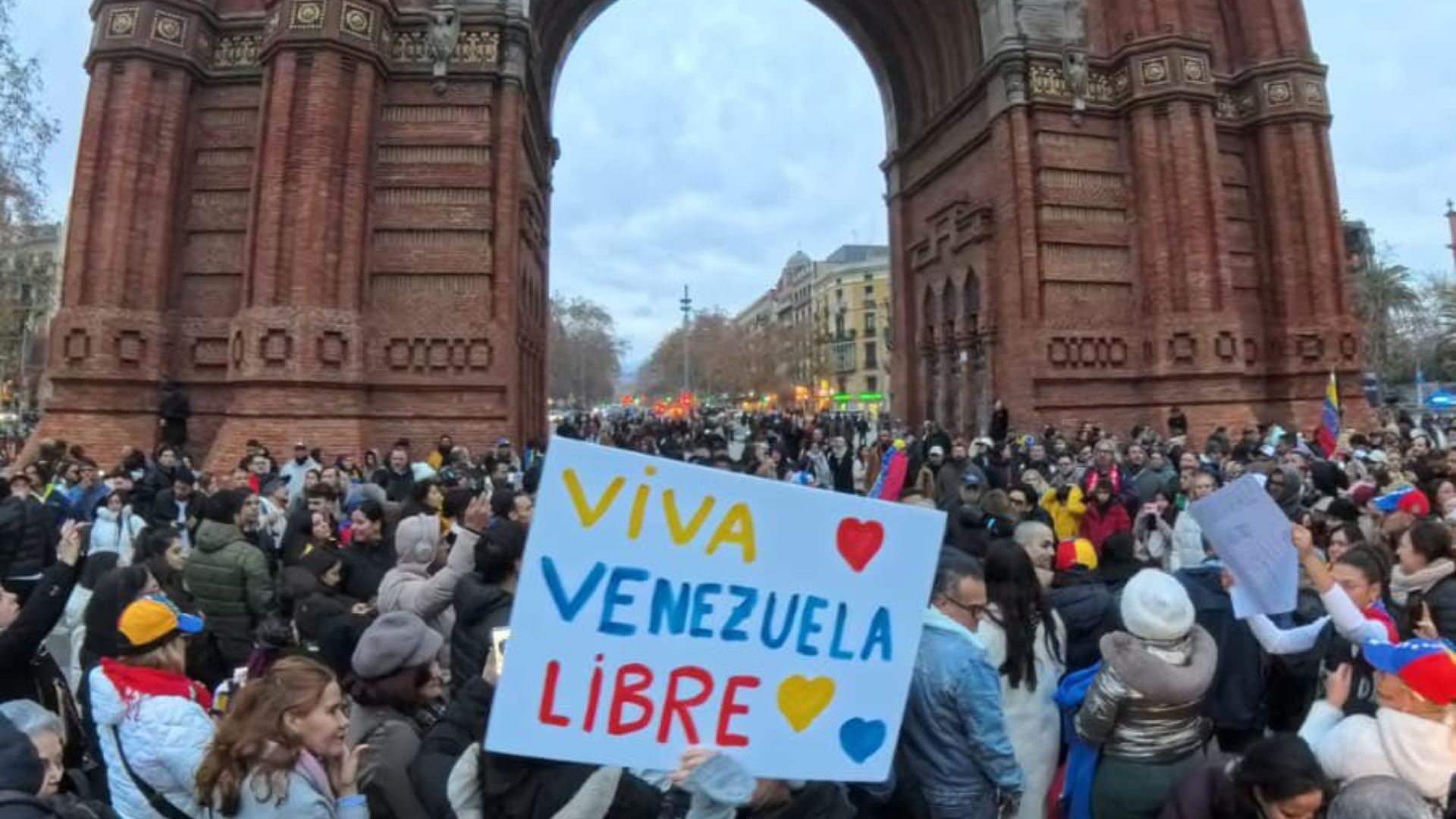
Hundreds of exiled Venezuelans and their supporters gathered at Barcelona’s landmark Arc de Triomf on the night of January 4, 2026, to celebrate the shocking U.S. operation which saw the detention of Venezuelan leader Nicolás Maduro and his wife, Cilia Flores.
Just a day before the celebration, on January 3, 400 others gathered in front of the Venezuelan Consulate in the Catalonian city, protesting what they deemed America’s “imperialist aggression” against the sovereign state of Venezuela.
Maduro was captured by U.S. forces after President Donald Trump deployed Operation Absolute Resolve on Caracas on Saturday, and is currently standing trial in a New York courthouse, accused of conspiracy to commit narco-terrorism, conspiracy to import cocaine, and possession of weapons of war, among others.
And, while protesters at the Arc de Triomf seemed to salute the news of Maduro’s detention, they also demanded respect for the electoral victory they claim opposition leader Edmundo González Urrutia obtained in the Venezuelan 2024 presidential election.
Such plea starkly contrasts Trump’s declarations at a January 3 press conference, where he dismissed the opposition’s popular backing and stated:
“We are going to run the country until such time as we can do a safe, proper and judicious transition. We don’t want to be involved with having somebody else get in and then we have the same situation.”
Meanwhile, demonstrators outside the Venezuelan Consulate chanted “Alert, alert, the sword of Bolivar is marching through Latin America,” a political slogan and popular song of the Latin American left. Banners were also displayed, one of which read “Yankees out of Latin America,” as reported by Catalonian newspaper El Periódico.
The protest, in which two U.S. flags were burned, was organized by the Bolivarian Assembly of Catalonia, a collective of Venezuelans and sympathizers that promotes Bolivarian thought and causes.
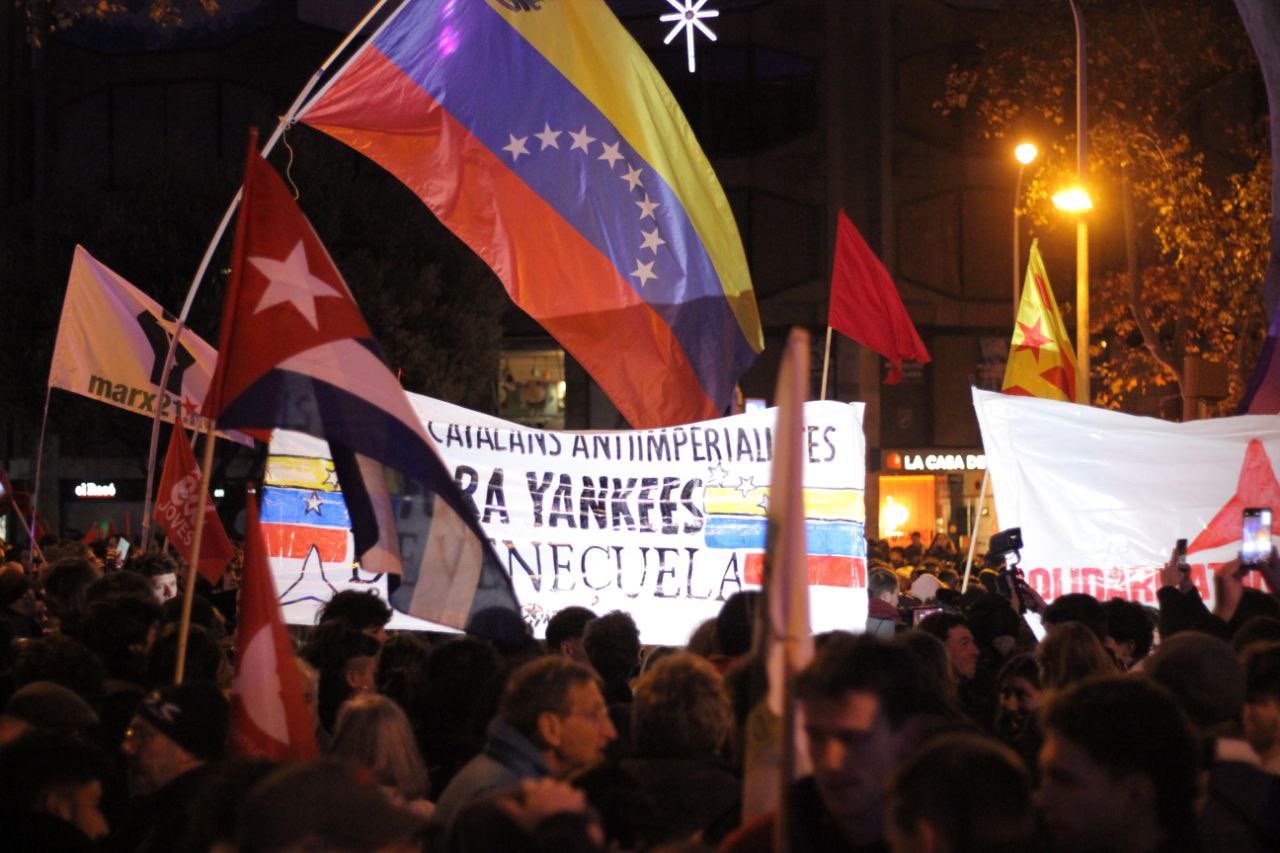
Image Source: Consulate of Venezuela in Barcelona via X.
Ian Barrera Sosa, a Venezuelan lawyer and activist with the Un Mundo Sin Mordaza (A World Without Gags) NGO, has been living in Barcelona for six years and attended both protests.
“I received notice of a call to gather in front of the Venezuelan Consulate. It was a group of people- usually Catalan and Spanish left-wing or far-left parties- showing solidarity with President Maduro and condemning the actions of the United States,” he told EU Reports.
“I first encountered slogans that I think had little to do with the Chavista message, and much more with European political messaging tied to certain local trends. Second, there were all kinds of flags- except for Venezuelan ones,” Barrera Sosa added.
The Venezuelan consulate issued a statement on X, explaining demonstrators were protesting “against the kidnapping of President Nicolás Maduro and his wife.”
“I spoke to them in Catalan, asking what they were doing, why they were there, what they were advocating for and why they believed this or that […] I was immediately labelled a facha (rightist), a Nazi,” Barrera Sosa noted.
“For safety reasons, police officers told me at one point, ‘Man, you’re the only Venezuelan here- they’re not Venezuelans. You should leave.’ Once I was more on the periphery, people told me it wasn’t really about Venezuela, but about other political issues.”
Spain has been the setting of mixed reactions following Maduro’s arrest and the bombing of Caracas by U.S. forces. While Prime Minister Pedro Sánchez said the country had not recognized Maduro’s regime, he also clarified that it would not recognize an “intervention that violates international law and pushes the region toward a horizon of uncertainty and militarism.”
Meanwhile, Alberto Núñez Feijóo, president of the opposition People’s Party, proclaimed that Venezuela’s future should not be Vice President- and now Interim President- Delcy Rodríguez, but that which all Venezuelans decide.
In contrast, Congressman Santiago Abascal, president of the right-wing Vox party, celebrated the news, claiming the world “is a little more free” following U.S. intervention in the Latin American nation.
Anti-Americanism sentiment, however, is prevalent in Spain. According to Pew Research Center, only 19% of Spaniards are confident in President Trump, with 80% of respondents to a 2025 survey noting they have “little or no confidence in Trump’s ability to do the right thing regarding world affairs.”
And, with Spanish citizens seeing the U.S. as a top global threat- alongside Russia and Israel- the question of why many protested Maduro’s detention becomes more pointed.
Regardless, Barrera Sosa was clear: Europeans are Venezuela’s allies.
“The vast majority tend to be caring, supportive, empathetic- aware that this is a complex situation marked by years of suffering, anguish, pain, of families being separated; that being Venezuelan means spending all your important celebrations alone at home, with a phone, on a video call with your friends and family spread across five or six different countries.”
As for Venezuelans in the diaspora- now part of the world’s second-largest displacement crisis after Syria- the reaction has been bittersweet.
“We dreamed of [Maduro’s exit from power] as a day of joy, celebration, crying, hugging each other. And many of us abroad could have celebrated that way. But, those of us outside were instead focused on how our families were doing out of fear of the regime’s reaction,” Barrera Sosa said.
“Yet, I have not met the first Venezuelan who has not moved in one way or another,” he concluded.
Featured image: Un Mundo Sin Mordaza via X.