
London, UK – The administration of Donald Trump proposed a 28-point U.S.–Russia peace plan for Ukraine in late November 2025. Full public access to the draft followed after Ukrainian President Volodymyr Zelenskyy received the document.
The opening provisions of the plan largely reiterate earlier peace proposals dating back to 2014, when Russia annexed the Crimean Peninsula. They reaffirm Ukraine’s sovereignty and rule out further invasions or NATO expansion- including Ukraine’s voluntary accession efforts.
Several elements of the proposal, however, raise significant concerns. While the plan calls for the U.S. to impose further sanctions in response to any future Russian aggression, some measures appear internally contradictory and vague in their enforcement mechanisms.
One particularly contentious point would cap the Ukrainian armed forces at 600,000 personnel, compared with the Russian army’s 1.32-1.5 million active-duty soldiers, as per Statista; Russia also holds 2 million reservists.
Critics argue that this imbalance undermines the plan’s stated objective of long-term stability.
To offset concerns, the U.S. has offered Ukraine unspecified “reliable” security assurances, paired with sanctions against Russia.
The plan also proposes to revoke recognition of newly-conquered territories, and to establish joint Russian-Ukrainian control over the Zaporizhzhia nuclear power plant- partly occupied by Russia since 2022.
Upon his review of the document, President Zelenskyy noted that while the U.S. wants to resolve the conflict quickly, Russia has no such plans.
Scrutinized NATO and security guarantees
Ukraine’s cautious approach to the U.S. peace plan is shaped by the country’s historical experience with international security promises. Most notably, the 1993 Budapest Memorandum pushed Ukraine to give up its nuclear weapons under enormous international pressure.
The nation’s inability to rely on nuclear deterrence, combined with the fact that Russia was itself one of the Budapest Memorandum’s guarantors, complicates its assessment of any new peace framework based on similar assurances.
Yan Earl-Ruzhytskyi, Ukrainian youth delegate at the United Nations, explained that security guarantees in the peace deal plan must be legally binding, while in conversation with EU Reports:
“In the case of the Budapest Memorandum, the English terms used were ‘assurances,’; ‘security assurances.’ This is very different from the word ‘guarantees,’ since ‘assurances’ do not require ratification,” he stressed.
According to Earl-Ruzhytskyi, ratification of any possible agreements following the adoption of a plan by both sides would constitute a full legal commitment by the countries involved, allowing Ukraine to genuinely rely on those obligations.
During his meeting in Berlin with European leaders and U.S. Special Envoy to the Middle East Steven Witkoff on December 14, President Zelenskyy spent five hours discussing the plan, and noted that its adoption would take some time.
“The peace plan will not be one that everyone likes,” said Zelenskyy, adding that some of the proposed Ukrainian amendments still require responses from European and U.S. partners.
Some observers, however, noted that the NATO question remains the main stumbling block.
Joshua R. Kroeker, CEO at geopolitical risk consultancy Reaktion Group, told EU Reports that NATO and a number of EU countries have come to understand that Ukraine’s security is directly tied to their own; security “guarantees”, including weapons deliveries, must not be delayed.
“The largest security and geopolitical risks come from the U.S.,” Kroeker added.
Sovereignty question
While the plan’s first point reaffirms Ukraine’s continued sovereignty, subsequent provisions undermine that claim: point 21 references territorial concessions that would effectively recognize Donetsk, Luhansk and Crimea as de facto Russian territories, alongside the demilitarization of Donetsk.
As of late 2025, Ukraine still controls major cities in the eastern region of Donetsk Oblast, including Kramatorsk, Slovyansk, Kostyantynivka and Druzhkivka, maintaining heavy fortifications despite sustained Russian offensives.
According to a UK-based analyst working in international policy and governance, who requested anonymity for security reasons, the issue of territorial concessions is extremely difficult.
Not only is a territorial concession constitutionally impossible for Ukraine, but it would also represent a significant victory for Russia:
“What Russia achieved in 2014, and what it could extend if such concessions were made today, would set a dangerous precedent that war can be used to achieve imperialist goals,” they noted.
Earl-Ruzhytskyi echoed this position:
“In principle, anything imposed in violation of the sovereignty of the Constitution and the existing legal system is unacceptable for Ukraine.”
President Zelenskyy has also been unequivocal on the matter. Speaking at a press conference in August, he stated that “concessions to not persuade killers,” as per Reuters.
Plan outlook
The plan remains under review by Ukrainian officials and the country’s European and American partners, as of December 2025.
A recent Reuters report, however, cited U.S. intelligence assessments that Russian President Vladimir Putin’s war aims remain unchanged- claims the Kremlin has dismissed as false.
Russian officials continue to argue that Ukrainian-proposed amendments fail to meet Moscow’s requirements, underscoring the distance between the parties.
Bohdan Veselovskyi, Associate Professor and Chair of Comparative European Law at the Educational and Scientific Institute of International Relations, also noted that the credibility of security guarantees depends on formal treaty commitments, domestic ratification and a clear assignment of obligations rather than vague political statements.
“A major unresolved issue is the scope of guarantees-specific content and how they would interact with the roles of the EU and NATO within the broader European security framework,” he told EU Reports.
With Ukraine also currently preparing for potential elections, the UK-based analyst said the plan is expected to influence domestic political dynamics, including public support for President Zelenskyy should he seek re-election.
However, the main priority for the Ukrainian state is clear: peace.
“Life in Kyiv is becoming increasingly difficult, especially this winter, but nobody will support an unjust peace or a deal that would be perceived as a loss,” they added.
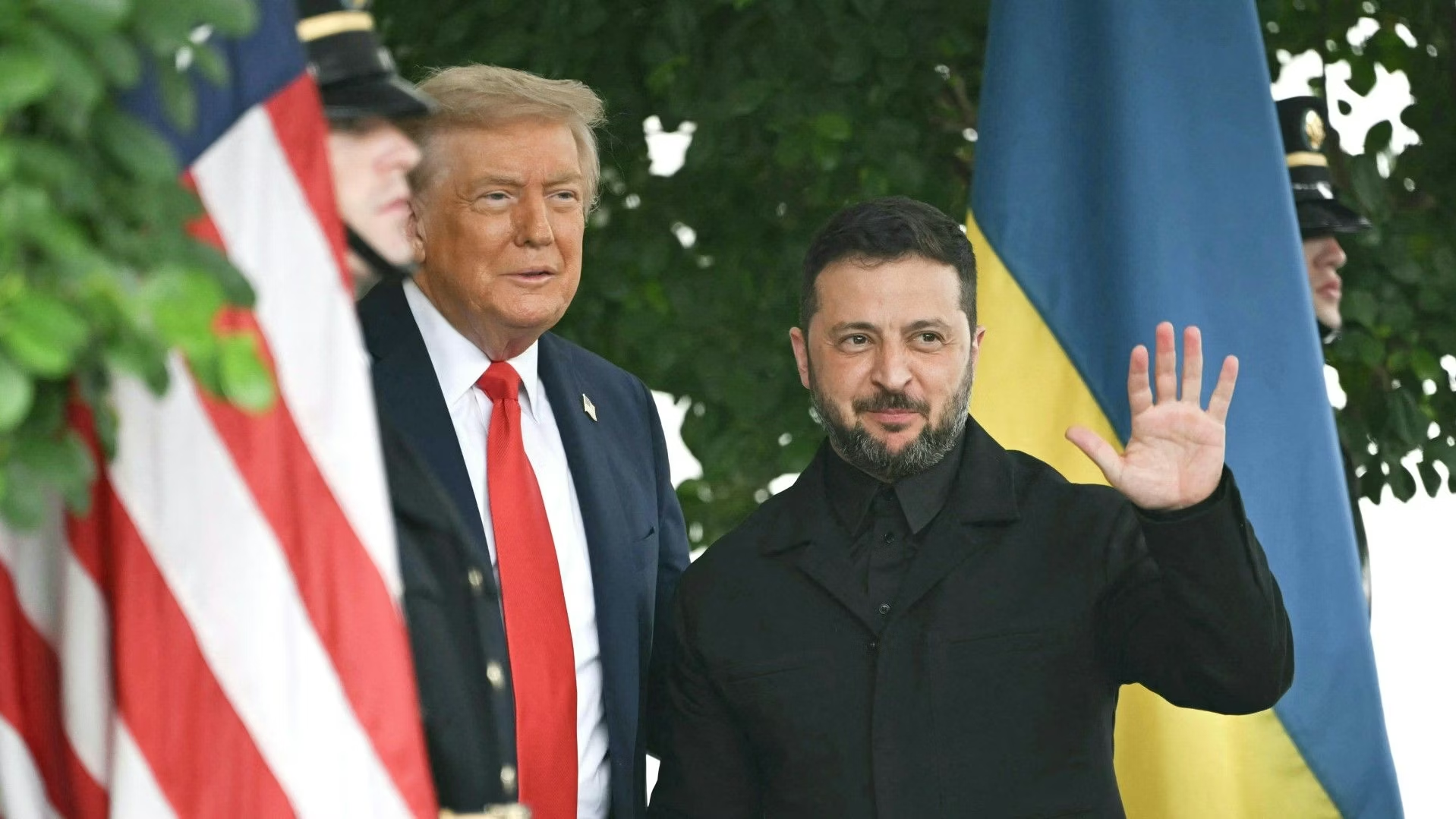
Featured image: Ukrainian President Volodymyr Zelenskyy will travel to meet Donald Trump this week
Source: Haute.at
License: Creative Commons Licenses