
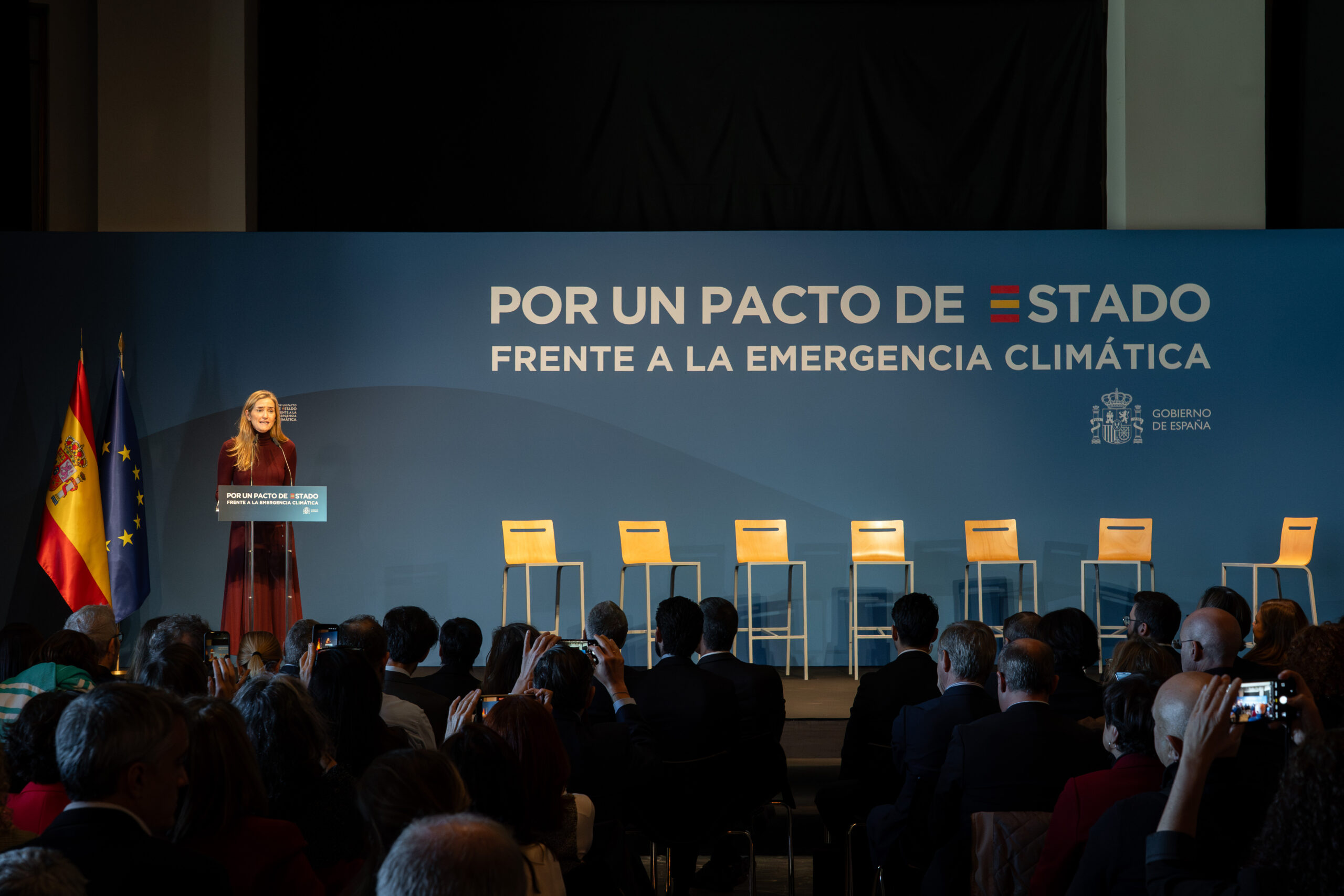
Madrid, Spain — The Spanish government has moved forward with a renewed State Pact on the Climate Emergency on Tuesday, December 16, pressing ahead with high-level talks despite right-wing protests outside the venue.
Officials warned that worsening climate impacts leave the country with “no time to lose.”
The meeting brought together senior government figures, including Prime Minister Pedro Sánchez, Third Deputy Prime Minister Sara Aagesen, Minister of Agriculture Luis Planas, and Minister of Interior Fernando Grande-Marlaska, alongside scientists, local authorities, civil society, and private-sector representatives.
It aimed to consolidate a national climate roadmap following a year marked by wildfires, floods, heatwaves, and mounting economic losses.
Spain has experienced a 1.69°C temperature increase since 1961, with the 2021–2025 period accounting for the four-hottest years on record, government data shows. Officials stressed that climate impacts are becoming more frequent and severe, stretching public services and testing national resilience.
“Not taking action is not a choice.”
Aagesen warned that Spain is “uniquely exposed” to climate risks, citing 141 identified climate threats and a national network of 1,700 risk factors, with climate-related losses exceeding €120 million.
“We are still on time to be better prepared,” the third vice president said, adding that “not taking action is not a choice.”
The updated pact expands its policy framework from 10 to 15 strategic pillars, incorporating health, biodiversity, marine conservation, and climate disinformation for the first time. A new scientific panel on climate, biodiversity, and oceans will support evidence-based policymaking, while a three-year auditing mechanism is intended to track implementation.
Officials confirmed that more than 4,000 proposals and amendments were submitted through an open civil-society consultation, reflecting input from youth groups, vulnerable communities, scientists, and third-sector organisations. The full text will be published in the coming weeks before being submitted to Spain’s Congress of Deputies.
Agriculture, water, and risk prevention
Agriculture Minister Luis Planas said the pact strengthens the role of the farming and fisheries sectors, focusing on water efficiency, biodiversity protection, and the economic viability of rural livelihoods under climate stress.
Key measures include the sustainable management of three million hectares, reforms to agricultural insurance schemes backed by €515 million, and a renewed emphasis on regenerative farming practices. A national food strategy will also be aligned with climate objectives.
Interior Minister Grande-Marlaska highlighted the need to reinforce disaster prevention and response systems, calling for a more integrated, long-term approach that combines institutional coordination with citizen self-protection. While Spain has a strong civil protection system, climate change requires “a step change” in preparedness, he stressed.
Science, health, and disinformation
Scientists involved in drafting the pact underlined the challenge of translating climate science into political action and public understanding. Around 500 scientists contributed to the process, which participants described as a breakthrough for evidence-based decision-making.
Health experts, such as Dr. Cristina Sánchez, Spanish representative of the United Nations One Health initiative, warned that climate impacts are increasingly intersecting with public health, pointing to heat stress, air quality, food safety, and the spread of vector-borne diseases such as mosquito-transmitted illnesses.
Urban planning and biosecurity measures, they argued, must play a greater role in adaptation strategies.
The pact also introduces measures to counter climate disinformation, with officials warning that denialism risks undermining public support at a critical moment. Instead, public figures such as meteorologist Mercedes Martín call for the rise of “techno-optimism” and the use of scientific data as a fundamental tool to combat these threats.
Local authorities and private sector involvement
Local leaders like Uxía Oviedo, Mayor of Maceda, emphasised the importance of action at regional and municipal levels, particularly in rural areas where land management and soil quality have proven decisive in preventing wildfires. Calls were made for stronger incentives to repopulate rural regions and support sustainable land use.
Private-sector representatives highlighted the role of ESG frameworks, sustainable public procurement, and simplified access to green suppliers for small and medium-sized enterprises, while warning that competitiveness concerns within EU value chains must be addressed.
Sánchez: Climate action is security policy
Closing the event, Prime Minister Pedro Sánchez framed climate action as a matter of security, prosperity, and democratic resilience rather than ideology.
“In the last five years alone, torrential rains have increased by 15%, Spain has gained 55 more summer days, and prolonged heatwaves are now the norm. Additionally, More than 400,000 hectares have been affected by climate impacts, with over 30,000 climate migrants recorded.” Sánchez illustrated.
To address these issues, the prime minister continued by announcing the upcoming plans for a national network of climate refuge centres, targeted funding for vulnerable communities, and flood-prevention financing for municipalities with fewer than 5,000 inhabitants. Water security, he added, would be incorporated into Spain’s national security framework.
Sánchez confirmed that the pact will now move to parliament for further amendments, calling it an “acuerdo de país,” (a country-wide agreement) and “a shield for Spain’s security and peace.”
The head of state also used the platform to criticise recent developments at the EU level, warning that existing sustainability frameworks risk being weakened through procedural reforms.
Referring to yesterday’s omnibus vote, he said such moves were “debilitating structures that have taken years to build,” and cautioned that rolling back environmental safeguards would undermine Europe’s credibility and capacity to respond to the climate emergency.
Featured image: Ministerio para la Transición Ecológica y el Reto Democrático